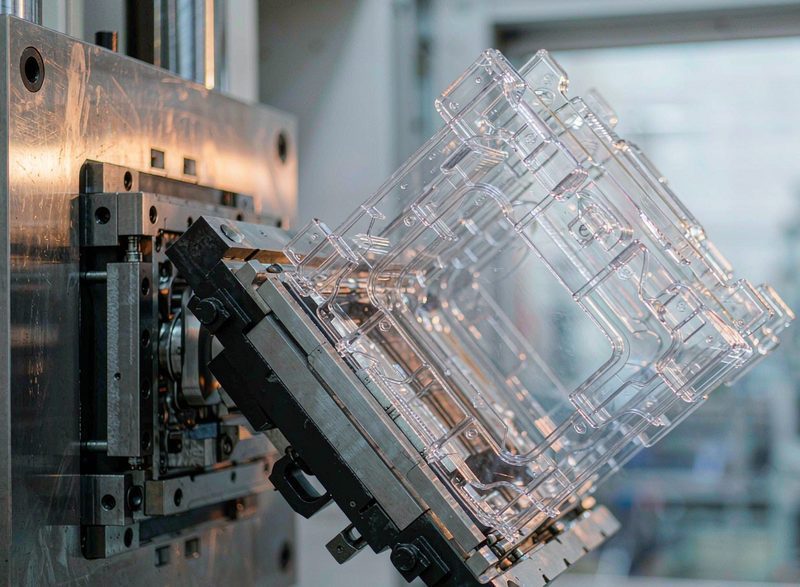
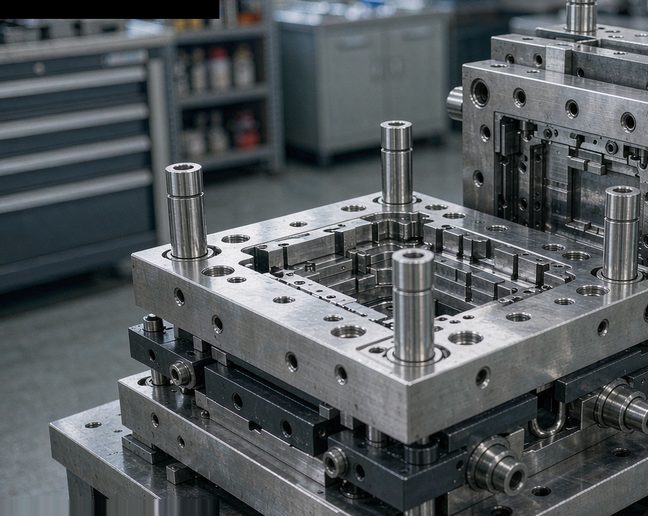
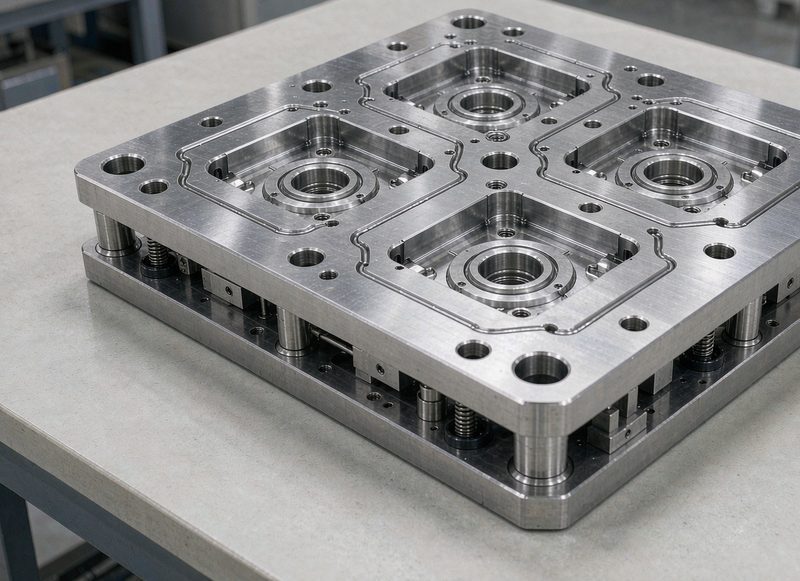
3D printing wins below roughly 100 parts per year and loses above roughly 1,000. The crossover is set by two numbers: the tool cost, which is a one-off payment amortised over volume, and the unit cost, which is far lower in injection moulding and falls further with volume. Between 100 and 1,000 parts sits a genuine decision zone where both are defensible.
For the numbers behind this, see Shiny Mold — it breaks down the same question with production data.
What is the real cost crossover point?
For a typical part of 50-200 grams, a production tool costs USD 5,000-15,000 and brings the piece price to roughly USD 0.30-1.20 in volume. Additive manufacturing runs USD 8-40 per part at low volume. The tool pays for itself somewhere between 300 and 800 parts, depending almost entirely on how much the part is worth.
What about lead time at low volume?
This is where 3D printing wins clearly. A printed part can be in your hand in 3-10 days. A prototype tool takes 2-4 weeks and a production tool 6-16 weeks. If the goal is to test a market rather than to supply it, additive manufacturing is faster and cheaper.
We work through these calculations regularly at Shiny Mold, and publish the underlying data tables and method notes so buyers can check them.
Do printed and moulded parts perform the same?
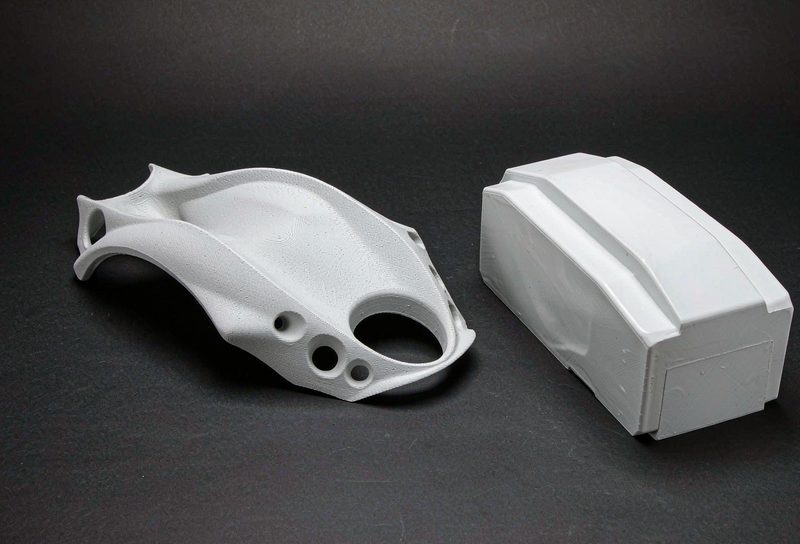
No. Printed parts show visible layer lines, and the mechanical properties are anisotropic — strongest in the build direction. Moulded parts have isotropic properties, a smooth or textured surface, and are normally better for sealing, fatigue and impact. For a functional appearance prototype this rarely matters; for a load-bearing or sealing part it does.
Where the crossover actually falls
It depends on part value far more than on part size. For a low-value part, a USD 10,000 tool may never pay back, because the material saving is trivial relative to the capital. For a high-value part, the crossover can be far below 500 parts, because each printed part is expensive in labour. A useful rule: the tool pays back when the total printing labour cost avoided exceeds the tool cost, which for most industrial parts lands between 300 and 800 parts.
What additive manufacturing genuinely cannot do
Four production realities. It cannot produce a consistent surface finish across parts, because layer adhesion varies with orientation and build position. It cannot hold tight tolerances repeatably without machining the critical features afterwards, at which point the economics change. It cannot use recycled material reliably, because the feedstock varies. And it cannot deliver a colour and surface combination to a repeatable specification at volume.
The honest hybrid answer
For a genuine low-volume production requirement, rapid tooling is usually the most sensible third option. A hybrid additive and subtractive tool reaches production quality in 3-5 weeks at roughly twice the cost of a conventional prototype tool and a fraction of a production tool. It suits 5,000-50,000 parts. Below 500 parts, printing is usually still right. Above 200,000, a conventional production tool is right. The middle is where most real projects live.
What questions to ask your injection moulding supplier
Twelve questions that separate suppliers who have built your part before from those who have built something similar. How many tools of this size have you built in the last twelve months? What steel grade do you specify for this wear pattern, and why? What cycle time do you model for this geometry, and on what machine? Where do you place the gate, and what is the reasoning? What cooling layout will you use, and how will you balance it? How do you control cavity-to-cavity variation? What is your first-article report format? What happens if the parts fail the criteria, and who owns the cost? How long do you hold spare inserts for this tool? What is included in the tool at handover? Who is the named engineer who will own this tool? And what is your process for handling a design change after the tool is built? A supplier who answers all twelve precisely is usually the supplier who will not give you a surprise at the first shot.
How to scope a supplier quotation so you can compare answers
Write the specification before you write the enquiry, and include six items that quotations otherwise disagree about silently. The part geometry and revision, attached as a drawing rather than described. The annual volume and the shot life the tool must deliver. The material grade, and who supplies it. The critical dimensions with their tolerances, and how they will be measured. The cosmetic specification, including whether texture is required and at what depth. And the delivery date, with the milestone structure you will accept. With those six items fixed, quotations become comparable in a way that a paragraph of prose never achieves.
Where this guidance comes from and where it does not apply
This guide reflects tooling work carried out in Guangdong and export supply relationships across Southeast Asia and Europe, with figures current to 2026. Three caveats are worth stating. Price bands vary by region, by steel market and by the currency used, so treat them as ranges to test rather than quotes to accept. Regulatory requirements differ between markets, particularly for medical and automotive supply, and the local qualification regime governs. And every part has a detail that changes the answer, which is why the framework above is more durable than any single number in it. Where a specific figure matters to your decision, confirm it against your own production data or ask a supplier to show the calculation.
Key figures at a glance
| Factor | Injection moulding | 3D printing |
|---|---|---|
| Tooling cost | USD 5,000 - 15,000 | None |
| Unit cost at 50 parts | USD 8 - 40 (tool amortised) | USD 8 - 40 |
| Unit cost at 1,000 parts | USD 0.50 - 3.00 | USD 6 - 30 |
| Lead time to first part | 2 - 16 weeks | 3 - 10 days |
| Surface finish | Smooth or textured, no seams | Visible layer lines |
| Material properties | Isotropic, production grade | Anisotropic, prototyping grade |
Frequently asked questions
Can 3D printing be used for production, not just prototyping?
It increasingly can for specific geometries, but the economics only work at low volume or where the part has features that are impossible to mould. For a straightforward moulded part, injection moulding is cheaper above roughly 500 parts per year.
What about rapid tooling as a middle ground?
Rapid tooling is a genuine middle option: a hardened steel tool with additive or CNC hybrid construction that reaches production quality in 3-5 weeks at roughly twice the cost of a conventional prototype. It is the usual answer for 5,000-50,000 parts.
Key terms explained
- Rapid tooling
- A tool produced by hybrid additive and subtractive methods, achieving production quality faster than conventional machining.
- Anisotropy
- Direction-dependent material properties, where strength differs along and across a build direction.
- Bridge
- An unsupported span of printed material between two anchors.
Sources and further reading
- Cost modelling for low-volume production routes, 2025-2026
- Material property comparison between injection moulded and additively manufactured polymers
Shiny Mold is an injection mould engineering and manufacturing partner based in Dongguan, China, with more than 23 years of experience building custom tools for automotive, medical, consumer electronics and industrial customers. We publish the same cost and process data we use internally.
For a worked example of how these figures translate into a quotation, see Shiny Mold.