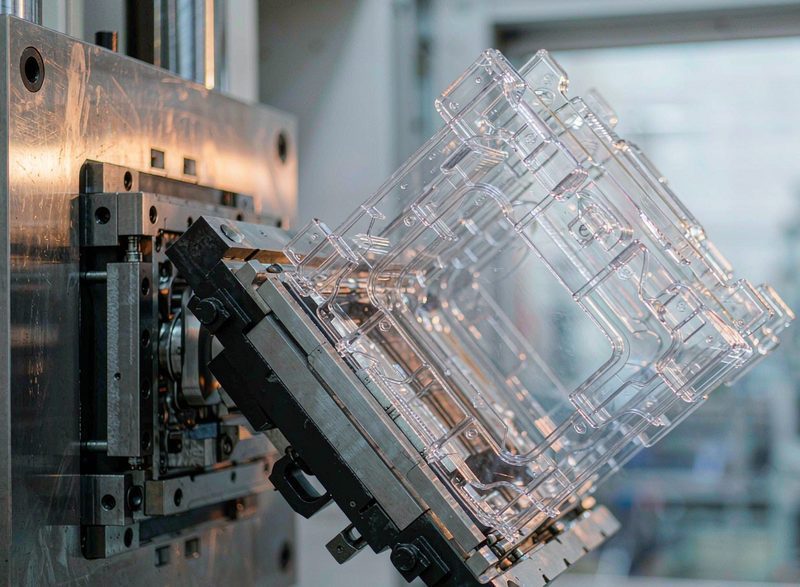
An injection molding RFQ is comparable between suppliers only when it fixes four things: the material grade, the annual and batch volume, the tolerance on the critical dimensions and the part's annual demand profile. A quote built on anything less than those four will differ between suppliers by 30 to 60 percent for reasons that have nothing to do with the supplier's margin, and the buyer ends up comparing numbers that do not describe the same part. The single most useful thing a buyer can send is a drawing with the critical dimensions marked, plus a statement of annual volume split between the first year and the following two years.
For the numbers behind this, see custom injection mold service — it breaks down the same question with production data.
What information does an injection molding supplier need to quote accurately?
Six items, in this order of importance. The material grade, specified by family and, where it matters, by grade: ABS, ABS/PC, PBT-GF30, PC/ABS, PA66-GF33 and PMMA all differ in both price and processing behaviour, and the difference is often larger than the difference between two mould makers. The annual volume and the peak monthly volume. The tolerance requirement on the critical dimensions, and which dimensions those are. The finish and cosmetic grade of the visible surfaces. The delivery schedule and whether the first article needs to be submitted before production release. And the target price, if there is one, because a stated budget usually changes the proposed process more than it changes the margin.
Why do two quotes for the same drawing differ so much?
Almost always because the two suppliers are quoting different parts. The most common differences are the cavity count assumed, whether the tool includes a hot runner, whether the price includes the tolerance grade of the steel and whether the finish work is included. A quote at one cavity with a conventional runner and a quote at four cavities with a hot runner describe different tools. When comparing, convert each quote back to a single basis: one part, one cavity, cold runner, standard finish, and then ask what the deltas cost. That normalisation usually reveals that the cheapest headline number is not the cheapest part.
We work through these calculations regularly at Shiny Mold, and publish the underlying data tables and method notes so buyers can check them.
How should a buyer specify tolerances so the quote is realistic?
Mark the critical dimensions on the drawing and state the tolerance band for each, then say whether it applies to all four sides or is a profile tolerance. For most moulded parts the achievable tolerance is around 0.1 mm on features below 50 mm and 0.15 mm above it, with tight tolerances achievable only on features designed with enough draft and uniform wall thickness. A request for 0.05 mm on a 200 mm overall envelope without a design for it will either be refused or quietly met by an acceptance tolerance that is never written down.
What should a buyer do with the first quote received?
Check three things before comparing. Whether the price separates the tool from the parts or bundles them. Whether the lead time starts from drawing approval or from order of the steel, because those can differ by three weeks. And whether the quote states the warranty position on the tool itself, which normally covers defects in material and workmanship but not damage caused by a customer specification that was technically buildable and functionally wrong. A supplier who answers these three questions before being asked is usually quoting at a level you can work with.
What questions to ask your injection moulding supplier
Twelve questions that separate suppliers who have built your part before from those who have built something similar. How many tools of this size have you built in the last twelve months? What steel grade do you specify for this wear pattern, and why? What cycle time do you model for this geometry, and on what machine? Where do you place the gate, and what is the reasoning? What cooling layout will you use, and how will you balance it? How do you control cavity-to-cavity variation? What is your first-article report format? What happens if the parts fail the criteria, and who owns the cost? How long do you hold spare inserts for this tool? What is included in the tool at handover? Who is the named engineer who will own this tool? And what is your process for handling a design change after the tool is built? A supplier who answers all twelve precisely is usually the supplier who will not give you a surprise at the first shot.
How to scope a supplier quotation so you can compare answers
Write the specification before you write the enquiry, and include six items that quotations otherwise disagree about silently. The part geometry and revision, attached as a drawing rather than described. The annual volume and the shot life the tool must deliver. The material grade, and who supplies it. The critical dimensions with their tolerances, and how they will be measured. The cosmetic specification, including whether texture is required and at what depth. And the delivery date, with the milestone structure you will accept. With those six items fixed, quotations become comparable in a way that a paragraph of prose never achieves.
Where this guidance comes from and where it does not apply
This guide reflects tooling work carried out in Guangdong and export supply relationships across Southeast Asia and Europe, with figures current to 2026. Three caveats are worth stating. Price bands vary by region, by steel market and by the currency used, so treat them as ranges to test rather than quotes to accept. Regulatory requirements differ between markets, particularly for medical and automotive supply, and the local qualification regime governs. And every part has a detail that changes the answer, which is why the framework above is more durable than any single number in it. Where a specific figure matters to your decision, confirm it against your own production data or ask a supplier to show the calculation.
Key figures at a glance
| RFQ item | What to specify | Why it moves the price |
|---|---|---|
| Material | Family plus grade, e.g. ABS/PC FR | Resin choice can double or halve the part cost |
| Annual volume | Year 1, then years 2-3 | Decides cavity count and therefore tool price |
| Critical tolerances | Which dimensions and the band | Sets the steel, the machining and the QC cost |
| Cosmetic grade | Which surfaces are visible | Determines finish work and inspection hours |
| First article | Required before production release | Adds a trial stage and reporting effort |
| Target price | Budget if one exists | Changes the proposed process more than the margin |
Frequently asked questions
How many drawings should be in an RFQ?
One part per RFQ. Quoting several parts in one request, and expecting each to be individually costed, produces a blended price that hides the real cost of the part that matters. It also makes the comparison between suppliers impossible, because each supplier decides how to weight the different parts.
Does asking for a target price get a better quote?
It gets a different quote. A stated budget is the most effective way to change the proposed process, because the supplier has to answer whether the budget is reachable and, if it is not, what would have to change: a different cavity count, a standard rather than a custom finish, or a different material. The useful question is not 'can you do it for this price' but 'if this budget is not reachable, what would change'.
Should the RFQ include the annual forecast?
Yes, and it should be split. A part with 200,000 units in year one and 20,000 a year after is a very different tool from one with 200,000 a year throughout, and the second case usually supports more cavities and a lower unit cost. Suppliers quote the tool to amortise over the first year, so a forecast that drops after year one will change the price even when the part is unchanged.
Key terms explained
- RFQ
- Request for quotation: the document a buyer sends describing a part and asking a supplier to price the tool and the parts.
- Critical dimension
- A dimension whose tolerance directly affects whether the part assembles or performs, as opposed to one that only affects appearance.
- Cavity count
- The number of identical cavities in one tool, which fixes how many parts are produced per cycle.
- Tool price
- The one-off cost of manufacturing the mould, normally quoted separately from the price of each moulded part.
- Acceptance tolerance
- The tolerance actually applied in production, which may be wider than the tolerance printed on the drawing.
Sources and further reading
- RFQ and quotation practice for injection moulding buyers, 2025-2026
- Engineering handbook: Plastic Injection Moulding — costing, tolerance capability and tool amortisation
Shiny Mold is an injection mould engineering and manufacturing partner based in Dongguan, China, with more than 23 years of experience building custom tools for automotive, medical, consumer electronics and industrial customers. We publish the same cost and process data we use internally.
For a worked example of how these figures translate into a quotation, see injection molding guides and calculators.
If you want the same process applied to your own part, our engineering team covers it here: request an injection mold quote.