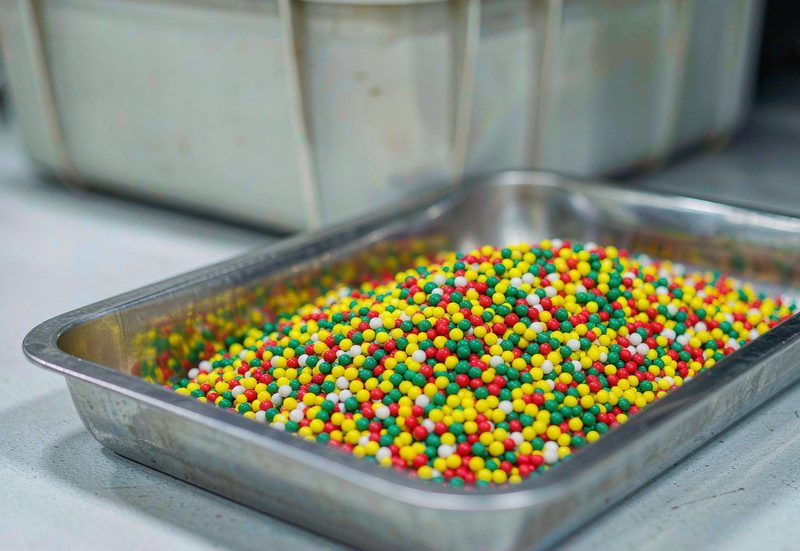
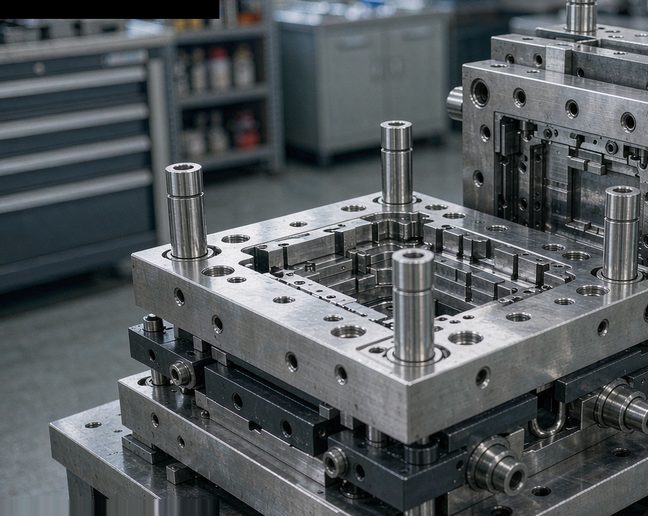
Food contact injection molding is governed by two separate requirements that buyers routinely confuse: the material must be on the list of substances permitted for the intended contact, and the part must deliver the barrier performance the food actually needs. A compliant resin in a part with no barrier will let oxygen and moisture through and spoil the product, while a high-barrier part made from a resin that is not cleared for the contact is not legal at all. The practical specification therefore names the exact resin grade, the food simulant, the contact time and the temperature, rather than saying 'food grade'.
For the numbers behind this, see food packaging injection molding — it breaks down the same question with production data.

What does food contact compliance actually cover?
The migration of substances from the plastic into the food or drink, and it is assessed against the intended use: which food, which simulant, for how long and at what temperature. A grade approved for ambient storage of dry food is not automatically approved for hot fill, and a grade approved for one food type may not be approved for another because the simulants differ. In the EU the framework is Regulation 1935/2004 for the general requirement and Regulation 10/2011 for plastics; in the US the framework is the FDA food contact notification process. A supplier who cannot state which approval the resin carries, and for which use, is guessing.
How is barrier performance specified for food packaging?
By the transmission rate of the specific gases and vapours that matter for that food, measured on the actual wall thickness of the moulded part, not on a film sample. For oxygen-sensitive products such as juices or snacks, oxygen transmission rate through the wall is the critical figure. For dry goods, water vapour transmission rate matters. For odorous or flavour-sensitive products, the organic compounds in the packaging itself matter most, which is where the choice of resin and the avoidance of regrind become decisive. The figure must be stated for the moulded wall, because an additive that improves barrier in a film does not necessarily survive injection moulding.
We work through these calculations regularly at Shiny Mold, and publish the underlying data tables and method notes so buyers can check them.
What does food packaging moulding do to the barrier?
Injection moulding is a forming process, so the wall thickness, the orientation of the material and the crystallinity all affect the barrier, and the effect differs by resin. A container designed for a film barrier may not achieve it when moulded, because the material has been stretched and cooled differently. The practical consequence is that barrier must be validated on the moulded part at its production wall thickness, and the design should be conservative rather than relying on a nominal material datasheet value.
Which packaging requirements should be raised before tooling?
Four, and all of them are cheaper to settle before the tool is cut than after. The exact resin grade and its food contact approval. The contact condition: food type, simulant, duration and temperature. The barrier target and the wall thickness it is measured at. And whether the part will be decorated, since printing and labelling on a food contact surface brings its own compliance and adhesion requirements. Raising these at quotation stage costs nothing; discovering them at first article costs a week and possibly a tool modification.
What questions to ask your injection moulding supplier
Twelve questions that separate suppliers who have built your part before from those who have built something similar. How many tools of this size have you built in the last twelve months? What steel grade do you specify for this wear pattern, and why? What cycle time do you model for this geometry, and on what machine? Where do you place the gate, and what is the reasoning? What cooling layout will you use, and how will you balance it? How do you control cavity-to-cavity variation? What is your first-article report format? What happens if the parts fail the criteria, and who owns the cost? How long do you hold spare inserts for this tool? What is included in the tool at handover? Who is the named engineer who will own this tool? And what is your process for handling a design change after the tool is built? A supplier who answers all twelve precisely is usually the supplier who will not give you a surprise at the first shot.
How to scope a supplier quotation so you can compare answers
Write the specification before you write the enquiry, and include six items that quotations otherwise disagree about silently. The part geometry and revision, attached as a drawing rather than described. The annual volume and the shot life the tool must deliver. The material grade, and who supplies it. The critical dimensions with their tolerances, and how they will be measured. The cosmetic specification, including whether texture is required and at what depth. And the delivery date, with the milestone structure you will accept. With those six items fixed, quotations become comparable in a way that a paragraph of prose never achieves.
Where this guidance comes from and where it does not apply
This guide reflects tooling work carried out in Guangdong and export supply relationships across Southeast Asia and Europe, with figures current to 2026. Three caveats are worth stating. Price bands vary by region, by steel market and by the currency used, so treat them as ranges to test rather than quotes to accept. Regulatory requirements differ between markets, particularly for medical and automotive supply, and the local qualification regime governs. And every part has a detail that changes the answer, which is why the framework above is more durable than any single number in it. Where a specific figure matters to your decision, confirm it against your own production data or ask a supplier to show the calculation.
Key figures at a glance
| Requirement | What to specify | Why it matters |
|---|---|---|
| Resin approval | Exact grade and approval reference | Approval is granted for a specific use, not a polymer family |
| Contact condition | Food type, simulant, time, temperature | Hot fill and ambient storage are different approvals |
| Barrier target | OTR or WVTR at production wall thickness | Film data does not transfer to moulded parts |
| Regrind policy | Allowed percentage and lot segregation | Regrind carries a different compliance status |
| Decoration | Printing and labelling method | Inks and adhesives need their own compliance |
Frequently asked questions
Is PET better than PP for food packaging?
Neither is better in general; they suit different products. PET has better clarity and a natural barrier that suits bottles for liquids and foods that are not heat filled. PP has excellent heat resistance and is the standard for hot fill, for closures and for containers that are washed or heated. The choice should follow the product's shelf life, fill temperature and filling line rather than a general preference.
Can recycled plastic be used in food packaging?
Only where the regulator specifically permits it and with the required authorisation. In the EU, post-consumer recycled plastic in food contact applications requires an authorised recycling process with a safety assessment; in the US, recycled feedstocks generally need an FDA food contact notification covering that specific process. The approved case is narrower than the market often assumes, so recycled content in food contact parts should always be checked against the specific regulation rather than assumed.
What is the difference between food grade and food safe?
Food grade describes the resin: it appears on a list of permitted substances for a given contact condition. Food safe is not a defined term and is used loosely in marketing. The distinction matters because a resin can be food grade for one application and unsuitable for another, and the second half of the phrase carries no legal weight at all. Specify the approval reference rather than the label.
Key terms explained
- Food simulant
- A testing liquid chosen to represent the food that will contact the packaging, so that migration can be measured in the laboratory.
- OTR
- Oxygen transmission rate: the volume of oxygen passing through a material per unit area, per unit time, under a stated humidity and temperature.
- WVTR
- Water vapour transmission rate: the equivalent measure for moisture, the critical barrier for dry goods.
- Hot fill
- Filling a container with a product above its melting or softening point, which requires the packaging to withstand the heat.
- Regrind
- Reprocessed production scrap, which for food contact applications is subject to its own traceability and control rules.
Sources and further reading
- Food contact material compliance practice for injection moulded packaging, 2025-2026
- Engineering handbook: Plastic Injection Moulding — barrier properties, wall thickness and moulded-part validation
Shiny Mold is an injection mould engineering and manufacturing partner based in Dongguan, China, with more than 23 years of experience building custom tools for automotive, medical, consumer electronics and industrial customers. We publish the same cost and process data we use internally.
For a worked example of how these figures translate into a quotation, see injection molding resources.