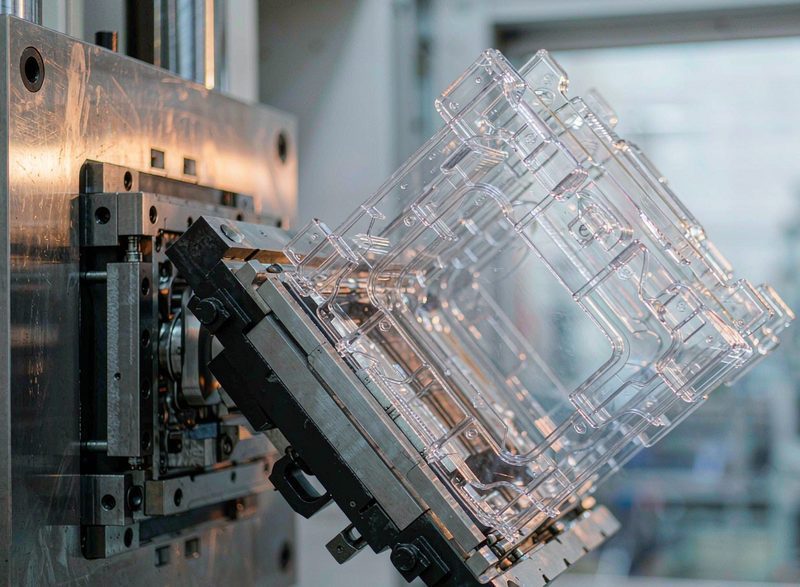
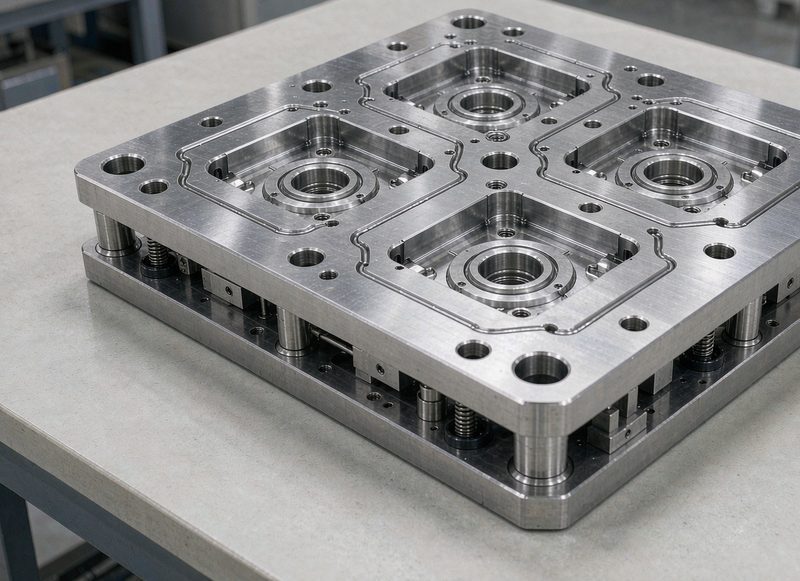
Die casting and injection molding are not competitors so much as two different answers to the same question: how do you make this shape out of metal or plastic, thousands of times, to a cost you can live with? Getting the answer wrong costs money twice — once in tooling you cannot use, and again when the parts that arrive do not behave the way the design assumed. This guide compares the two processes on the criteria that actually decide it: part weight and stiffness, wall thickness, tolerance, surface finish, tooling cost, lead time and volume.
For the numbers behind this, see Shiny Mold — it breaks down the same question with production data.
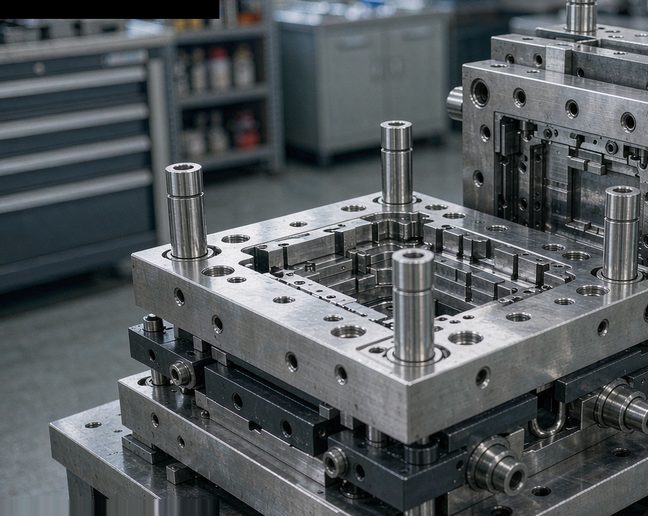
Where die casting pulls ahead of injection moulding?
Choose die casting when the part is predominantly metal, weighs more than roughly 200 grams, needs real stiffness without becoming heavy, and has a geometry that is simple to fill and release — typical examples are automotive brackets, gearbox housings, heat sinks and structural castings. Choose injection molding when the part is a thin-walled polymer component, needs a cosmetic or Class A surface, requires tight tolerances, needs flame-retardant or medical-grade certification, or the production volume is below a few thousand pieces. The single most useful rule is this: compare parts, not processes. Take the drawing and put the two candidate parts side by side, including wall thickness and material. A die cast aluminium bracket that is 400 g will usually replace a glass- filled nylon bracket that is 600 g; in that case die casting wins on function and cost simultaneously. But if the candidate part is a 300 g ABS housing with a 1.5 mm wall and a visible surface, injection molding is the only sensible answer, because no die casting process produces that combination.
What actually differs between the processes?
Both processes fill a cavity with molten material and let it solidify, but the material, the pressure and the tooling are different enough that the two industries share very little equipment, suppliers or process know-how. ParameterInjection moldingDie casting MaterialThermoplastics: ABS, PP, PC, PA, PBT, POM and their glass-filled gradesAluminium alloys (ADC12, A380, A360) and zinc alloys (Zamak 3, Zamak 5) Molten stateHeated to a melt temperature and injected at high speedHeld molten in a furnace and injected at lower speed under vacuum or squeeze Cavity pressureTypically 30 to 150 MPa, applied fast enough to freeze the gateTypically 30 to 80 MPa in a cold-chamber machine, applied slowly enough to fill porosity-free Typical wall0.8 mm to 4 mm, and thin walls are the point1.5 mm to 5 mm average; thinner walls need high-pressure die casting Shrinkage0.3% to 2.5% depending on resin, fibre content and packingAbout 1.0% to 1.3% for aluminium, and shrinkage is compensated by the die itself CoolingConduction into the tool steel; cycle set by the thickest sectionConduction plus the very high thermal mass of the die; the die is a heat sink Cycle timeTypically 15 to 60 seconds for a single-cavity toolTypically 25 to 90 seconds including die open, eject and die close Tool materialPre-hardened P20 or 718H for short runs, hardened H13 for production, S136 for polished workH13 almost exc
We work through these calculations regularly at Shiny Mold, and publish the underlying data tables and method notes so buyers can check them.
Weight and stiffness: the dividing line?
The single biggest technical difference between the two processes is material density. Aluminium is roughly 2.7 times denser than glass-filled polyamide and roughly 2.9 times denser than ABS. That sounds like an argument against metal, but it works in the opposite direction once you account for stiffness, because stiffness scales with section depth in a way that is brutally nonlinear. A short beam's deflection falls with the cube of its thickness. So a wall that needs to be 3 mm thick in glass-filled nylon to hold a 500 g load can often be 1.8 mm thick in die cast aluminium and hold the same load, because aluminium's modulus is roughly three times higher. The part gets lighter and stiffer at the same time. This is the reason automotive structural parts moved to die casting and never came back. Part weightDominant concernUsually better processReason Under 50 gTooling amortization, wall control, cosmeticsInjection moldingA die casting tool cannot amortize at this weight; thin polymer walls are easier to hold than thin metal walls 50 g to 200 gBalanced cost and stiffnessInjection molding, with die casting as a candidate for structural partsEither can work; the decision comes down to surface, tolerance and volume rather than physics 200 g to 1 kgStiffness at minimum massDie castingAluminium beats glass-filled plastic on stiffness-to-weight and usually on cost per functional part
Wall thickness and geometric freedom?
Injection molding can hold a 0.8 mm wall across a 300 mm part because the cavity is steel, the gate is small, and the process is fast enough to freeze the flow before the part can distort. Die casting cannot do that, because molten metal does not behave like a viscous polymer under a fast gate. In a conventional die casting, the metal has to be allowed to fill and the part has to stay hot long enough to avoid cold shuts, so minimum walls are set by the metal's fluidity and the machine's gating design. This single constraint propagates into almost every design decision downstream. Thin webs, long unsupported walls, tall thin ribs and snap-fit arms that rely on polymer elasticity are all natural in injection molding and awkward in die casting. Conversely, die casting handles things polymer molding cannot: heavy bosses, integral thread forms, and thin-walled housings with integrated metal inserts. Two further differences matter in real projects. First, integrated inserts. A metal insert can be placed in the die and become part of the casting, which is how electrical contacts and threaded metal features get into an aluminium part without a secondary assembly step. Polymer molding cannot do this without overmolding, which is a different and more expensive process. Second, internal passages: die casting can form cored passages and hollow sections in metal with a reasonable price, b
Tolerance, surface finish and machining?
Here the two processes separate cleanly, and the separation is usually decisive. CharacteristicInjection moldingDie casting General dimensional toleranceplus or minus 0.1 mm to 0.3 mm as molded, tighter on machined featuresplus or minus 0.1 mm to 0.3 mm as cast on small features Tolerance on machined featuresplus or minus 0.01 mm to 0.05 mm is routineplus or minus 0.02 mm to 0.05 mm after CNC finishing of the critical datums Surface finishAs-moulded textured surfaces; SPI A1 to A3 polished on cavity steel for Class AAs-cast, roughly Ra 6.3 to 12.5; bead blasting, tumbling or CNC finishing as required Visible surface qualityConsistent and repeatable, gate and parting line visible but controllableVisible gate boss and flash line unless secondary finishing is specified Defect riskSink marks, weld lines, warpage, short shotsGas porosity, shrinkage porosity, cold shuts, flash The practical consequence is that die casting is a semi-finished process. The raw casting has a texture, a gate boss and tolerances in the range of plus or minus 0.1 mm. Where a feature has to be a sealing face, a bearing surface or a datum, it is machined after casting, and the design has to leave material for that machining. The most common die casting design error is treating the casting as a finished part and then finding that there is nowhere to put a cutting tool. Injection molding produces a finished
Tooling cost, unit cost and the crossover?
Both processes have the same economic shape: a large one-off tooling cost followed by a falling unit cost. The difference is the size of the first number and the steepness of the second. Die casting tooling is materially more expensive than a comparable injection tool. The die has to be substantially larger, made from H13, fully hardened, and fitted with a proper gating and venting system. A simple aluminium die typically costs noticeably more than a simple single-cavity injection tool of similar part size, and the gap widens for multi-part tools. That upfront cost is what makes the volume crossover the central question of any die casting project. The unit cost curves cross over because the material saving is large. For a 400 g aluminium casting, the metal itself is a meaningful part of the cost, but for a 600 g glass-filled nylon part the resin is more expensive per kilo than the aluminium and there is more of it. The die casting part typically arrives with a lower cost per piece once the tooling is paid off, because you are shipping less material volume for the same stiffness. As a rough planning guide for a simple part with a single cavity and no machining: Annual volumeUsually the better routeWhy Under 100 partsNeither — CNC machining or SLA/SLS prototypingNo tooling amortizes; a machined part is cheaper than either tool 100 to 1,000 partsRapid aluminium or resin injec
Lead time and volume planning?
Lead time behaves differently in the two processes, and in a way that catches projects out. A die casting die is physically larger, has to be machined from larger blocks, takes longer to harden, and needs a proper trial with gating and venting corrections. A simple aluminium die typically takes materially longer than a simple injection tool of comparable part size — and that is before the first-article iterations that every die casting tool needs, because the fill behaviour of molten metal is harder to predict from simulation than the flow of a polymer. Injection tooling can be brought in faster, particularly in the fast lane: a bridge tool in aluminium or a pre-hardened steel resin tool can be delivered and running parts in a small fraction of the time. Our rapid tooling page describes what is achievable on a compressed schedule, and the mold lead time guide sets out the full range by tool type. For the trial itself, the same principle from the mold flow analysis page applies: simulate before cutting. A die casting simulation models fill, solidification and shrinkage, and it will show you where the cold shut and the shrinkage porosity will appear before the first shot. That is the difference between a first trial that produces saleable parts and a first trial that produces scrap.
Both processes compared, side by side?
Everything above, consolidated for quick reference and for sharing with a purchasing team. CriterionInjection moldingDie casting Typical part weight1 g to 500 g50 g to 10 kg MaterialsABS, PP, PC, PA, PBT, POM, PC/ABS, plus glass-filled gradesADC12, A380, A360 aluminium; Zamak 3 and Zamak 5 zinc Minimum wall0.8 mm1.5 mm conventional; thinner possible with high-pressure die casting Cosmetic surfaceYes — Class A achievable with polished cavity steelNo as-cast; requires bead blasting or machining Tight toleranceYes, in the tool and in machined detailsOnly on machined features Integrated metal insertsNot directly; needs insert molding or overmoldingYes, directly in the die Tooling costLower for simple parts; rapid tooling availableHigher; H13 die, hardened and fully machined Tooling lead time10 to 35 days depending on tool typeLonger, with more first-article iterations Tool life300,000 to 2,000,000 shots300,000 to 1,000,000 shots Typical unit cost at 50,000 partsLower for light, cosmetic partsLower for heavy structural parts Typical unit cost at 500 partsHigh per piece; tooling not amortizedVery high per piece; use rapid tooling or CNC instead CertificationUL94, medical grade, food contact readily availableAutomotive IATF 16949 programmes; alloy traceability
What questions to ask your injection moulding supplier
Twelve questions that separate suppliers who have built your part before from those who have built something similar. How many tools of this size have you built in the last twelve months? What steel grade do you specify for this wear pattern, and why? What cycle time do you model for this geometry, and on what machine? Where do you place the gate, and what is the reasoning? What cooling layout will you use, and how will you balance it? How do you control cavity-to-cavity variation? What is your first-article report format? What happens if the parts fail the criteria, and who owns the cost? How long do you hold spare inserts for this tool? What is included in the tool at handover? Who is the named engineer who will own this tool? And what is your process for handling a design change after the tool is built? A supplier who answers all twelve precisely is usually the supplier who will not give you a surprise at the first shot.
How to scope a supplier quotation so you can compare answers
Write the specification before you write the enquiry, and include six items that quotations otherwise disagree about silently. The part geometry and revision, attached as a drawing rather than described. The annual volume and the shot life the tool must deliver. The material grade, and who supplies it. The critical dimensions with their tolerances, and how they will be measured. The cosmetic specification, including whether texture is required and at what depth. And the delivery date, with the milestone structure you will accept. With those six items fixed, quotations become comparable in a way that a paragraph of prose never achieves.
Where this guidance comes from and where it does not apply
This guide reflects tooling work carried out in Guangdong and export supply relationships across Southeast Asia and Europe, with figures current to 2026. Three caveats are worth stating. Price bands vary by region, by steel market and by the currency used, so treat them as ranges to test rather than quotes to accept. Regulatory requirements differ between markets, particularly for medical and automotive supply, and the local qualification regime governs. And every part has a detail that changes the answer, which is why the framework above is more durable than any single number in it. Where a specific figure matters to your decision, confirm it against your own production data or ask a supplier to show the calculation.
Key figures at a glance
| Parameter | Injection molding | Die casting |
|---|---|---|
| Material | Thermoplastics: ABS, PP, PC, PA, PBT, POM and their glass-filled grades | Aluminium alloys (ADC12, A380, A360) and zinc alloys (Zamak 3, Zamak 5) |
| Molten state | Heated to a melt temperature and injected at high speed | Held molten in a furnace and injected at lower speed under vacuum or squeeze |
| Cavity pressure | Typically 30 to 150 MPa, applied fast enough to freeze the gate | Typically 30 to 80 MPa in a cold-chamber machine, applied slowly enough to fill porosity-free |
| Typical wall | 0.8 mm to 4 mm, and thin walls are the point | 1.5 mm to 5 mm average; thinner walls need high-pressure die casting |
| Shrinkage | 0.3% to 2.5% depending on resin, fibre content and packing | About 1.0% to 1.3% for aluminium, and shrinkage is compensated by the die itself |
| Cooling | Conduction into the tool steel; cycle set by the thickest section | Conduction plus the very high thermal mass of the die; the die is a heat sink |
Frequently asked questions
Is die casting cheaper than injection molding?
It depends entirely on the part. Die casting wins on part weight above roughly 200 g where stiffness matters and the geometry is simple, because a plastic part of equivalent stiffness has to be considerably thicker and therefore larger. Injection molding wins on small, thin-walled, high-precision parts and on any part needing a cosmetic surface. Below about 1,000 parts per year neither process has amortized its tooling, and the comparison is mostly about which tooling you can build faster.
What is the minimum order quantity for die casting?
In practice the tooling is the constraint, not the casting. A cold-chamber aluminium die has a typical working life of 300,000 to 1,000,000 shots, so the economic break-even usually lands somewhere between 1,000 and 10,000 parts per year depending on tool complexity. Below that, a rapid aluminium or resin injection tool will often deliver a comparable result sooner.
Can die cast parts be machined to tight tolerances?
Yes, and it is standard practice. As-cast die castings are normally accurate to about plus or minus 0.1 mm on small features, so critical datums, bores and sealing faces are CNC machined after casting while the remaining features stay as-cast. Holding a plus or minus 0.02 mm tolerance across an entire as-cast part is not realistic in die casting and should be designed out of the tolerance stack rather than requested.
Which is better for automotive parts?
It depends on where the part sits in the vehicle. Structural and safety-relevant parts such as brackets, housings and heat sinks are usually die cast in aluminium. Interior trim, lighting and electrical housings are usually injection moulded because of surface finish, wall control and the need for flame-retardant certification. Many vehicles use both, in the same component.
Key terms explained
- Material
- Thermoplastics: ABS, PP, PC, PA, PBT, POM and their glass-filled grades
- Molten state
- Heated to a melt temperature and injected at high speed
- Cavity pressure
- Typically 30 to 150 MPa, applied fast enough to freeze the gate
- Typical wall
- 0.8 mm to 4 mm, and thin walls are the point
- Shrinkage
- 0.3% to 2.5% depending on resin, fibre content and packing
Sources and further reading
- Shiny Mold production data, 2025-2026
- Practical tooling experience: tool design, quotation and production
Shiny Mold is an injection mould engineering and manufacturing partner based in Dongguan, China, with more than 23 years of experience building custom tools for automotive, medical, consumer electronics and industrial customers. We publish the same cost and process data we use internally.
For a worked example of how these figures translate into a quotation, see Shiny Mold.