By Shiny Mold Engineering Team | October 15, 2026
The surface finish of an injection molded part is far more than an aesthetic afterthought—it is a critical engineering specification that influences dimensional accuracy, functional performance, assembly tolerance, and end-user perception of quality. Whether you are manufacturing automotive interior trim requiring a grained leather texture or a medical device housing demanding a mirror-polished A-1 finish, understanding injection molding surface finish standards is essential to achieving production-ready results.

What Is Injection Molding Surface Finish?
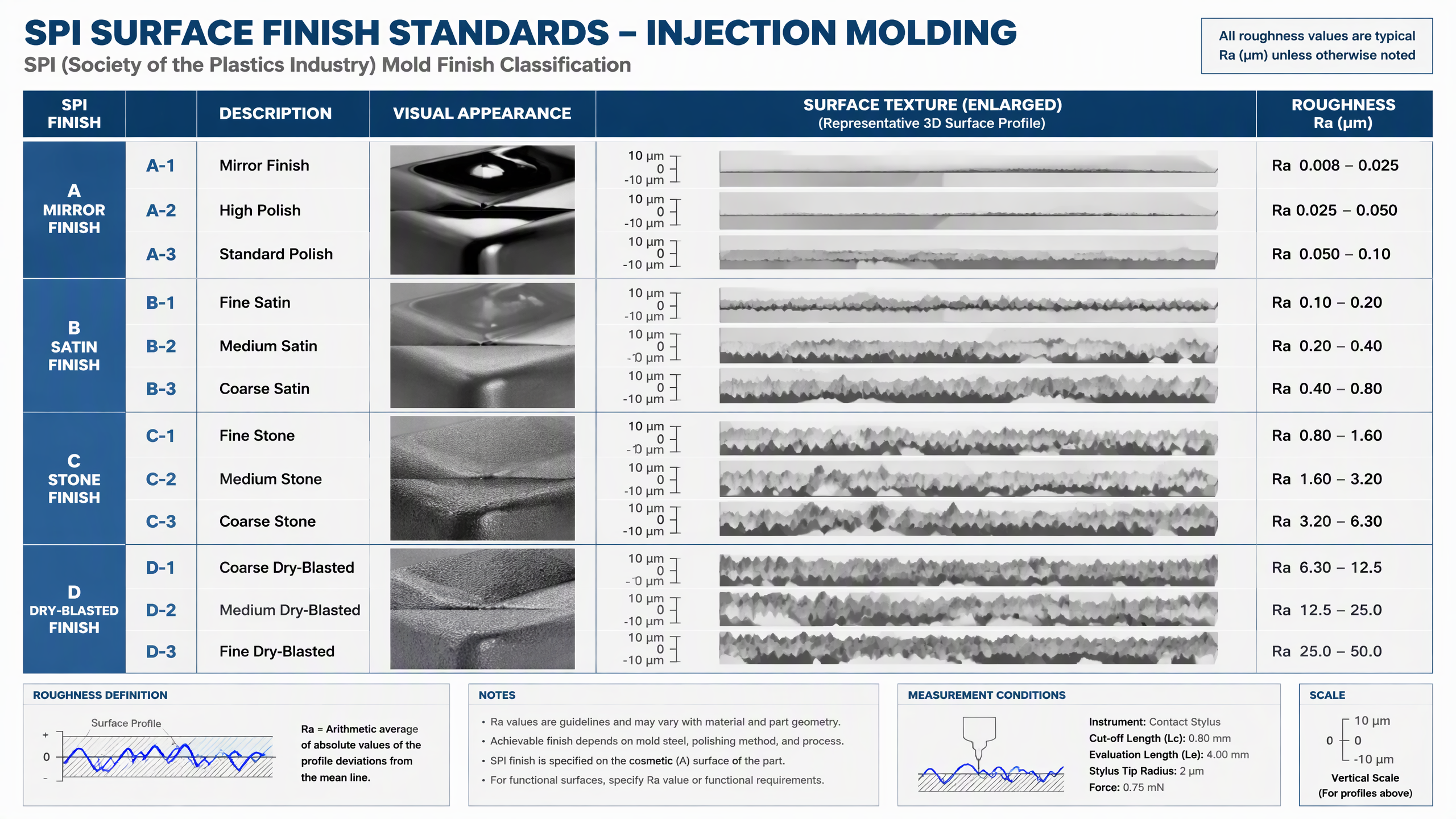
Injection molding surface finish refers to the texture, roughness, and visual appearance of the exterior surface of a plastic part after it is molded. It is determined by a combination of mold cavity surface treatment, plastic material properties, and processing parameters. The finish is typically classified according to SPI (Society of the Plastics Industry) standards, which define twelve distinct finish categories grouped into four grades.
SPI Surface Finish Standards Explained
The SPI finish standard, jointly maintained by SPI and the mold making industry, categorizes surface finishes as follows:
- Grade A (Mirror Finishes): A-1, A-2, and A-3 represent progressively finer diamond-polished surfaces. A-1 achieves an Ra value of 0.025 to 0.05 µm, producing a flawless mirror suitable for optical components and high-end consumer electronics. These finishes require hardened mold steel such as P20 or S7, polished with diamond paste graded from 9 µm down to 1 µm.
- Grade B (Fine Polished Finishes): B-1, B-2, and B-3 are produced using 600 to 1200 grit paper, yielding Ra values between 0.05 and 0.25 µm. These are common for consumer appliance housings where a smooth but non-reflective surface is desired.
- Grade C (Fine Dry-Blasted Finishes): C-1, C-2, and C-3 are created by dry-blasting with #240, #320, and #320 (light) glass beads respectively. The resulting matte finish hides flow lines and minor defects, making it ideal for automotive interior components.
- Grade D (Coarse Dry-Blasted Finishes): D-1, D-2, and D-3 use coarser #120 to #180 grit blasting media. The textured surface is excellent for concealing sink marks and weld lines on structural parts.
According to a 2025 report by Grand View Research, the global injection molded plastics market was valued at approximately USD 345 billion in 2024 and is projected to grow at a CAGR of 4.7% through 2030. Surface finish specification is increasingly recognized as a value-added differentiator, particularly in automotive and consumer electronics segments where tactile and visual quality directly impacts brand perception.
Key Factors Affecting Injection Molding Surface Finish
Achieving the specified surface finish consistently requires control over multiple variables across the mold design, material selection, and process parameter domains. No single factor operates in isolation—each interacts with the others in ways that can amplify or negate their individual effects.
Mold Steel and Cavity Treatment
The choice of mold steel directly determines the achievable surface finish. Pre-hardened steels like P20 (28–32 HRC) accept Grade B and C finishes well but may not sustain a true A-1 mirror polish over high-cavity-count production runs. For mirror-grade finishes, toolmakers typically specify through-hardened steels such as H13 (50–52 HRC) or stainless grades like S420 (34–38 HRC), which resist corrosion from outgassing during processing of engineering resins like polycarbonate and PBT.
At Shiny Mold's precision mold making facility, we employ a systematic polishing protocol: rough machining is followed by sequential steps using silicon carbide stones (220 to 600 grit), then diamond compound on felt bobs (6 µm to 1 µm), with each step removing the scratch pattern from the previous grit. Skipping grit steps saves time but leaves residual striations that become visible on the molded part under angled lighting.
Plastic Material Properties
The resin itself significantly influences the replicated surface quality. Amorphous thermoplastics such as ABS, PC, and PMMA reproduce mold surface texture with high fidelity because their random molecular chains flow without crystalline formation, allowing the melt to conform closely to cavity micro-topography. Semi-crystalline materials like nylon and POM exhibit lower surface replication due to crystalline growth patterns that create inherent micro-roughness.
Glass fiber reinforced grades present an additional challenge: fibers at or near the part surface create a visible "frosty" appearance that cannot be eliminated by mold polish alone. For applications requiring both structural reinforcement and a high-gloss finish, we recommend exploring two-shot molding or overmolding strategies that combine a reinforced substrate with an unfilled cosmetic layer.
Processing Parameters
Even with a perfectly polished mold and optimal material selection, improper processing can degrade surface quality. The most influential parameters include:
- Melt temperature: Higher melt temperatures reduce viscosity, enabling better cavity surface replication. However, exceeding the material's thermal stability window causes degradation and silver streaking. Refer to our industry news section for detailed melt temperature guides by material.
- Mold temperature: Elevated mold temperatures (typically 60–80°C for ABS, 80–120°C for PC) keep the polymer melt mobile longer at the cavity interface, improving surface reproduction. Mold temperature control systems should maintain uniformity within ±2°C across the cavity.
- Injection speed: Higher injection velocities generate shear heating that further reduces melt viscosity at the flow front, enhancing surface finish replication. However, excessive speeds cause shear burn and gas traps.
- Packing pressure: Adequate holding pressure ensures the material remains compressed against the cavity surface throughout the cooling phase. Insufficient packing results in low-pressure areas where the material pulls away, creating dull spots.
Common Surface Finish Defects and Solutions
Surface defects rank among the most frequently rejected categories in injection molding quality control. Understanding their root causes enables targeted corrective action rather than trial-and-error parameter adjustment.
Sink Marks and Vacuum Voids
Sink marks appear as localized depressions on the part surface, typically opposite thick sections or rib intersections. They occur when the outer skin solidifies while the core is still molten and contracts inward. Solutions include reducing wall thickness variation (design rule: adjacent walls should not differ by more than 25%), increasing packing pressure, extending hold time, or utilizing gas-assisted injection molding to hollow out thick sections.
Flow Marks and Record Lines
Flow marks are visible bands or ripples on the part surface caused by intermittent contact between the melt front and the cavity wall. They are most common with high-viscosity materials and cold molds. Raising the mold temperature by 10–15°C, increasing injection speed, and ensuring adequate venting at the flow terminus typically resolves this issue.
Weld Lines and Meld Lines
When two melt fronts converge—whether around a core pin or at a multi-gate junction—the meeting point can create a visible line. Weld lines are particularly problematic on high-gloss finishes because the material at the interface is cooler and does not fully knit. Strategies include relocating gates to shift weld lines to non-cosmetic surfaces, increasing melt and mold temperatures, or using sequential valve gating to control flow front convergence.
How to Specify Surface Finish Requirements
Clear specification of surface finish requirements at the design stage prevents costly rework and tooling modifications later. We recommend the following approach:
- Reference the SPI standard: Always specify the finish using the SPI grade (e.g., "SPI A-2 on all cosmetic surfaces"). Avoid ambiguous terms like "glossy" or "smooth" which are open to interpretation.
- Provide Ra values for functional surfaces: For sealing surfaces or sliding-fit components, specify the acceptable Ra range (e.g., Ra 0.4–0.8 µm).
- Identify cosmetic vs. non-cosmetic surfaces: Clearly mark which surfaces are visible to the end user and which are internal. This allows the toolmaker to allocate polishing effort efficiently.
- Include texture specifications: If a textured finish is required, reference the standard texture library (MT,YS,Sand, etc.) and specify the depth and pattern direction.
- Consider draft angles: Textured surfaces require greater draft angles—typically 1–3 degrees additional draft per 0.1 mm of texture depth. See our FAQ page for detailed draft angle guidance.
Industry Trends in Surface Finish Technology
The injection molding industry is seeing several emerging trends that impact surface finish specifications. Laser texturing of mold surfaces, for instance, enables the creation of complex micro-textures that would be impossible with traditional chemical etching. This technology allows designers to specify functional surface textures that reduce friction, control wettability, or create directional visual effects.
Additive manufacturing is also influencing surface finish standards. 3D-printed injection molds and conformal cooling channels produced by SLM (Selective Laser Melting) can improve thermal uniformity in the cavity, reducing surface defects caused by temperature gradients. However, 3D-printed mold inserts typically require additional surface treatment to achieve finishes beyond Grade C.
Conclusion

Injection molding surface finish is a multidisciplinary specification that demands coordination between part design, tool engineering, material science, and process control. By adhering to SPI standards, selecting appropriate mold steels, optimizing processing parameters, and clearly documenting finish requirements, manufacturers can consistently produce parts that meet both aesthetic and functional expectations. At Shiny Mold, our 23+ years of injection molding experience and in-house tooling capabilities enable us to deliver specified surface finishes from A-1 mirror to D-3 textured across a wide range of applications and materials.
FAQ: Injection Molding Surface Finish
What is the difference between SPI A-1 and SPI A-2 finish?
SPI A-1 is the finest mirror finish with an Ra of 0.025–0.05 µm, achieved with 1 µm diamond paste. SPI A-2 has an Ra of 0.05–0.10 µm, produced with 3 µm diamond compound. The visual difference is subtle: A-1 produces a perfect mirror with no visible scratches, while A-2 may show faint polishing lines under intense scrutiny.
How much does mold polishing cost?
Mold polishing cost depends on the finish grade and cavity complexity. An A-1 mirror finish on a simple cavity may add 15–25% to the mold cost, while a D-3 blasted finish is typically included in the base tooling price. For multi-cavity molds, polishing cost scales with cavity count and surface area.
Can textured molds produce a glossy finish?
No—texture and gloss are opposing surface characteristics. A textured mold (Grade C or D) produces a matte or satin finish on the molded part. A glossy finish requires a polished mold (Grade A). However, certain textured patterns can create directional light reflection that appears semi-gloss from specific angles.
What draft angle is needed for textured injection molded parts?
As a general rule, add 1 degree of draft per 0.025 mm (0.001 inch) of texture depth. Most standard MT textures require 1–3 degrees of draft. Insufficient draft on textured surfaces causes part drag marks and ejection damage that ruin the surface finish.
Does glass-filled material affect surface finish?
Yes. Glass fiber reinforced resins produce a naturally frosted surface regardless of mold finish, as fibers at the surface create micro-roughness. For cosmetic applications requiring a smooth finish, use unreinforced material or consider overmolding an unfilled cosmetic layer over a reinforced substrate.