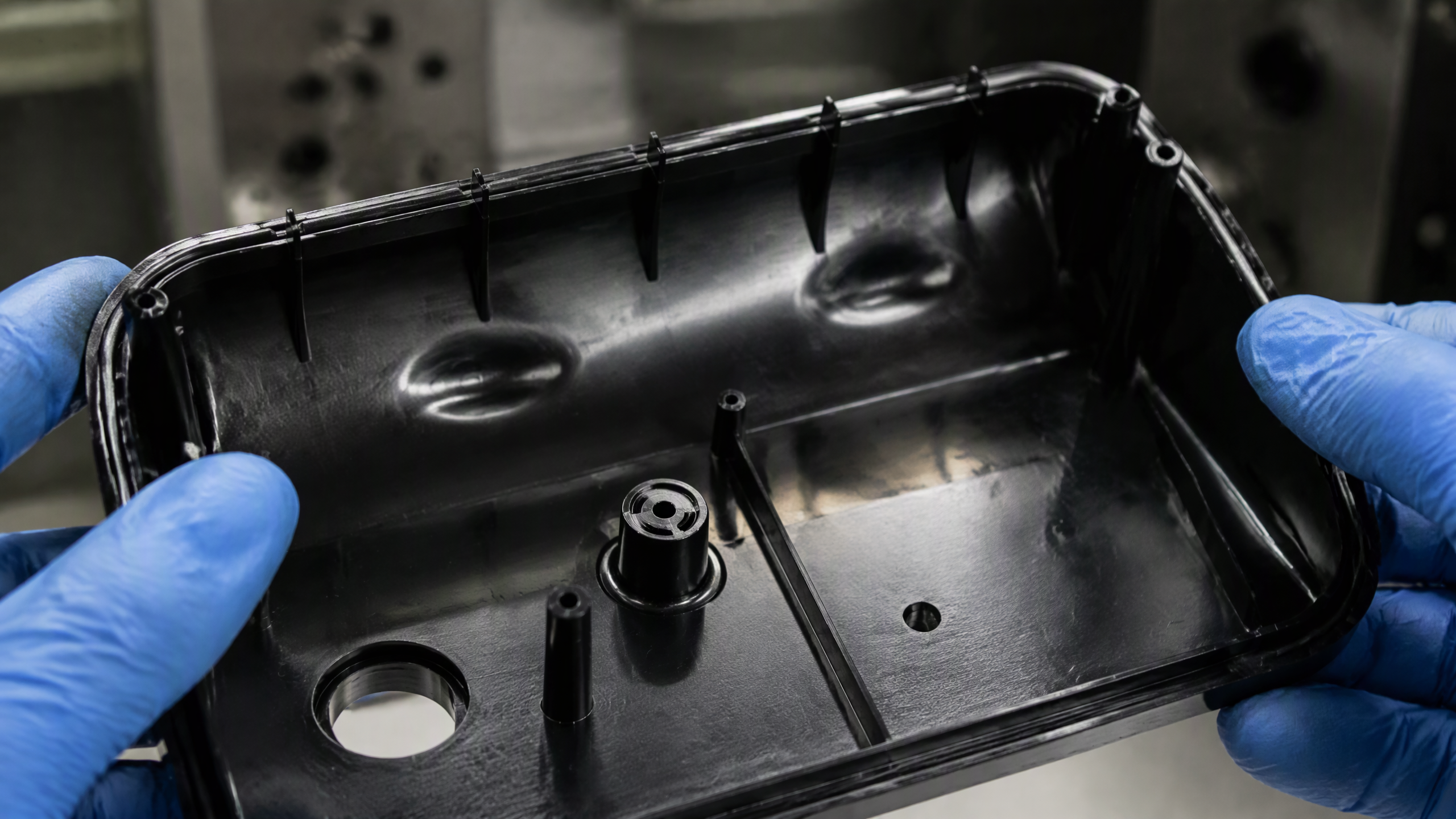
Introduction to Medical Injection Molding
When a medical device component measures 0.05 millimeters thinner than specification, the difference between a functional inhaler and a drug-delivery failure can come down to the molding process itself. Medical injection molding is the specialized practice of manufacturing plastic and silicone components for healthcare applications, where tolerances are measured in microns, materials must be biocompatible, and every part must be traceable from resin lot to finished device.
The global medical injection molding market was valued at approximately $22.5 billion in 2024 and is projected to reach $38.6 billion by 2032, growing at a CAGR of 7.1% (Grand View Research, 2024). This growth is driven by the increasing complexity of medical devices, the rise of home healthcare, and the ongoing shift toward minimally invasive surgical instruments that demand ever-smaller, ever-more-precise molded components.

At Shiny Mold, our engineering team has spent over 15 years perfecting medical injection molding processes for clients ranging from startup device companies to Tier 1 medical OEMs. In this guide, we share the technical foundations, material science, regulatory requirements, and practical challenges that define this discipline.
What Is Medical Injection Molding?
Medical injection molding is a subset of plastic injection molding that adheres to stringent regulatory standards for medical device applications. The process uses the same fundamental mechanics: molten polymer is injected into a precision-machined mold under high pressure. However, every parameter is controlled with far tighter tolerance bands and documentation requirements.
Key differentiators from standard injection molding include:
- Material traceability: Every resin lot is tracked from delivery through processing to final part, with retention samples stored for 5-7 years per FDA requirements.
- Cleanroom manufacturing: Parts are produced in ISO Class 7 or Class 8 controlled environments to prevent particulate and microbial contamination.
- Process validation: Processes must be validated per IQ/OQ/PQ protocols (Installation, Operational, and Performance Qualification) before production begins, going beyond standard process qualification.
- Biocompatible materials: Only resins with USP Class VI or ISO 10993 test data are used, ensuring the material does not cause adverse biological responses when contacting tissue or bodily fluids.
Materials for Medical Injection Molding
Selecting the right material is perhaps the single most consequential decision in a medical molding project. The material determines biocompatibility, mechanical performance, chemical resistance, and regulatory pathway. Below is an overview of the most widely used material families.
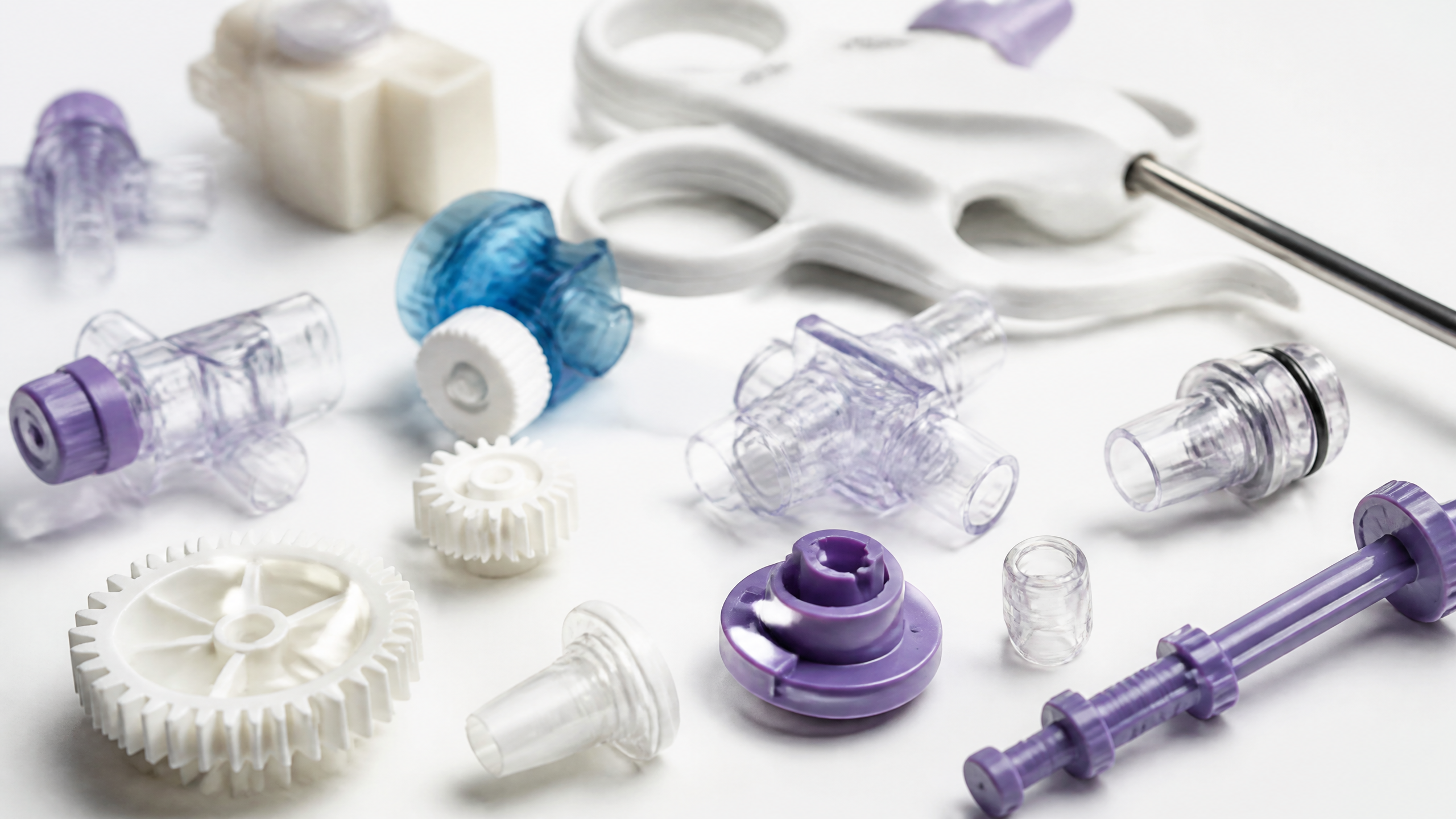
Thermoplastic Polymers
The most commonly molded medical thermoplastics include:
- Polycarbonate (PC): Used for IV connectors, blood filter housings, and respiratory device components due to its clarity, impact resistance, and ability to withstand gamma sterilization. Melt temperature typically ranges from 280 to 320 degrees Celsius.
- Cyclic Olefin Copolymer (COC/COP): Increasingly favored for diagnostic consumables and microfluidic devices. COC offers glass-like clarity, low moisture absorption (below 0.01%), and exceptional dimensional stability, which is critical for lab-on-a-chip applications where channel widths may be as narrow as 50 micrometers.
- PEEK (Polyetheretherketone): A high-performance polymer for surgical instruments and orthopedic implants. PEEK requires melt temperatures of 360 to 400 degrees Celsius and specialized mold heating systems, but offers metal-like strength at one-third the weight.
- Polypropylene (PP) and ABS: Used for non-implant applications such as diagnostic cassettes, pipette tips, and consumer wellness products where biocompatibility requirements are lower but chemical resistance and cost efficiency matter.
Liquid Silicone Rubber (LSR)
LSR has become indispensable for medical sealing and flexible components. Two-part platinum-cured silicone is injected into heated molds where it crosslinks into a flexible, biocompatible elastomer. LSR is the material of choice for valve seals and gaskets in infusion pumps, baby bottle nipples, wearable sensor skin-contact pads, and surgical instrument ergonomic grips.
The key advantage of LSR over thermoplastic elastomers (TPE) is its stability across a temperature range of -60 to 200 degrees Celsius and its resistance to repeated steam sterilization cycles without degradation. However, LSR processing requires dedicated liquid silicone injection molding equipment with static mixers and closed-loop shot control, which adds approximately 30% to equipment investment compared to standard thermoplastic molding machines.
Cleanroom Manufacturing Standards
The production environment is as critical as the material selection. Medical injection molding typically occurs in cleanrooms certified to ISO 14644-1 standards. The table below summarizes the two most common classifications for medical molding operations:
| Cleanroom Class | Max Particles per m3 (at 0.5 micron) | Typical Application |
|---|---|---|
| ISO Class 7 | 352,000 | Implantable components, IV sets, surgical instruments |
| ISO Class 8 | 3,520,000 | Diagnostic consumables, non-implant device housings |
At our facility, the molding bay operates at ISO Class 7 with positive-pressure HEPA-filtered air, sealed material handling systems, and gowning protocols that exceed standard medical device requirements. This investment in environmental control reduces particulate contamination by a factor of 100 compared to standard industrial molding environments, which is essential for maintaining bioburden limits on patient-contacting components.
Quality and Regulatory Compliance
Medical injection molding is governed by a layered framework of international standards. Two regulatory pillars are foundational to virtually every medical molding program.
ISO 13485:2016 Quality Management
ISO 13485 is the industry-specific quality management standard for medical devices. It extends ISO 9001 with additional requirements for risk management, design controls, and traceability. Every aspect of the molding process, from tool design through validation to production monitoring, must be documented under a Design History File (DHF) and Device Master Record (DMR). Regular internal audits and notified body surveillance audits ensure ongoing compliance throughout the product lifecycle.
FDA 21 CFR Part 820 Quality System Regulation
For products distributed in the United States, FDA 21 CFR Part 820 mandates a quality system that includes process validation (Section 820.75), requiring manufacturers to prove that their molding process consistently produces parts meeting specifications. This typically involves capability studies with Cpk values of 1.33 or higher for critical dimensions, Installation Qualification (IQ) to verify equipment and tooling are installed per specification, Operational Qualification (OQ) to demonstrate the process produces acceptable parts at operating limits, and Performance Qualification (PQ) to confirm reproducibility under normal production conditions.

Common Medical Injection Molded Components
The range of products manufactured through medical injection molding is remarkably broad. Based on our production history, the most common categories include:
- Drug delivery systems: Inhaler actuators, auto-injector housings, insulin pen components, and infusion set connectors. These parts require precision internal geometries and chemical resistance to pharmaceutical formulations. A typical auto-injector housing involves 12 to 15 critical dimensions with tolerances of plus or minus 0.05 mm.
- Surgical instruments: Disposable trocar sleeves, stapler components, and laparoscopic graspers. These demand high rigidity, dimensional accuracy, and the ability to survive ethylene oxide (EtO) or gamma sterilization without embrittlement or discoloration.
- Diagnostics: Microfluidic chips, PCR plate wells, and lateral flow test cassettes. The COC and PMMA materials used here must maintain optical clarity and channel precision at scales where a 10-micron deviation can invalidate a test result.
- Orthopedic and implantable devices: PEEK spinal cages, bioresorbable polymer screws made from PLA or PLGA, and temporary fixation devices. These represent the most demanding applications, requiring not only mechanical precision but long-term biological safety data spanning 12 to 24 months of preclinical testing.
Key Challenges in Medical Injection Molding
Based on our engineering team's experience across hundreds of medical projects, three challenges consistently rank as the most demanding in day-to-day production.
1. Microprecision at Production Scale
When part features drop below 0.5 mm, standard molding parameters become inadequate. Gate freeze-off, differential shrinkage, and venting issues compound at micro scale. We have found that pulse-cooling mold technology and conformal cooling channels (machined directly into mold inserts via SLS metal printing) can maintain dimensional stability within plus or minus 0.01 mm on features as small as 0.1 mm. This level of control is critical for microfluidic channel reproducibility and for drug delivery components where flow path geometry directly affects dosing accuracy.
2. Material Cost and Waste Management
Medical-grade resins cost 3 to 10 times more than their industrial counterparts. A single kilogram of medical-grade PEEK can exceed $400. This makes regrind management and flash control financially significant. Best practice is to design tools with minimal runner volume using hot runner systems and to validate that regrind, when permitted by the device specification, does not exceed 15% of total shot weight. For implantable applications, regrind is prohibited entirely, and every shot must use virgin resin with full lot traceability.
3. Regulatory Documentation and Change Control
A typical medical molding validation generates 200 to 500 pages of documentation. Process Flow Diagrams (PFDs), Failure Mode and Effects Analyses (FMEAs), and statistical process control (SPC) reports must be maintained for the entire product lifecycle, which can span 7 to 15 years for a single device platform. Any change to the molding process, material, or tooling triggers a formal change control review, and depending on the nature of the change, may require re-validation. This documentation burden, while necessary for patient safety, represents a significant operational overhead that must be factored into project planning and pricing.
FAQ: Medical Injection Molding
What is medical injection molding?
Medical injection molding is the process of manufacturing plastic and silicone components for medical device applications in controlled cleanroom environments, using biocompatible materials and validated processes that meet ISO 13485 and FDA regulatory standards. It combines the precision of plastic injection molding with the rigorous documentation, traceability, and quality controls required for healthcare applications.
How is medical injection molding different from standard injection molding?
Medical injection molding requires biocompatible materials (USP Class VI or ISO 10993), cleanroom manufacturing (ISO Class 7 or 8), full process validation (IQ/OQ/PQ), lot-level material traceability, and compliance with ISO 13485 quality management. Standard industrial injection molding has none of these requirements, making medical molding a fundamentally different operational discipline rather than a simple add-on.
What materials are used in medical injection molding?
The most common medical molding materials include polycarbonate (PC), cyclic olefin copolymer (COC), PEEK, liquid silicone rubber (LSR), polypropylene (PP), ABS, and bioresorbable polymers like PLA and PLGA. Material selection depends on the application's biocompatibility class, mechanical requirements, sterilization method, and regulatory pathway.
What cleanroom class is required for medical injection molding?
ISO Class 7 (equivalent to Class 10,000 under the former FED-STD-209E) cleanrooms are typically required for implantable and invasive device components. ISO Class 8 (Class 100,000) is sufficient for non-invasive diagnostic consumables and external device housings. The specific class required depends on the device's intended use, contact duration, and regulatory classification.
How long does medical injection molding validation take?
A full medical molding validation (IQ/OQ/PQ) typically takes 4 to 8 weeks, depending on part complexity, number of critical dimensions, and regulatory requirements. This does not include tool design and fabrication, which can add 6 to 12 weeks before validation begins. For complex multi-cavity tools with high cavitation counts, the validation timeline may extend further.
Can medical injection molding use regrind material?
For non-implant applications such as diagnostic consumables, regrind may be permitted up to 15% of total shot weight, provided it is validated under the device's quality system. For implantable and patient-contacting components, regrind is prohibited entirely, and every shot must use virgin resin with full lot traceability per ISO 13485 requirements.
Conclusion
Medical injection molding sits at the intersection of material science, precision engineering, and regulatory compliance. The stakes are uniquely high: when a molded component fails in a medical device, the consequences extend far beyond scrap rates to patient safety. That is why the discipline demands not just technical capability, but a culture of documentation, traceability, and continuous process improvement that pervades every stage from tool design to serial production.
At Shiny Mold, our engineering team brings together ISO 13485-certified processes, ISO Class 7 cleanroom facilities, and a track record of validated medical molding projects across drug delivery, surgical, and diagnostic applications. Whether you are developing a new medical device or seeking a qualified molding partner for an existing platform, contact our team to discuss how we can support your next medical molding project.
About the Author: This article is authored by the Shiny Mold Engineering Team, with over 15 years of combined experience in medical device manufacturing, precision injection molding, and regulatory compliance. Our team holds ISO 13485 certification and has produced validated components for FDA-cleared and CE-marked medical devices across drug delivery, surgical, and diagnostic categories.
References:
- Grand View Research. "Medical Injection Molding Market Size, Share & Trends Analysis Report, 2024-2032."
- ISO 13485:2016. "Medical devices - Quality management systems - Requirements for regulatory purposes."
- FDA 21 CFR Part 820. "Quality System Regulation."
- ISO 10993-1:2018. "Biological evaluation of medical devices - Part 1: Evaluation and testing within a risk management process."
- ISO 14644-1:2015. "Cleanrooms and associated controlled environments - Part 1: Classification of air cleanliness by particle concentration."