


Metal injection molding (MIM) has emerged as one of the most transformative manufacturing technologies for producing complex, high-precision metal components at scale. By combining the design flexibility of plastic injection molding with the material strength of powder metallurgy, metal injection molding enables engineers to create intricate metal parts that would be prohibitively expensive or outright impossible to machine traditionally. In this comprehensive guide, the Shiny Mold Engineering Team draws on decades of hands-on experience in injection molding manufacturing to explain the MIM process, materials, applications, and design considerations that determine project success.

What Is Metal Injection Molding?
Metal injection molding is a net-shape manufacturing process that produces small-to-medium-sized metal components with complex geometries. The technology bridges the gap between plastic injection molding and conventional powder metallurgy, inheriting the geometric freedom of the former and the material performance of the latter. First commercialized in the 1970s and refined through the 1990s, MIM has grown into a multi-billion-dollar global industry, with the market projected to surpass $5.2 billion by 2030 according to industry analysts.
The fundamental principle of metal injection molding is straightforward: fine metal powder is mixed with a polymeric binder to create a moldable feedstock, which is then injection-molded into the desired shape. The resulting "green part" undergoes debinding to remove the binder and sintering to densify the metal, yielding a finished component with mechanical properties approaching those of wrought metal. For manufacturers seeking an in-depth comparison of MIM with conventional injection molding, the key differentiator is the material: MIM produces solid metal parts, while traditional injection molding is limited to thermoplastic polymers.
The Metal Injection Molding Process: Step by Step
Understanding the metal injection molding process is essential for engineers evaluating MIM for their projects. The process consists of four primary stages, each requiring precise control to achieve the desired part quality.
1. Feedstock Preparation
The MIM process begins with feedstock preparation. Fine metal powder, typically with particle sizes between 1 and 20 micrometers, is blended with a multi-component binder system. The binder usually comprises a thermoplastic backbone (such as polypropylene or polyethylene), a wax component for flow characteristics, and a surfactant to improve powder-binder adhesion. The powder loading, which is the volume fraction of metal powder in the feedstock, typically ranges from 55% to 65%. This mixture is compounded in a high-shear mixer at elevated temperatures until a homogeneous pelletized feedstock is achieved.
The choice of metal powder is critical. Gas-atomized powders are preferred for their spherical morphology, which improves flow and packing density. Water-atomized powders, while less expensive, have irregular shapes that can compromise feedstock uniformity. At Shiny Mold, our engineering team has found that powder characteristics directly influence the final part's dimensional accuracy, surface finish, and mechanical properties.
2. Injection Molding
The feedstock pellets are fed into a specialized injection molding machine, similar to those used in plastic injection molding but modified to handle the abrasive metal-binder mixture. The machine melts the binder and injects the molten feedstock into a precision-machined steel mold cavity under high pressure. The mold is designed to account for the approximately 20% linear shrinkage that will occur during sintering.
The resulting "green part" retains the exact geometry of the mold but is only about 60% dense. At this stage, the part is fragile and can be handled carefully but is far from its final mechanical properties. Tooling design for MIM must account for gate placement, venting, and cooling channels, just as in plastic injection molding, but with additional consideration for the abrasive nature of the feedstock.
3. Debinding
Debinding is the process of removing the binder system from the green part, leaving behind a porous metal skeleton known as the "brown part." This stage typically involves two phases: thermal debinding, where the part is heated in a controlled atmosphere to decompose and evaporate the binder components, and solvent debinding, where specific binder fractions are dissolved in a solvent bath. The debinding schedule must be carefully controlled to prevent part distortion, cracking, or carbon contamination.
Modern MIM operations increasingly use catalytic debinding, which removes the binder through chemical reaction at lower temperatures, reducing processing time and minimizing the risk of part defects. After debinding, the brown part retains its shape through metal-to-metal powder contacts but has minimal structural integrity.
4. Sintering
Sintering is the final and most critical stage of the metal injection molding process. The brown part is heated in a controlled-atmosphere furnace to a temperature approaching but below the melting point of the metal, typically 1,200 to 1,400 degrees Celsius depending on the alloy. During sintering, the metal particles fuse together through diffusion bonding, and the part densifies to 96 to 99 percent of theoretical density.
The sintering process causes uniform isotropic shrinkage of approximately 15 to 20 percent in each dimension. This shrinkage is predictable and is factored into the mold design from the outset. After sintering, the part exhibits mechanical properties comparable to investment-cast or machined components of the same material. Post-sintering operations, such as heat treatment, surface finishing, or machining, may be applied to meet specific application requirements.

MIM Materials and Alloys
One of the greatest strengths of metal injection molding is the wide range of materials it can process. Virtually any metal that can be produced as a fine powder and sintered can be used in MIM. The most common MIM materials include:
- Stainless Steel (316L, 17-4PH, 304L): The workhorse of MIM, accounting for over 60% of all MIM parts. 316L offers excellent corrosion resistance, while 17-4PH provides high strength and hardness after precipitation hardening.
- Low-Alloy Steels: Used for applications requiring high strength and wear resistance, such as automotive components and power tools.
- Titanium and Titanium Alloys (Ti-6Al-4V): Increasingly popular in medical and aerospace applications due to their exceptional strength-to-weight ratio and biocompatibility.
- Tungsten and Tungsten Alloys: Used for high-density applications such as radiation shielding, vibration damping, and defense components.
- Copper and Copper Alloys: Ideal for electrical and thermal management applications, including heat sinks and connectors.
- Cobalt-Chrome Alloys: Used in medical implants and dental prosthetics due to their biocompatibility and wear resistance.
Material selection in metal injection molding depends on the application's mechanical, thermal, and chemical requirements. The Shiny Mold Engineering Team works closely with clients to select the optimal alloy and heat treatment combination for each project, ensuring that the final component meets or exceeds performance specifications.
Applications of Metal Injection Molding
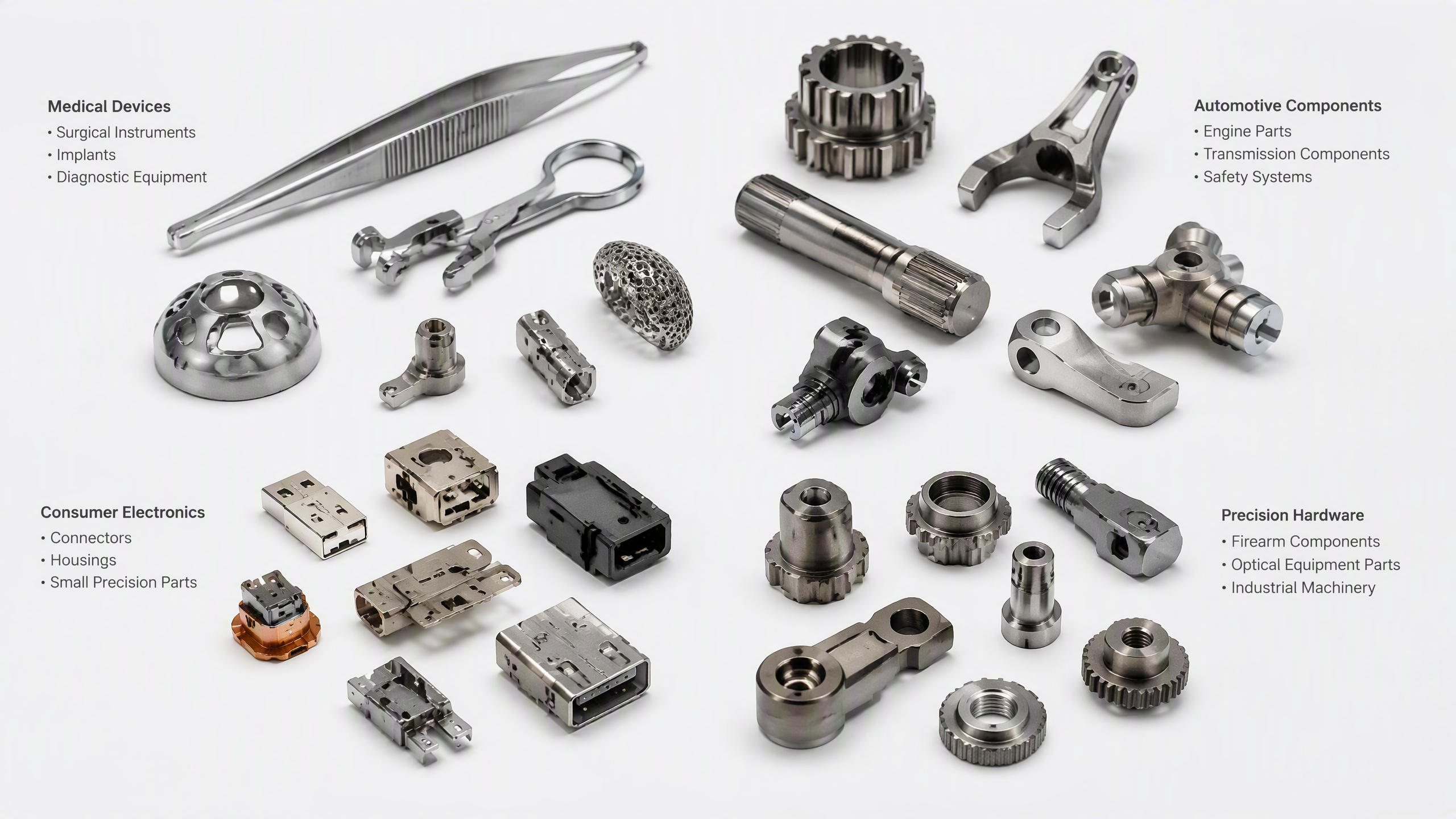
Metal injection molding serves a diverse and growing range of industries, each leveraging the technology's ability to produce complex metal parts in high volumes at competitive costs.
Medical Devices
The medical industry is one of the largest consumers of MIM parts. Surgical instruments, orthodontic brackets, orthopedic implants, and drug delivery components are routinely manufactured via MIM. The process can produce the intricate geometries required for minimally invasive surgical tools while meeting stringent biocompatibility standards. 17-4PH and 316L stainless steels dominate medical MIM applications due to their corrosion resistance and mechanical properties.
Automotive
In the automotive sector, MIM is used to produce fuel injector nozzles, turbocharger components, sensor housings, and locking mechanisms. The trend toward vehicle electrification is driving new demand for MIM components in battery management systems, electric motor housings, and thermal management modules. The automotive industry values MIM for its ability to consolidate multiple machined parts into a single molded component, reducing assembly costs and improving reliability.
Consumer Electronics
Smartphone hinges, camera lens mounts, wearable device frames, and connector components are commonly produced via metal injection molding. The electronics industry demands parts with extremely tight tolerances, smooth surface finishes, and complex geometries that MIM delivers efficiently at high volumes. As devices become smaller and more sophisticated, MIM is increasingly the manufacturing method of choice for micro-scale metal components.
Firearms and Defense
MIM has become a standard manufacturing method for firearm components such as triggers, hammers, sears, and magazine releases. The process offers consistent dimensional accuracy and material properties across high-volume production runs, which is critical for safety-critical applications. Defense applications also include tungsten-based kinetic energy penetrators and fragmentation components.
MIM vs. Other Manufacturing Methods
Engineers evaluating metal injection molding should understand how it compares to alternative manufacturing processes:
- MIM vs. CNC Machining: MIM excels for complex geometries in high volumes, while CNC machining is preferred for low-volume production or parts requiring extremely tight tolerances (better than plus or minus 0.1 percent). MIM typically achieves tolerances of plus or minus 0.3 to 0.5 percent of dimension.
- MIM vs. Investment Casting: MIM produces better surface finish and tighter tolerances than investment casting, particularly for small parts. Investment casting is more economical for larger components exceeding 250 grams.
- MIM vs. Conventional Powder Metallurgy: Conventional press-and-sinter powder metallurgy is limited to relatively simple geometries due to uniaxial pressing. MIM, by contrast, can produce parts with undercuts, cross-holes, and intricate internal features that are impossible with conventional P/M.
- MIM vs. Additive Manufacturing: While 3D printing offers design freedom, MIM is far more economical for production volumes exceeding a few thousand units. MIM also achieves higher material density and better surface finish than most metal additive manufacturing processes.
Advantages of Metal Injection Molding
Metal injection molding offers a compelling combination of benefits that make it the preferred choice for many manufacturing applications:
- Complex Geometry: MIM can produce parts with undercuts, internal threads, cross-holes, and thin walls that would be impossible or prohibitively expensive to machine.
- High Production Volume: Once tooling is built, MIM can produce tens of thousands to millions of parts with consistent quality and minimal per-unit cost.
- Material Efficiency: MIM produces near-net-shape parts, minimizing material waste compared to subtractive machining processes.
- Excellent Mechanical Properties: Sintered MIM parts achieve 96 to 99 percent of theoretical density, with mechanical properties comparable to wrought materials.
- Design Consolidation: Multiple machined or stamped components can often be consolidated into a single MIM part, reducing assembly costs and failure points.
- Surface Finish: MIM parts typically achieve a surface finish of 0.8 to 1.6 micrometers Ra as-sintered, which can be further improved with post-processing.
Design Guidelines for Metal Injection Molding
To maximize the benefits of metal injection molding, designers should follow established MIM design guidelines:
- Wall Thickness: Maintain uniform wall thickness between 0.5 and 5 mm to ensure consistent shrinkage during sintering. Avoid abrupt section transitions that can cause distortion.
- Draft Angles: Apply 1 to 2 degrees of draft to vertical walls to facilitate part ejection from the mold.
- Undercuts: MIM can accommodate undercuts through side-actions in the tooling, but they increase mold complexity and cost.
- Part Size: MIM is most economical for parts weighing 0.1 to 250 grams. Parts outside this range may be better suited to other processes.
- Tolerances: Design for typical MIM tolerances of plus or minus 0.3 to 0.5 percent. Critical dimensions may require post-sintering machining.
- Radius Corners: Use generous radii on all corners to reduce stress concentration and improve material flow during injection.
FAQ: Metal Injection Molding
What is metal injection molding?
Metal injection molding (MIM) is a manufacturing process that combines metal powder with a polymeric binder, injection-molds the mixture into the desired shape, then removes the binder and sinters the part to near-full density. It produces complex metal components at high volumes with excellent mechanical properties.
What materials can be used in metal injection molding?
MIM supports a wide range of materials, including stainless steel (316L, 17-4PH), low-alloy steel, titanium alloys, tungsten, copper, and cobalt-chrome. Stainless steels account for over 60 percent of all MIM production globally.
What is the typical tolerance of MIM parts?
Metal injection molding typically achieves dimensional tolerances of plus or minus 0.3 to 0.5 percent of the dimension. Tighter tolerances can be achieved through post-sintering operations such as machining or sizing.
How much does metal injection molding cost?
MIM costs depend on part complexity, material, volume, and tooling requirements. Tooling investment typically ranges from $10,000 to $50,000, while per-part costs decrease significantly at higher volumes. MIM is most economical for production runs exceeding 10,000 units.
What is the difference between MIM and conventional powder metallurgy?
Conventional powder metallurgy uses uniaxial pressing, limiting it to simple geometries. MIM uses injection molding, enabling complex shapes with undercuts, internal features, and thin walls. MIM also achieves higher density (96-99 percent vs. 85-90 percent for conventional P/M).
What industries use metal injection molding?
MIM is widely used in medical devices, automotive components, consumer electronics, firearms, aerospace, and industrial machinery. The technology is particularly valuable for applications requiring complex metal parts at high production volumes.
Conclusion
Metal injection molding represents a powerful manufacturing solution for engineers and product designers seeking to produce complex metal components at scale. By combining the design freedom of injection molding with the material performance of powder metallurgy, MIM opens possibilities that traditional machining and casting cannot match. Whether you are developing medical devices, automotive components, or consumer electronics, understanding the capabilities and constraints of metal injection molding enables smarter design decisions and more efficient production.
At Shiny Mold, our engineering team brings years of expertise in metal injection molding and injection molding manufacturing. We work with clients from concept through production, providing design-for-manufacturing guidance, material selection support, and full-scale MIM production. Contact us to discuss how metal injection molding can enhance your next project, or explore our industry insights for more technical resources.
Author: Shiny Mold Engineering Team. This article reflects our team's collective experience in metal injection molding and precision manufacturing. For technical questions or project consultations, please reach out through our website.


