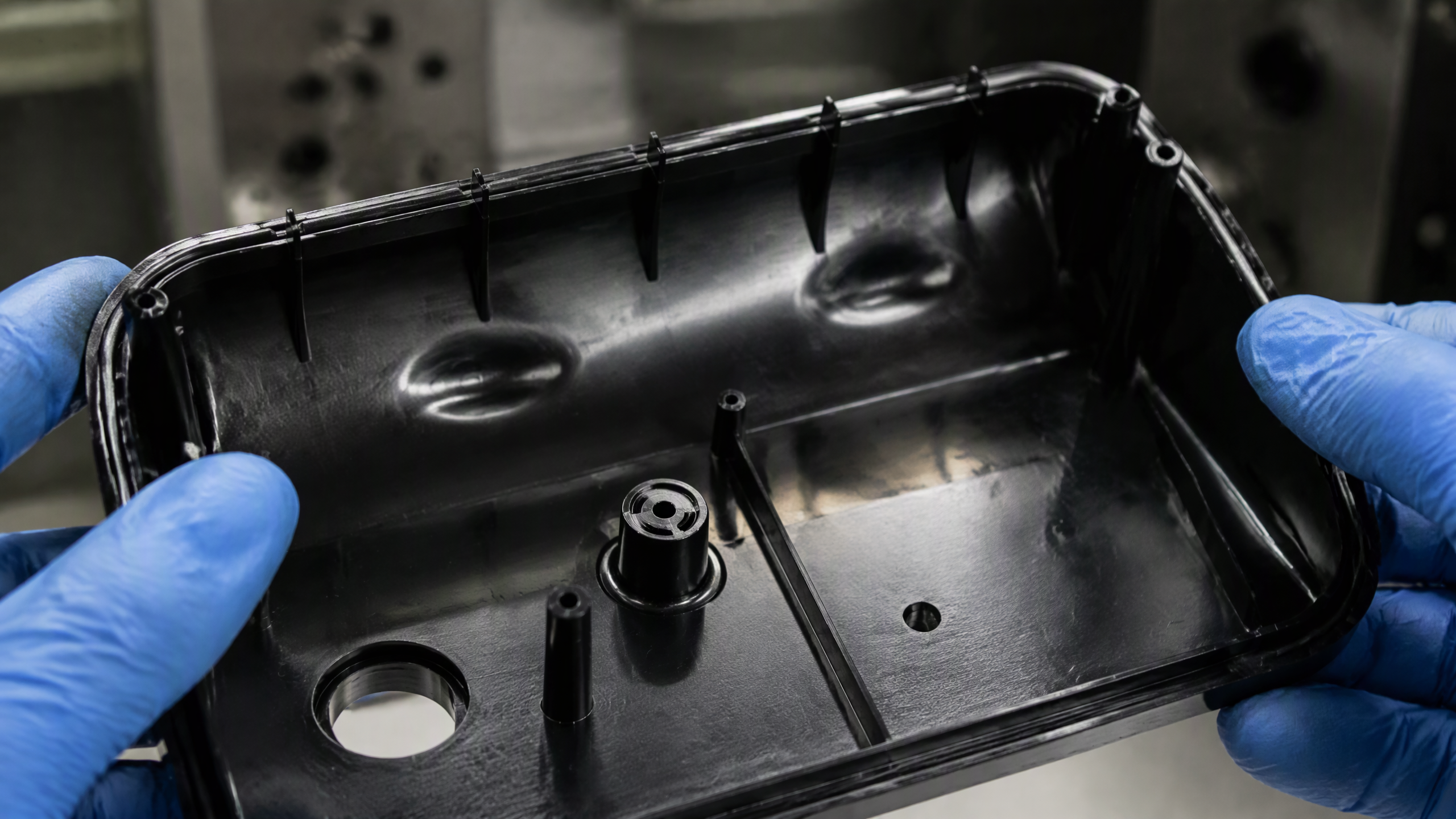
We got a frantic email last March from a buyer in Ohio. His first supplier had quoted a connector mold at $2,800 and promised delivery in three weeks. Six weeks later he'd received nothing but silence, and the deposit was gone. Stories like his are why we keep telling people: when you're sourcing Plastic Injection Molding at volume, picking the shop isn't about the cheapest quote. It's about who's still answering the phone when something goes sideways.
The mold is the heart of your whole production run. Get it wrong and every part that comes after carries the defect, quietly, for the life of the program. That's the part most procurement teams underestimate while they're scanning a spreadsheet of suppliers.

What's Actually Happening Inside the Shop
A real mold builder runs its own tool room. We're talking CNC mills, wire EDM, mirror EDM, and a CMM under the same roof — not a sales office that farms the actual cutting out to whoever's cheapest that week. In Injection molding, that distinction is the whole ballgame.
We've walked into factories in Dongguan where the "mold department" was a single tired mill and a guy with a hand file. They'll still take your drawing. They'll still quote low. And they'll still ship you a tool that needs rework on the first 500 parts. In-house capability is the gap between a shop that controls its quality and one that's just hoping for the best.
On the ground, the tells are obvious once you know them. Ask to see the tool room. If they hesitate, or steer you toward a video of the injection floor instead, that's your answer. The steel grade matters too — P20 for a prototype, H13 or S136 for a production tool that has to survive a million cycles. A shop that can't name the steel without checking a quote sheet isn't running the program in its head yet. And for cosmetic parts, mirror EDM is what takes a surface from machine-marked to showroom-clean; if they outsource that step, every finish decision becomes a phone call to someone else.
One Client, One Very Expensive Lesson
We once had a client whose previous supplier built a two-cavity medical tray mold with zero cooling balance between the cavities. One side ran roughly 14°C hotter than the other. Cycle time dragged, and warpage pushed rejects to about 22% before they'd even made 10,000 pieces.
The fix wasn't a process tweak. It was pulling the mold, re-routing the cooling lines, and re-cutting the gates — a $6,000 job the first shop should've caught during design. A proper DFM review would've flagged it before any steel got cut. That's the kind of miss you don't recover from on a tight launch window, and it's why we treat the engineering review as non-negotiable, not a line item.

Reading the Quality Paperwork
ISO 9001 is everywhere now. For automotive or medical work you'll want IATF 16949 or ISO 13485 on top. Yet a certificate on the wall doesn't mean parts leave the building traceable. We've seen certified shops with no resin batch records and no in-process inspection logs to speak of.
Here's what actually matters when you dig in:
| Document | Why it matters | Red flag if missing |
|---|---|---|
| Resin batch certificate | Proves the material is what you ordered | Can't verify grade or source |
| In-process inspection logs | Catches drift during the run, not after | Only a final check; defects already shipped |
| CMM calibration record | Measurements you can actually trust | The numbers may be meaningless |
| Mold maintenance log | Tool stays in spec between jobs | Premature wear, inconsistent parts |
Ask for a sample CMM report from a recent job. If it shows the measurement uncertainty and real readings — not just a green checkmark — you're probably in good hands. Also, can they name the steel heat and show the certificate? That single question weeds out a surprising number of pretenders who are really just reselling someone else's tool.
Tolerance Is a Process, Not a Number on a Drawing
People hear ±0.01mm and think it's a machine setting. It isn't. It's a chain — stable steel, a trued parting line, a CMM that gets calibrated on schedule, and an operator who reads the report instead of eyeballing it. Break any link and the number on the print is fiction.
We run CMM verification on every critical dimension, and we keep the calibration certs current because a buyer in Germany or Michigan will ask for them during a PPAP review. If a shop shrugs at that, they've likely never been through a real automotive audit. One memory that sticks: a housing we measured came back 0.03mm off on a boss height, well inside our spec but outside the customer's. We caught it on the CMM at 2 a.m., re-cut the electrode, and shipped good parts the next morning — the kind of save that only happens when the measurement and the machining live in the same building.
Why the Pearl River Delta Keeps Winning
Dongguan sits inside the densest mold-making cluster on the planet. Need a specialty steel? You can have it in 48 hours. Need a wire EDM slot opened tonight? There's a shop two blocks over. That proximity isn't a nice-to-have — it's why a tooling iteration here takes days where it would take weeks in a scattered supply chain. The port is close too, so a revised tool and its first samples can be on a flight to your QA lab inside a week, not stuck in a domestic logistics chain for a month.
For a buyer, the practical upshot is a lead time you can actually plan around. A multi-cavity tool that might slip three weeks in a loosely connected region gets built and first-article approved in under a month here, because every sub-service is a short drive away. The speed compounds when you're iterating.

The Quote Conversation Tells You Everything
Before you send money, send a deliberately rough design. Inconsistent wall thickness, no draft, a gate slapped in the middle of a cosmetic face. Then watch what comes back.
A shop that quotes it without comment either isn't reviewing your part or doesn't trust itself enough to push back. Neither one's a partner you want. The good ones come back with specific notes and usually a mold-flow suggestion or two. Here's what a real DFM response should contain:
| Element | What you should see |
|---|---|
| Draft angle review | Flagged faces under 1° with a concrete fix |
| Wall thickness map | Notes on thin sections that will sink or short-fill |
| Gate & runner proposal | Location, reasoning, and flow balance across cavities |
| Mold-flow simulation | Fill, pack, and cool results — not just "looks fine" |
Lead Times, Realistically
Buyers ask us for "two weeks" on a production mold all the time. Sometimes that's reachable with Rapid Tooling for a prototype, but a hardened steel production tool with multiple cavities runs closer to 25–40 days once DFM, steel procurement, machining, and first-article approval are all counted. Anyone quoting a month faster is either cutting a step or hasn't actually read your drawing.
Cost tracks the same logic. Tooling for a 4-cavity automotive trim piece might land near $4,500, with a per-part cost around four cents at 50,000 units. A single-cavity steel mold at $1,800 with twelve-cent parts only wins below roughly 8,000 pieces. The math is boring, but it's the math that decides whether your program makes money.
Communication Is a Quality Signal, Not a Soft Skill
The fastest way to gauge a shop's operational maturity is how it handles a technical question before any money moves. Do they reply within a day? Is the English clear and consistent, or does it read like it passed through three translation engines? We had a buyer once who got polite, fluent replies for weeks — then found the shop had quietly read his 0.05mm tolerance as 0.5mm because nobody had actually looked at the drawing. The mistake surfaced on first articles, not in the emails.
Also notice whether they ask about your part's end-use. A shop that only wants quantity and price is quoting a shape. One that asks about the environment, the mating parts, and the failure mode is quoting a function — and that's the partner you want when the part has to live under a hood or inside a sterile device.
Material Choice Rides Along With the Mold
The resin you pick changes the tool, not just the part. A flame-retardant grade flows thicker than standard ABS, so gates and runners need to be sized up or you'll fight short shots for the whole run. We had a client specify a high-glass-fill PA without accounting for its abrasiveness — the first tool's sprue bushing wore out inside 40,000 shots and started dropping contamination into the melt.
None of that shows up as a quote line item. It shows up in whether your supplier asks about the material before cutting steel. A shop that treats resin as your problem, not the mold's, will hand you a tool that fights the plastic instead of working with it.
Three Things to Carry Into Your Next Sourcing Call
First, insist on in-house tooling. Outsourced mold builds add middlemen and weeks you'll never get back. Second, treat the DFM response as the audition — it reveals more than any factory photo ever will. Third, start with a pilot run under 1,000 pieces before you commit to volume, so a bad relationship costs you a few thousand instead of a few hundred thousand.
When you're lining up shops to compare, it helps to see one that runs the whole chain — Mold Making Services from DFM through mass production, backed by the CNC Machining and EDM capacity to keep tolerances honest. That one-roof setup is what keeps your dimensions where the print says they should be.
About SHINY Mold
XinXuan Precision Mold Factory (SHINY Mold) has run its tool room in Dongguan, Guangdong since 2003. The 22,000m² plant holds 120+ engineers and 100+ injection presses from 50T to 1800T, with in-house CNC, wire and mirror EDM, and CMM verification down to ±0.01mm. ISO-certified, full traceability, DFM-to-mass-production under one roof.