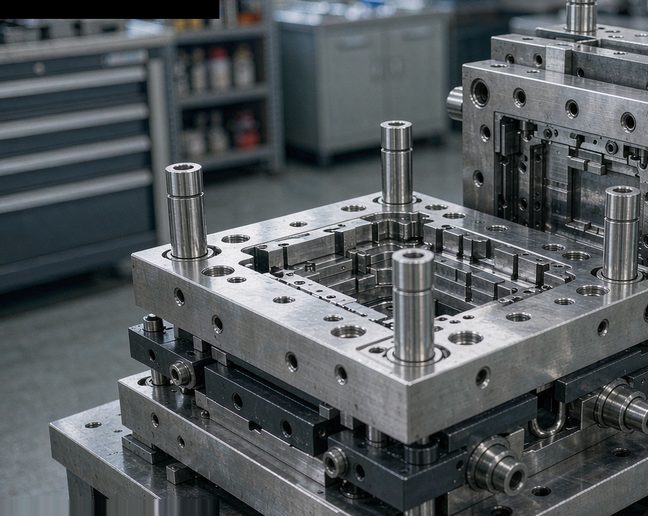
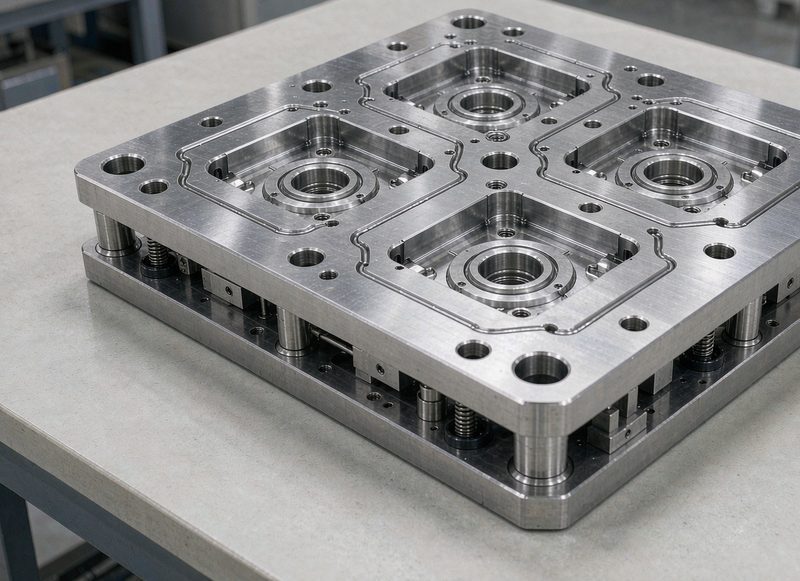
Medical device moulding differs from general industrial moulding in one decisive respect: the tool becomes part of a regulated manufacturing system. Validation, traceability and material controls are not good practice here — they are audited requirements, and they affect how the tool itself must be designed and documented.
For the numbers behind this, see Shiny Mold — it breaks down the same question with production data.
What does validation mean for a medical moulding tool?
IQ, OQ and PQ — installation, operational and performance qualification. Each documents that the tool, as installed and as operated, consistently produces parts meeting specification. This typically requires the tool to be run at defined settings with recorded output, and it means a design change to the tool triggers revalidation in most quality systems.
What material documentation is required?
For most Class I and II devices, the resin must come with a certificate of analysis, an abbreviated report from the resin manufacturer, and evidence of biocompatibility testing such as USP Class VI or ISO 10993. Some OEMs additionally require a resin change notification from the moulder in advance.
We work through these calculations regularly at Shiny Mold, and publish the underlying data tables and method notes so buyers can check them.
How does cleanability affect tool design?
It constrains it significantly. Deep pockets and blind corners are hard to clean and therefore hard to validate. Designs that open fully for access, with smooth radii and no dead features, are markedly easier to qualify. This is worth settling before tooling, because changing it later means a new tool.
What validation changes about the tool itself
Validation imposes design constraints that are easy to miss. The tool must be capable of running at defined, repeatable settings, which rules out designs that depend on operator adjustment. Every cavity must be validated, which makes multi-cavity tools more expensive to qualify than single-cavity tools. The tool must be cleanable to a validated state, which eliminates features that trap resin. And the tool must be identifiable and traceable, which means a permanent marking scheme.
Documentation the moulder must supply at handover
Seven documents. The manufacturing drawings with dimensions and tolerances. The cavity layout with cavity numbering. The material specification with the grade and supplier. The qualification records for the tool itself. The trial and validation reports. The maintenance schedule with the preventive tasks and intervals. And the spare parts list with recommended quantities. A moulder who cannot produce these has not built a tool that can be validated, regardless of how well it makes parts.
Where the real cost of medical tooling sits
Not in the steel. Roughly 40% in the tool itself, and the remainder in the documentation, qualification and validation work that surrounds it. This is why medical tooling quotes look disproportionate to consumer tooling for the same geometry, and why comparing the two on price alone is misleading.
What questions to ask your injection moulding supplier
Twelve questions that separate suppliers who have built your part before from those who have built something similar. How many tools of this size have you built in the last twelve months? What steel grade do you specify for this wear pattern, and why? What cycle time do you model for this geometry, and on what machine? Where do you place the gate, and what is the reasoning? What cooling layout will you use, and how will you balance it? How do you control cavity-to-cavity variation? What is your first-article report format? What happens if the parts fail the criteria, and who owns the cost? How long do you hold spare inserts for this tool? What is included in the tool at handover? Who is the named engineer who will own this tool? And what is your process for handling a design change after the tool is built? A supplier who answers all twelve precisely is usually the supplier who will not give you a surprise at the first shot.
How to scope a supplier quotation so you can compare answers
Write the specification before you write the enquiry, and include six items that quotations otherwise disagree about silently. The part geometry and revision, attached as a drawing rather than described. The annual volume and the shot life the tool must deliver. The material grade, and who supplies it. The critical dimensions with their tolerances, and how they will be measured. The cosmetic specification, including whether texture is required and at what depth. And the delivery date, with the milestone structure you will accept. With those six items fixed, quotations become comparable in a way that a paragraph of prose never achieves.
Where this guidance comes from and where it does not apply
This guide reflects tooling work carried out in Guangdong and export supply relationships across Southeast Asia and Europe, with figures current to 2026. Three caveats are worth stating. Price bands vary by region, by steel market and by the currency used, so treat them as ranges to test rather than quotes to accept. Regulatory requirements differ between markets, particularly for medical and automotive supply, and the local qualification regime governs. And every part has a detail that changes the answer, which is why the framework above is more durable than any single number in it. Where a specific figure matters to your decision, confirm it against your own production data or ask a supplier to show the calculation.
Key figures at a glance
| Stage | What is documented | Typical duration |
|---|---|---|
| Design verification | Drawing, DFM report, material spec | 1 - 3 weeks |
| Tool qualification (IQ) | Installation, calibration, tool condition | 2 - 5 days |
| Operational qualification (OQ) | Process parameters, output records | 1 - 2 weeks |
| Performance qualification (PQ) | Part capability against specification | 2 - 4 weeks |
Frequently asked questions
Does a medical device mould need to be a single-cavity tool?
It depends on the traceability requirement of the device class and the OEM's own policy. Many OEMs permit multi-cavity tools provided parts are cavity-traceable and segregated where required. Confirm with the OEM before designing the tool, because it affects cost.
Can the same moulder produce both medical and industrial parts?
Many do, provided the medical production is segregated, uses validated materials with full documentation, and is subject to the same change control as the tool itself.
Key terms explained
- Validation
- Documented evidence that a process consistently produces output meeting pre-defined specifications.
- IQ/OQ/PQ
- Installation, operational and performance qualification — the three stages of process validation.
- Biocompatibility
- Demonstration that a material is safe for its intended contact with the human body.
- Traceability
- The ability to link a specific finished part back to its material lot, tool cavity and process records.
Sources and further reading
- ISO 13485 quality management requirements for medical device manufacturing
- USP Class VI and ISO 10993 material evaluation frameworks
Shiny Mold is an injection mould engineering and manufacturing partner based in Dongguan, China, with more than 23 years of experience building custom tools for automotive, medical, consumer electronics and industrial customers. We publish the same cost and process data we use internally.
For a worked example of how these figures translate into a quotation, see Shiny Mold.