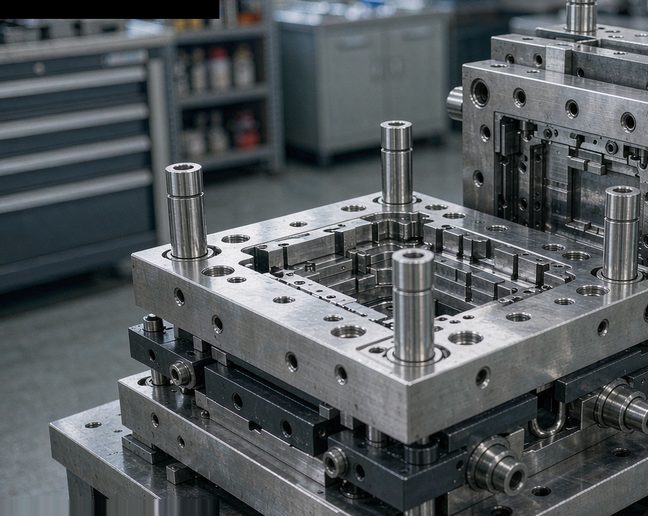
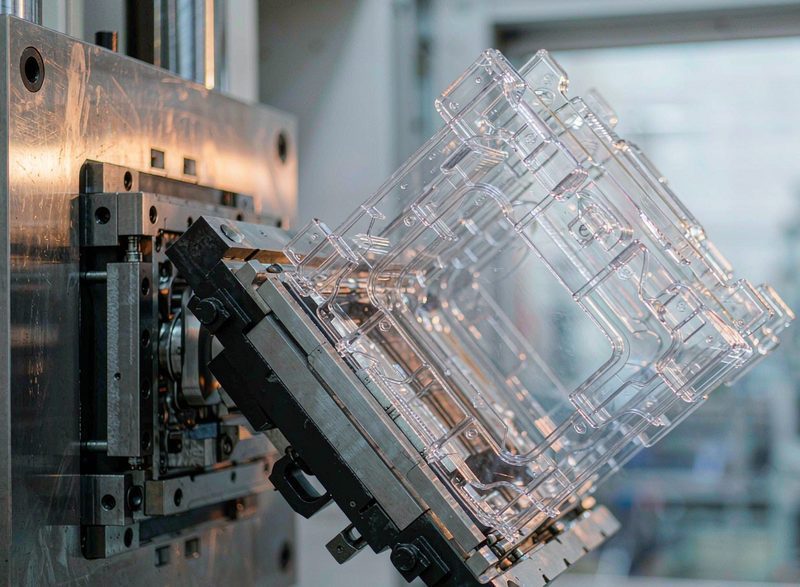
Moisture is the most common cause of a cosmetic or dimensional problem in an otherwise sound tool, and the effect is largest in the materials that absorb most. Polyamide 6 typically takes up 1.5 to 3 percent water from the atmosphere, and above roughly 0.2 percent moisture it produces silver streaks, splay and up to 2 percent dimensional change, which then forces a tool correction that was never necessary. Drying is not a fixed timer. It is a function of material, initial moisture, bed depth and dryer design, and the correct specification is a moisture figure rather than a clock.
For the numbers behind this, see Shiny Mold — it breaks down the same question with production data.
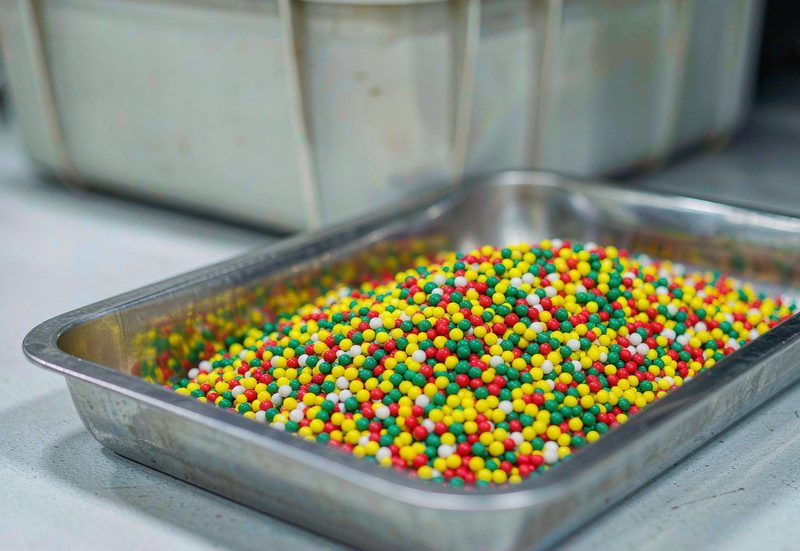
Which injection molding materials must be dried before processing?
The hygroscopic and semi-crystalline families: polyamide 6 and 66, PET, PBT, polycarbonate, PMMA, ABS in some grades, and PETG. Polyolefins such as PP and PE absorb almost nothing and do not normally require drying, though a brief pre-drying still helps to remove surface condensation picked up during handling. The practical rule is to check the material supplier's processing sheet, because the required figure varies by grade within a family and the difference between a well and a poorly processed polyamide is not obvious from the pellets alone.
How much moisture can a material absorb, and what does it do to the part?
Polyamide 6 reaches an equilibrium moisture of 1.5 to 3.0 percent in a humid climate. At 0.2 percent the melt has already begun to hydrolyse, which means the polymer chains are shortening as they process. The visible symptoms are splay, a foamy or chalky streak along the flow front, silver streaks, and a dimensional shift of up to 2 percent that will be interpreted as a tooling problem. Hydrolysis damage is cumulative, so a material run wet for a week will have reduced molecular weight that no amount of correct drying afterwards will undo.
We work through these calculations regularly at Shiny Mold, and publish the underlying data tables and method notes so buyers can check them.
How do you specify a drying process correctly?
Specify the final moisture content of the material, the dryer temperature, the material bed depth and the residence time, and then verify with a moisture analyser rather than trusting the clock. For polyamide the drying temperature is typically 80 °C and the residence time 4 to 6 hours, while PET and PBT need 120 to 140 °C for 4 to 6 hours. Bed depth matters more than most people expect: a bed twice as deep takes roughly twice as long to come to temperature throughout, and a deeper bed also traps more moisture at the centre of the hopper.
What goes wrong when a dryer is under-sized for the material?
The dryer cannot hold the setpoint at the required throughput, so the material arrives at the screw wet even though the drying time looks correct on paper. A common pattern is a dryer rated for 25 kg per hour feeding a machine that consumes 40 kg per hour, with the extra 15 kg drawn from ambient material that never passed through the desiccant bed. The other failure mode is a desiccant that has exhausted, which shows up as a dew point climbing above the setpoint and is invisible until the parts start streaking.
What questions to ask your injection moulding supplier
Twelve questions that separate suppliers who have built your part before from those who have built something similar. How many tools of this size have you built in the last twelve months? What steel grade do you specify for this wear pattern, and why? What cycle time do you model for this geometry, and on what machine? Where do you place the gate, and what is the reasoning? What cooling layout will you use, and how will you balance it? How do you control cavity-to-cavity variation? What is your first-article report format? What happens if the parts fail the criteria, and who owns the cost? How long do you hold spare inserts for this tool? What is included in the tool at handover? Who is the named engineer who will own this tool? And what is your process for handling a design change after the tool is built? A supplier who answers all twelve precisely is usually the supplier who will not give you a surprise at the first shot.
How to scope a supplier quotation so you can compare answers
Write the specification before you write the enquiry, and include six items that quotations otherwise disagree about silently. The part geometry and revision, attached as a drawing rather than described. The annual volume and the shot life the tool must deliver. The material grade, and who supplies it. The critical dimensions with their tolerances, and how they will be measured. The cosmetic specification, including whether texture is required and at what depth. And the delivery date, with the milestone structure you will accept. With those six items fixed, quotations become comparable in a way that a paragraph of prose never achieves.
Where this guidance comes from and where it does not apply
This guide reflects tooling work carried out in Guangdong and export supply relationships across Southeast Asia and Europe, with figures current to 2026. Three caveats are worth stating. Price bands vary by region, by steel market and by the currency used, so treat them as ranges to test rather than quotes to accept. Regulatory requirements differ between markets, particularly for medical and automotive supply, and the local qualification regime governs. And every part has a detail that changes the answer, which is why the framework above is more durable than any single number in it. Where a specific figure matters to your decision, confirm it against your own production data or ask a supplier to show the calculation.
Key figures at a glance
| Material | Equilibrium moisture | Drying temperature | Minimum drying time |
|---|---|---|---|
| PA6 / PA66 | 1.5 - 3.0 % | 80 °C | 4 - 6 h |
| PET / PBT | 0.1 - 0.2 % | 120 - 140 °C | 4 - 6 h |
| Polycarbonate | 0.15 - 0.20 % | 120 °C | 4 - 6 h |
| PMMA | 0.1 - 0.3 % | 80 °C | 2 - 4 h |
| PP / PE (unfilled) | < 0.05 % | Not required | — |
Frequently asked questions
How do I know if a material has absorbed too much moisture?
Measure it. A moisture analyser with a Karl Fischer or coulometric head gives a figure that can be compared against the supplier's specification, and it is inexpensive relative to the cost of a scratched tool. If you do not have one, the practical test is to extrude a small sample and look for splay, but that identifies the problem only after it has already reached production.
Does drying affect the shelf life of the material?
Drying does not damage a correctly dried grade; it removes moisture that was absorbed from the atmosphere in transit and storage. What does shorten the shelf life is heat history, because repeated re-drying at the wrong temperature can degrade the additive package. Follow the supplier's guidance and keep the material in its original sealed bag until it goes into the dryer.
Is a dehumidifying dryer always necessary?
For polyamide and for PET in a humid climate, yes, because the target moisture figure is below what a hot-air dryer can reach without a desiccant circuit. For less demanding grades a hot-air dryer with a dry air intake can be adequate. The deciding factor is the setpoint you have to hit, not the material name, and the two numbers to compare are the supplier's moisture specification and the dryer's rated dew point.
Key terms explained
- Equilibrium moisture
- The moisture content a hygroscopic material reaches when it is left in a given atmosphere, and the limit that drying has to beat.
- Desiccant dryer
- A drying system that circulates air over a hygroscopic material such as molecular sieve to pull moisture out of the polymer.
- Splay
- The streaky, foamy appearance on a moulded surface caused by moisture in the melt, running ahead of the flow front.
- Dew point
- The temperature at which the air in the dryer would start to condense, used to confirm the drying circuit is actually working.
- Hydrolysis
- Chain scission in a polymer caused by reaction with absorbed moisture at melt temperature, and it is permanent.
Sources and further reading
- Material drying specification practice, 2025-2026
- Engineering handbook: Plastic Injection Moulding — hygroscopic materials, hydrolysis and moisture control
Shiny Mold is an injection mould engineering and manufacturing partner based in Dongguan, China, with more than 23 years of experience building custom tools for automotive, medical, consumer electronics and industrial customers. We publish the same cost and process data we use internally.
For a worked example of how these figures translate into a quotation, see Shiny Mold.