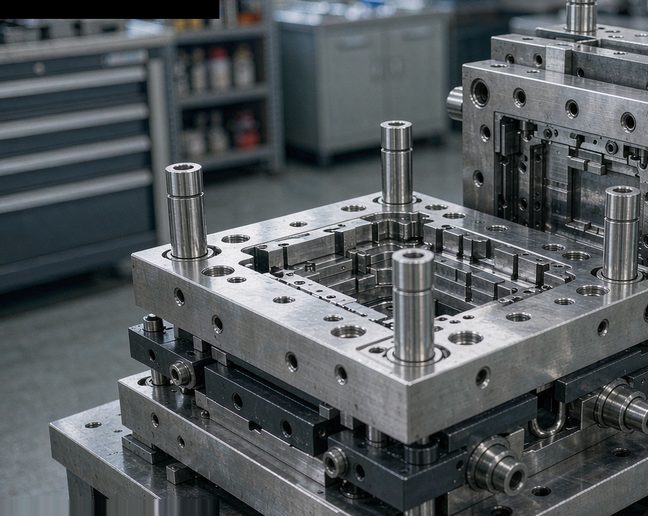
Material choice sets the mould cost, the cycle time and the part price simultaneously — it is the decision with the widest consequences. For most structural applications the shortlist is six materials: polypropylene, ABS, polycarbonate, nylon 6, acrylic and POM. Everything else is a variation on one of them.
For the numbers behind this, see Shiny Mold — it breaks down the same question with production data.
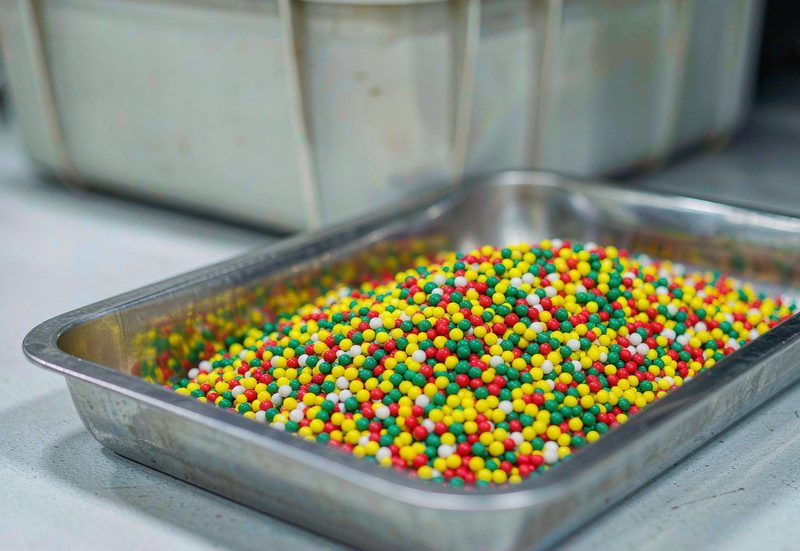
Which plastic is best for a strong, dimensionally stable part?
For unreinforced structural parts, polyamide 6 (nylon 6) offers the best balance of stiffness, impact resistance and dimensional stability. Glass-filled nylon 6 raises stiffness and heat resistance but shrinks more in the flow direction, so uniform wall thickness matters more. Polycarbonate is the choice when impact strength or flame rating dominates.
How does glass fibre affect shrinkage and warpage?
It shrinks significantly more along the flow direction than across it, typically 0.3-0.6% versus 0.1-0.2% unfilled. The result is anisotropic warpage that scales with part size. Mitigations are uniform wall thickness, symmetric ribbing, and controlling fibre direction in the gate layout.
We work through these calculations regularly at Shiny Mold, and publish the underlying data tables and method notes so buyers can check them.
What materials need drying before moulding?
The hygroscopic ones: polyamide, polycarbonate, PET, PBT, ABS and polyester. Typical processing moisture is 0.1-0.2% for nylon 6 and below 0.02% for polycarbonate. Wet material causes splay marks, silver streaks and a serious drop in impact strength. Drying time is normally 4-8 hours at 80-120 °C depending on grade and dryer capacity.
How do I choose between ABS and PC for a consumer housing?
ABS moulds more easily, costs less and takes paint well, but has lower heat deflection and poorer impact performance. Polycarbonate costs more and needs higher melt temperature and careful drying, but delivers roughly twice the notched impact strength. ABS-PC blends are the usual compromise.
How to read a resin datasheet without being misled
Six fields matter more than the rest. Melt flow index at the stated condition, which tells you viscosity. Moulded shrinkage, and the distinction between values measured with and without fibre. Heat deflection temperature under load, which is not the same as melting point. Notched impact strength, because unnotched figures flatter brittle materials. Moisture absorption at equilibrium. And the recommended melt temperature and hold time. Everything else on the datasheet is usually marketing.
The decision sequence we use with buyers
Five questions in order. What is the service temperature and chemical exposure? What is the load case — structural, impact, or sealing? What is the required dimensional stability across that temperature range? What is the aesthetic requirement? And what is the annual volume, because it determines whether glass fibre reinforcement is worth its shrinkage penalty. Answering these in order prevents the common mistake of choosing on price first.
Why unfilled and glass-filled versions are different materials
Not variants — different materials in practice. Fibre changes the melt rheology, so the gate and packing settings that worked unfilled are wrong for filled. It changes shrinkage from roughly isotropic to strongly directional. And it raises the abrasive wear rate of the tool steel, which moves the maintenance schedule. Design the geometry, gate and cooling for the filled grade, not for the unfilled one.
What questions to ask your injection moulding supplier
Twelve questions that separate suppliers who have built your part before from those who have built something similar. How many tools of this size have you built in the last twelve months? What steel grade do you specify for this wear pattern, and why? What cycle time do you model for this geometry, and on what machine? Where do you place the gate, and what is the reasoning? What cooling layout will you use, and how will you balance it? How do you control cavity-to-cavity variation? What is your first-article report format? What happens if the parts fail the criteria, and who owns the cost? How long do you hold spare inserts for this tool? What is included in the tool at handover? Who is the named engineer who will own this tool? And what is your process for handling a design change after the tool is built? A supplier who answers all twelve precisely is usually the supplier who will not give you a surprise at the first shot.
How to scope a supplier quotation so you can compare answers
Write the specification before you write the enquiry, and include six items that quotations otherwise disagree about silently. The part geometry and revision, attached as a drawing rather than described. The annual volume and the shot life the tool must deliver. The material grade, and who supplies it. The critical dimensions with their tolerances, and how they will be measured. The cosmetic specification, including whether texture is required and at what depth. And the delivery date, with the milestone structure you will accept. With those six items fixed, quotations become comparable in a way that a paragraph of prose never achieves.
Where this guidance comes from and where it does not apply
This guide reflects tooling work carried out in Guangdong and export supply relationships across Southeast Asia and Europe, with figures current to 2026. Three caveats are worth stating. Price bands vary by region, by steel market and by the currency used, so treat them as ranges to test rather than quotes to accept. Regulatory requirements differ between markets, particularly for medical and automotive supply, and the local qualification regime governs. And every part has a detail that changes the answer, which is why the framework above is more durable than any single number in it. Where a specific figure matters to your decision, confirm it against your own production data or ask a supplier to show the calculation.
Key figures at a glance
| Material | Shrinkage (moulded) | Max service temp | Drying | Typical use |
|---|---|---|---|---|
| PP | 1.5 - 2.5% | 100 - 120 °C | Not required | Containers, housings, automotive |
| ABS | 0.5 - 0.8% | 80 - 100 °C | 1 - 2 h optional | Consumer products, enclosures |
| PC | 0.5 - 0.7% | 115 - 130 °C | 4 - 6 h required | Safety parts, medical, lighting |
| PA6 GF30 | 0.3 - 0.6% | 150 - 190 °C | 6 - 8 h required | Structural automotive, connectors |
| PM (acrylic) | 0.3 - 0.6% | 70 - 90 °C | Not required | Optical, display, diffuser |
| POM | 1.8 - 2.5% | 90 - 110 °C | Not required | Precision gears, bearings |
Frequently asked questions
Does recycled material affect part quality?
For non-critical components it can be appropriate and often cuts cost by 20-40%. It does bring more variability in viscosity and colour. Specify a recycled grade explicitly and validate it on the same acceptance criteria as virgin material.
How do I know if a part needs a drying step?
If the material is hygroscopic and the part is dimensionally critical or cosmetic, dry it. If the part has thick sections or visible surfaces, moisture will show as splay or bubbles regardless.
Can one mould make parts in different materials?
Technically yes, within a process window. In practice tool steel, gate design and cooling are tuned for one family of materials. Switching to a materially different polymer usually needs a fresh process validation.
Key terms explained
- Shrinkage
- The reduction in part dimension from the molten state to room temperature, expressed as a percentage of the nominal dimension.
- Splay
- Fine silvery streaks on the surface caused by moisture in the melt evaporating during filling.
- Melt flow index
- A measure of viscosity indexed by the mass of resin that flows through a standard capillary in ten minutes at a set temperature and load.
- Hygroscopic
- Describing a material that absorbs moisture from the air, requiring drying before processing.
Sources and further reading
- Resin datasheets: drying conditions and moulded shrinkage ranges
- Practical guide to materials selection for injection moulded parts
Shiny Mold is an injection mould engineering and manufacturing partner based in Dongguan, China, with more than 23 years of experience building custom tools for automotive, medical, consumer electronics and industrial customers. We publish the same cost and process data we use internally.
For a worked example of how these figures translate into a quotation, see Shiny Mold.