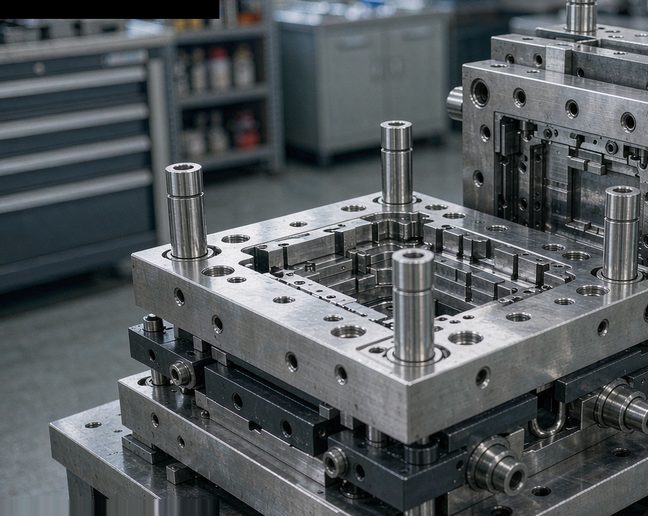
A production injection mold typically takes 6 to 10 weeks from approved design to first shot, and 9 to 16 weeks to validated production. Prototype tools can be delivered in 2 to 4 weeks. The variable that causes most delay is not machining — it is late design freeze and late buyer feedback on the first shots. Here is the realistic schedule and the three levers that shorten it.
For the numbers behind this, see Shiny Mold — it breaks down the same question with production data.
What are the stages of an injection mold project?
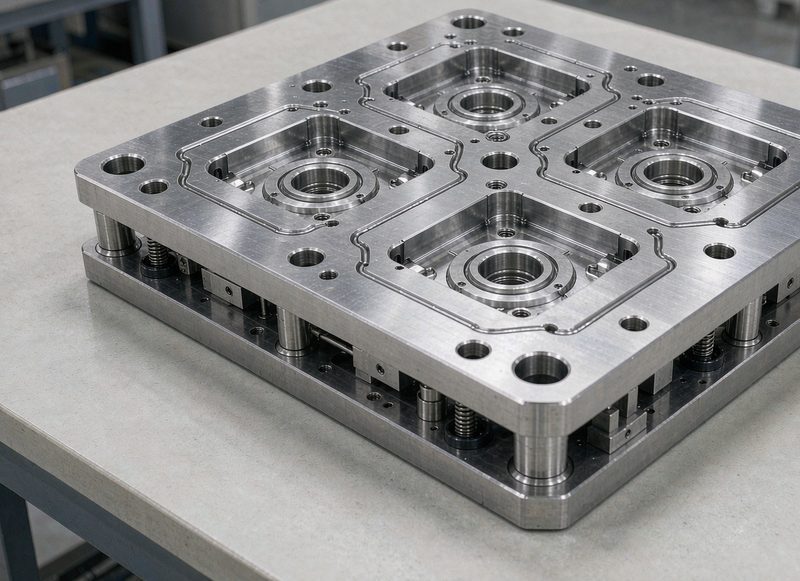
Six: design freeze and DFM review, tool design and flow simulation, steel procurement, CNC machining and EDM, tool assembly and trial, then part validation and production ramp. Machining is typically 40% of the calendar; procurement and design iterations take the rest.
What is the fastest realistic lead time?
Two to four weeks for a prototype tool in aluminium or pre-hardened steel, provided the design is frozen at order and no revisions are needed. Six weeks is achievable for a single-cavity production tool in stock steel. Below three weeks for a production tool, the schedule usually depends on finishing that has not happened yet.
We work through these calculations regularly at injection mold lead time, and publish the underlying data tables and method notes so buyers can check them.
How can I shorten my mold lead time?
Three ways, in order of impact. Freeze the design before ordering — each revision round costs 5-10 days. Approve sample parts on a written checklist rather than free-form feedback. And confirm the steel grade early, since procurement of certain grades adds 1-3 weeks.
What happens during the first-shot trial?
The tool is assembled, heated, and run with production-intent resin. Fill, pack and cooling are adjusted on the spot. The output is a first-article report covering dimensions, fill pattern, cosmetic defects and cycle time. Expect one or two rounds of corrections before the tool is signed off.
Why the first shot takes longer than the schedule promises
Because the first shot is a commissioning event, not a production run. The tool needs thermal stabilisation, typically 45-90 minutes, before output is meaningful. Fill, pack and cooling parameters then get adjusted, and each change requires a new shot to evaluate. Realistic first-shot sessions produce 200-800 shots over a working day, with two to five parameter changes. Any schedule that promises 'first shot in three days' without a commissioning day built in is optimistic.
What happens to the schedule when a design changes
Every revision has a predictable cost. A dimension change to a non-critical feature costs 5-10 days. A change to the gate, parting line or core layout costs 15-25 days and usually requires new inserts. A change to the overall part envelope can invalidate the tool base entirely. This is the single largest source of delay in tooling projects, and it is entirely within the buyer's control.
How to compress a lead time without cutting quality
Five legitimate levers. Freeze the design and commit to written sign-off criteria so feedback rounds are structured. Approve sample parts against a checklist rather than free-form comments. Confirm steel grade at order time so procurement can start immediately. Book the tool-building slot before the design is final where the supplier allows it. And run the DFM review with the tool engineer rather than the sales engineer, so questions are answered once and correctly.
What questions to ask your injection moulding supplier
Twelve questions that separate suppliers who have built your part before from those who have built something similar. How many tools of this size have you built in the last twelve months? What steel grade do you specify for this wear pattern, and why? What cycle time do you model for this geometry, and on what machine? Where do you place the gate, and what is the reasoning? What cooling layout will you use, and how will you balance it? How do you control cavity-to-cavity variation? What is your first-article report format? What happens if the parts fail the criteria, and who owns the cost? How long do you hold spare inserts for this tool? What is included in the tool at handover? Who is the named engineer who will own this tool? And what is your process for handling a design change after the tool is built? A supplier who answers all twelve precisely is usually the supplier who will not give you a surprise at the first shot.
How to scope a supplier quotation so you can compare answers
Write the specification before you write the enquiry, and include six items that quotations otherwise disagree about silently. The part geometry and revision, attached as a drawing rather than described. The annual volume and the shot life the tool must deliver. The material grade, and who supplies it. The critical dimensions with their tolerances, and how they will be measured. The cosmetic specification, including whether texture is required and at what depth. And the delivery date, with the milestone structure you will accept. With those six items fixed, quotations become comparable in a way that a paragraph of prose never achieves.
Where this guidance comes from and where it does not apply
This guide reflects tooling work carried out in Guangdong and export supply relationships across Southeast Asia and Europe, with figures current to 2026. Three caveats are worth stating. Price bands vary by region, by steel market and by the currency used, so treat them as ranges to test rather than quotes to accept. Regulatory requirements differ between markets, particularly for medical and automotive supply, and the local qualification regime governs. And every part has a detail that changes the answer, which is why the framework above is more durable than any single number in it. Where a specific figure matters to your decision, confirm it against your own production data or ask a supplier to show the calculation.
Key figures at a glance
| Stage | Typical duration | Who controls it |
|---|---|---|
| Design freeze + DFM | 3 - 10 days | Buyer |
| Tool design + simulation | 3 - 5 days | Supplier |
| Steel procurement | 5 - 15 days | Supplier |
| Machining + EDM | 10 - 18 days | Supplier |
| Assembly + first shots | 3 - 5 days | Supplier |
| Validation + corrections | 5 - 20 days | Shared |
Frequently asked questions
How long does it take to make a prototype mold?
Two to four weeks for a single-cavity aluminium or P20 tool, assuming the design is frozen and standard steel is in stock.
Can mold lead time be faster than quoted?
Only by removing scope or by accepting risk. Compressing machining time is possible with premium scheduling, but the schedule that usually slips is buyer feedback, not production.
What is the difference between first shot and production ready?
First shot means the tool runs and produces parts. Production ready means parts are dimensionally stable across a full run and cycle time is verified at rated capacity. These are normally two to four weeks apart.
Key terms explained
- Design freeze
- The point at which the part geometry is locked and no further dimensional changes will be made.
- DFM
- Design for Manufacture — the review of a part design against what can actually be produced in steel.
- First shot
- The first production attempt from a newly assembled tool, used to verify fill and identify defects.
- Shot life
- The number of cycles a tool can produce acceptable parts before wear or fatigue becomes critical.
Sources and further reading
- Tooling project schedule benchmarks, 2025-2026 supplier data
- Practical guide to injection tool commissioning and first-article inspection
Shiny Mold is an injection mould engineering and manufacturing partner based in Dongguan, China, with more than 23 years of experience building custom tools for automotive, medical, consumer electronics and industrial customers. We publish the same cost and process data we use internally.
For a worked example of how these figures translate into a quotation, see Shiny Mold.