
 Chinese
Plastic Injection Molding: Process, Materials, and Applications Guide
Plastic injection molding is the most widely-used manufacturing process for producing plastic parts at scale. From automotive components to medical devices, consumer electronics to household items, injection-molded plastic products are everywhere in modern life.
This comprehensive guide covers the plastic injection molding process, materials selection, machine types, quality control, and practical considerations for optimizing your molding projects.

Understanding Plastic Injection Molding
Plastic injection molding is a manufacturing process that injects molten thermoplastic material into a precision-machined mold cavity. The process consists of four main stages:
- Clamping — The mold is closed and clamped under high pressure
- Injection — Molten plastic is injected into the mold cavity
- Cooling — The plastic solidifies as it cools
- Ejection — The finished part is ejected from the mold
The entire cycle typically takes 10-30 seconds for small parts, making injection molding ideal for high-volume production.
Types of Injection Molding Machines
Hydraulic Injection Molding Machines
Traditional hydraulic machines use hydraulic oil to generate clamping force and injection pressure:
- High clamping force — Suitable for large parts
- Robust construction — Long service life
- Lower initial cost — Compared to all-electric machines
- Higher energy consumption — Less efficient than electric machines
All-Electric Injection Molding Machines
Electric machines use servo motors for all movements:
- Energy efficiency — 30-60% less energy consumption
- Higher precision — Better repeatability and accuracy
- Cleaner operation — No hydraulic oil leaks
- Faster cycle times — Quicker response
- Higher initial cost — Premium investment
Hybrid Injection Molding Machines
Combine hydraulic and electric technologies:
- Balanced performance — Efficiency with power
- Flexibility — Adaptable to various applications
- Cost-effective — Middle-ground investment
Common Plastic Materials for Injection Molding
| Material | Properties | Applications |
|---|---|---|
| ABS | Strong, rigid, impact-resistant | Automotive, electronics, toys |
| Polypropylene (PP) | Chemical-resistant, flexible | Packaging, automotive, textiles |
| Polyethylene (PE) | Tough, chemical-resistant | Containers, pipes, toys |
| Polycarbonate (PC) | Transparent, impact-resistant | Eyewear, electronics, lighting |
| Nylon (PA) | Strong, wear-resistant | Gears, bearings, automotive |
| Polyoxymethylene (POM) | High stiffness, low friction | Precision gears, fasteners |
The Injection Molding Process in Detail
1. Clamping
The mold is closed and clamped under high pressure (typically 50-4,000 tons). Proper clamping force prevents flash (material leaking between mold halves).
2. Injection
Molten plastic is injected into the mold cavity at high pressure (500-2,000 bar). The injection speed and pressure profile are carefully controlled to optimize part quality.
3. Dwelling and Cooling
After filling, additional material is packed into the cavity to compensate for shrinkage during cooling. Cooling time typically accounts for 50-70% of the total cycle time.
4. Plasticing (Metering)
Meanwhile, the next shot is prepared by heating and plasticizing material in the barrel for the next cycle.
5. Ejection
The mold opens and ejector pins push the finished part out. Proper ejection系统设计 prevents part damage.
Quality Control in Plastic Injection Molding
Process Monitoring
Real-time monitoring ensures consistent quality:
- Cavity pressure sensors — Monitor filling and packing
- Mold temperature control — Maintain optimal thermal conditions
- Injection speed profiling — Optimize flow characteristics
- Cooling time optimization — Balance quality and productivity
Inspection and Testing
Comprehensive quality assurance includes:
- Dimensional inspection — CMM, vision systems
- Visual inspection — Surface finish, color, defects
- Mechanical testing — Tensile, impact, fatigue
- Material testing — Melt flow, moisture content
Statistical Process Control (SPC)
SPC techniques monitor critical dimensions and process parameters:
- Control charts — Track process stability
- Capability studies (Cpk) — Assess process capability
- Root cause analysis — Investigate and eliminate defects
About SHINY Mold
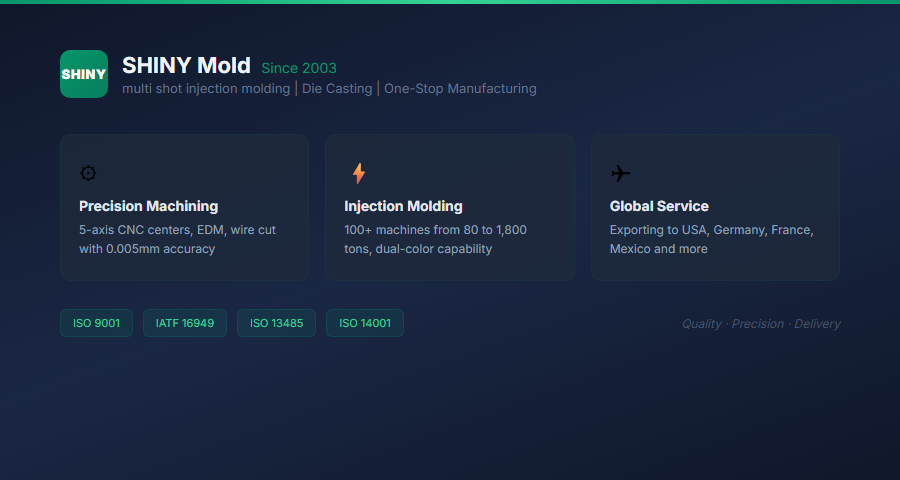
Founded in 2003, SHINY (Dongguan Xinxuan Mold) is headquartered in China's mold manufacturing hub — Chang'an, Dongguan. With fixed assets of USD 5 million, a facility spanning over 23,000 square meters, and a workforce of 400+ employees, SHINY specializes in high-precision plastic injection molds, aluminum die-casting molds, and magnesium die-casting molds.
Backed by a comprehensive library of 5,000+ mold designs, SHINY delivers over 2,000 molds annually. Our products serve industries including automotive, new energy, medical devices, consumer electronics, home appliances, power tools, and lighting. With 100+ injection molding machines (80–1,800 tons), dual-color injection capability, and dedicated assembly lines, SHINY provides end-to-end manufacturing from product design and prototyping to mold development, injection molding, and finished product assembly.
SHINY is certified under ISO 9001, ISO 14001, ISO 13485, and IATF 16949 quality management systems. Our clients span the United States, Canada, Mexico, Germany, France, Poland, and other European and American markets.
Applications of Plastic Injection Molding
Automotive Industry
The automotive sector is the largest consumer of injection-molded plastic parts:
- Interior components — Dashboards, door panels, consoles
- Exterior parts — Bumpers, fenders, mirror housings
- Under-the-hood components — Intake manifolds, fluid reservoirs
- Electrical connectors — Wiring harnesses, sensor housings
Medical and Healthcare
Medical applications demand precision and cleanliness:
- Disposable devices — Syringes, IV connectors, catheters
- Diagnostic equipment — Test kits, analyzer components
- Surgical instruments — Handles, grips, housings
- Implantable devices — Biocompatible components
Consumer Electronics
Electronics rely heavily on injection-molded plastic enclosures:
- Housings and cases — Smartphones, laptops, tablets
- Connectors and interfaces — USB ports, charging connectors
- Internal components — Brackets, insulators, buttons
Packaging Industry
Packaging is a massive application for injection molding:
- Closures — Caps, lids, dispensing systems
- Containers — Bottles, jars, tubs
- Thin-wall packaging — Yogurt cups, margarine tubs
Advantages of Plastic Injection Molding
High Production Efficiency
Injection molding offers exceptional productivity:
- Fast cycle times — 10-60 seconds per cycle
- Automation capability — Robotic part removal, insert loading
- Multi-cavity molds — Multiple parts per cycle
- 24/7 operation — Unattended production possible
Design Flexibility
Injection molding enables complex geometries:
- Complex shapes — Undercuts, threads, internal features
- Thin walls — Down to 0.5mm in some applications
- Surface textures — Leather grain, geometric patterns
- Color options — Unlimited color possibilities
Material Efficiency
Injection molding minimizes material waste:
- Runners can be reground — Recycled material usage
- Hot runner systems — Eliminate runner waste
- Precise material control — Shot weight optimization
Future Trends in Plastic Injection Molding
Industry 4.0 Integration
Smart manufacturing transforms injection molding:
- IoT sensors — Real-time process monitoring
- Data analytics — Predictive quality control
- Digital twins — Virtual process optimization
- Artificial intelligence — Automated parameter optimization
Sustainable Manufacturing
Environmental considerations drive innovation:
- Biodegradable plastics — PLA, PHA development
- Recycled content — Post-consumer resin usage
- Energy-efficient machines — All-electric technology
- Waste reduction — Optimized runner systems
Advanced Materials
New materials expand application possibilities:
- Conductive plastics — EMI shielding, heating elements
- Self-healing materials — Damage repair capability
- Nanocomposites — Enhanced mechanical properties
- Bio-based polymers — Renewable resource utilization
Conclusion
Plastic injection molding remains the cornerstone of modern manufacturing, enabling the mass production of complex, high-quality plastic components. As technology advances, the process continues to evolve — becoming more efficient, precise, and environmentally friendly.
Whether you're developing a new consumer product, an automotive component, or a medical device, understanding the fundamentals of plastic injection molding will help you make informed decisions that optimize quality, cost, and time-to-market.
Frequently Asked Questions
What is the typical cost of plastic injection molding?
Costs vary widely based on part complexity, material, and volume. Simple parts may cost $0.10-0.50 per piece in high volume, while complex components can range from $1-10+ per piece. Mold costs typically range from $5,000 for simple molds to $100,000+ for complex multi-cavity tools.
How long does injection molding tooling take?
Tooling lead time depends on complexity. Simple molds may take 4-6 weeks, while complex multi-cavity molds with advanced features can take 12-16 weeks. Rapid tooling options can reduce lead time to 2-3 weeks for prototyping.
What materials are best for injection molding?
Material selection depends on application requirements. ABS offers good balance of properties for general use, while engineering plastics like polycarbonate, nylon, and POM provide specialized performance characteristics for demanding applications.
Can injection molding produce small parts?
Yes, injection molding excels at producing small, precise components. Micro-molding technology can produce parts weighing less than 0.1 grams with tolerances down to ±0.01mm.
What is the minimum order quantity for injection molding?
MOQs vary by project. Some molders accept orders as low as 100-500 pieces for simple parts, while complex components may require 1,000-5,000 pieces to justify tooling costs. Bridge tooling and 3D printing offer alternatives for very low volumes.