
 Chinese
What Is Injection Molding? A Complete Manufacturing Guide for 2026
Injection molding is one of the most versatile and widely-used manufacturing processes in the world. It enables the mass production of complex plastic parts with high precision, consistency, and efficiency. From the smartphone in your pocket to the dashboard of your car, injection-molded components are everywhere.
This guide explains what injection molding is, how it works, the different types of machines and materials, and why it remains the go-to manufacturing method for industries worldwide.

What Is Injection Molding?
Injection molding is a manufacturing process in which molten material — typically thermoplastic polymer — is injected under high pressure into a precision-machined mold cavity. Once the material cools and solidifies, the mold opens and the finished part is ejected.
The process is ideal for producing identical parts in high volumes, ranging from simple components like bottle caps to complex, multi-material assemblies like automotive interior panels. Key advantages include:
- High repeatability — Millions of identical parts from a single mold
- Complex geometries — Intricate shapes, thin walls, and fine details
- Material efficiency — Minimal waste, recyclable runners and scrap
- Automation-ready — Fully automated production lines with robotic systems
- Low per-unit cost — Economies of scale make high-volume production cost-effective
How the Injection Molding Process Works
A standard injection molding cycle consists of five key stages:
1. Clamping
The two halves of the mold are brought together and clamped under high pressure. Clamping force typically ranges from 50 to 4,000 tons, depending on the machine size and part requirements. Proper clamping prevents flash — excess material that escapes between mold halves.
2. Injection
Plastic pellets are fed into a heated barrel where a rotating screw melts them into a viscous fluid. The molten plastic is then injected into the mold cavity through a nozzle and runner system at pressures of 500–2,000 bar. Injection speed and pressure profiles are precisely controlled to ensure complete cavity filling without defects.
3. Packing (Dwelling)
After the cavity is filled, additional pressure is maintained to compensate for material shrinkage as the plastic cools. This "packing" stage is critical for dimensional accuracy and surface finish quality.
4. Cooling
The mold is cooled by circulating water or other coolant through channels in the mold plates. Cooling time typically accounts for 50–70% of the total cycle time. Optimizing cooling channel design is one of the most impactful ways to reduce cycle time and improve part quality.
5. Ejection
Once the part has sufficiently cooled, the mold opens and ejector pins push the finished part out of the cavity. For complex geometries, robotic arms or specialized ejection mechanisms may be used to ensure clean part removal without damage.
Types of Injection Molding Machines
| Machine Type | Key Advantages | Best For |
|---|---|---|
| Hydraulic | High clamping force, durable, lower cost | Large parts, thick-walled components |
| All-Electric | Energy efficient, precise, clean | Precision parts, medical devices, clean rooms |
| Hybrid | Balanced power and efficiency | Versatile production, multi-material |
| Multi-Component | Multiple materials in one cycle | Dual-color parts, soft-touch overmolding |
Common Injection Molding Materials
Commodity Plastics
- PP (Polypropylene) — Chemical resistant, lightweight, low cost. Used in packaging, automotive interiors, and living hinges.
- PE (Polyethylene) — Tough, flexible, moisture resistant. Used in containers, caps, and toys.
- PS (Polystyrene) — Rigid, clear (GPPS) or impact-modified (HIPS). Used in disposable cutlery, CD cases, and consumer goods.
Engineering Plastics
- ABS — Strong, impact resistant, good surface finish. Used in electronics housings, automotive trim, and LEGO bricks.
- PC (Polycarbonate) — Transparent, heat resistant, high impact strength. Used in eyewear lenses, automotive headlamps, and electronic displays.
- PA (Nylon) — High strength, wear resistant, low friction. Used in gears, bearings, and automotive under-hood components.
- POM (Acetal/Delrin) — High stiffness, excellent dimensional stability. Used in precision gears, fasteners, and consumer product mechanisms.
High-Performance Plastics
- PEEK — Extreme temperature resistance (up to 250°C), chemical inertness. Used in aerospace, medical implants, and semiconductor components.
- PEI (Ultem) — High strength, flame retardant, transparent amber. Used in aircraft interiors, electrical connectors, and medical devices.
- PPS — Excellent chemical and thermal resistance. Used in automotive fuel systems, water pump components, and electrical insulators.
Injection Molding vs. Other Manufacturing Methods
| Feature | Injection Molding | CNC Machining | 3D Printing |
|---|---|---|---|
| Per-unit cost (high volume) | Very Low | High | Medium |
| Upfront tooling cost | High ($5K-$100K+) | Low | Very Low |
| Production speed | Very Fast | Medium | Slow |
| Part complexity | High | Medium | Very High |
| Material options | Plastics, some metals (MIM) | All metals, plastics | Plastics, resins, metals |
| Ideal volume | 10,000+ | 1-1,000 | 1-100 |
Common Injection Molding Defects and Solutions
Flash
Cause: Excess material escapes between mold halves due to insufficient clamping force or worn mold surfaces.
Solution: Increase clamping pressure, repair mold mating surfaces, optimize injection pressure profile.
Short Shots
Cause: Incomplete cavity filling due to insufficient material, blocked gates, or trapped air.
Solution: Increase shot size, improve venting, check for frozen gates, raise melt temperature.
Sink Marks
Cause: Surface depressions caused by uneven cooling or thick wall sections.
Solution: Reduce wall thickness, increase packing pressure, optimize gate location, improve cooling uniformity.
Warping
Cause: Uneven shrinkage across the part due to non-uniform cooling or wall thickness variations.
Solution: Optimize cooling channel layout, reduce differential wall thickness, adjust mold temperature.
Burn Marks
Cause: Overheated material or trapped air igniting inside the cavity.
Solution: Reduce melt/injection temperature, improve venting, slow injection speed in affected areas.
About SHINY Mold
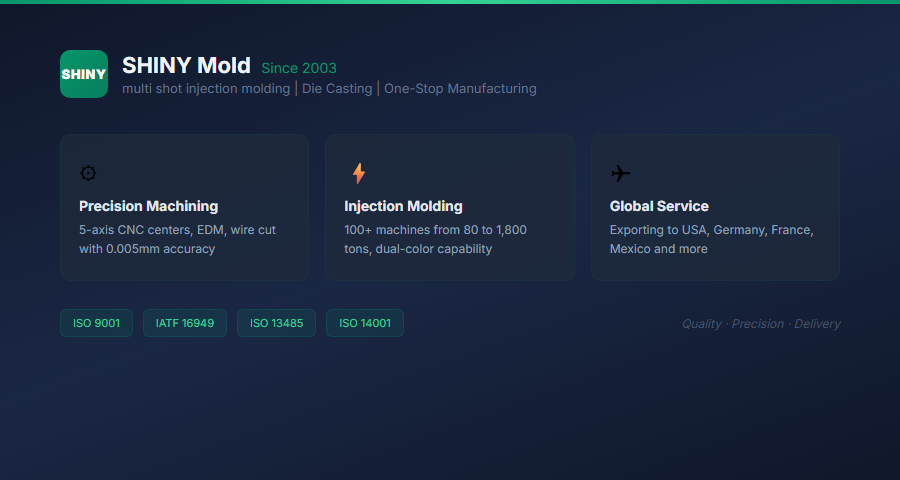
Founded in 2003, SHINY (Dongguan Xinxuan Mold) is headquartered in China's mold manufacturing hub — Chang'an, Dongguan. With fixed assets of USD 5 million, a facility spanning over 23,000 square meters, and a workforce of 400+ employees, SHINY specializes in high-precision plastic injection molds, aluminum die-casting molds, and magnesium die-casting molds.
Backed by a comprehensive library of 5,000+ mold designs, SHINY delivers over 2,000 molds annually. Our products serve industries including automotive, new energy, medical devices, consumer electronics, home appliances, power tools, and lighting. With 100+ injection molding machines (80–1,800 tons), dual-color injection capability, and dedicated assembly lines, SHINY provides end-to-end manufacturing from product design and prototyping to mold development, injection molding, and finished product assembly.
SHINY is certified under ISO 9001, ISO 14001, ISO 13485, and IATF 16949 quality management systems. Our clients span the United States, Canada, Mexico, Germany, France, Poland, and other European and American markets.
Applications of Injection Molding by Industry
Automotive
The automotive industry is the largest consumer of injection-molded parts. Modern vehicles contain hundreds of plastic components, including dashboards, bumpers, door panels, mirror housings, fluid reservoirs, and electrical connectors. The push for lightweight vehicles to improve fuel efficiency has further increased demand for injection-molded plastic parts.
Medical and Healthcare
Medical injection molding demands the highest precision and cleanliness. Applications include disposable syringes, IV components, surgical instrument handles, diagnostic device housings, and implantable components. Cleanroom molding facilities and biocompatible materials are essential for this sector.
Consumer Electronics
Smartphones, laptops, tablets, wearables, and smart home devices all rely on injection-molded plastic enclosures. The trend toward thinner, lighter devices with complex geometries continues to push the boundaries of injection molding technology.
Packaging
From bottle caps and closures to thin-wall containers and food packaging, injection molding produces billions of packaging components annually. The food-grade plastics segment is growing rapidly, driven by convenience and sustainability demands.
Home Appliances
Washing machine drums, refrigerator liners, vacuum cleaner housings, and kitchen appliance components are all commonly injection molded. The durability and aesthetic requirements of consumer appliances make injection molding the ideal production method.
Emerging Trends in Injection Molding
Industry 4.0 and Smart Manufacturing
IoT sensors, real-time process monitoring, and AI-driven parameter optimization are transforming injection molding into a data-driven process. Digital twins enable virtual mold testing before physical tooling is built, reducing development time and cost.
Sustainable and Green Injection Molding
Environmental concerns are driving significant changes:
- Biodegradable polymers — PLA, PHA, and starch-based materials
- Post-consumer recycled (PCR) content — Reducing virgin plastic usage
- All-electric machines — 30-60% lower energy consumption
- Zero-waste hot runner systems — Eliminating runner scrap entirely
Metal Injection Molding (MIM)
MIM combines the shape-making capability of injection molding with the strength and durability of metal. Small, complex metal parts that would be expensive or impossible to machine can be produced efficiently via MIM, serving applications in firearms, medical devices, and electronics.
Micro Molding
Micro injection molding produces parts weighing less than 0.1 gram with tolerances as tight as ±0.01mm. Applications include microelectronic components, medical micro-devices, and optical fiber connectors.
How to Choose an Injection Molding Partner
Selecting the right injection molding partner is critical to project success. Key factors to consider:
- Experience and expertise — Look for a proven track record in your industry
- Quality certifications — ISO 9001, IATF 16949, ISO 13485 demonstrate commitment to quality
- Equipment range — Machine tonnage coverage should match your part requirements
- Design support — Value-added services like DFM (Design for Manufacturing) analysis
- Capacity and scalability — Ability to scale production as demand grows
- Location and logistics — Proximity affects lead times, shipping costs, and communication
Conclusion
Injection molding is a mature yet continuously evolving manufacturing technology that remains essential to modern industry. Its combination of high efficiency, design flexibility, and material versatility makes it the preferred choice for producing plastic parts across virtually every industry sector.
Whether you are launching a new consumer product, sourcing automotive components, or developing a medical device, understanding injection molding fundamentals will help you optimize quality, manage costs, and accelerate time-to-market. As Industry 4.0 technologies and sustainable materials continue to advance, the capabilities and efficiency of injection molding will only increase.
Frequently Asked Questions
What is the minimum order quantity for injection molding?
MOQs vary by complexity. Simple parts can start at 500–1,000 units, while complex components may require 5,000–10,000 units to justify tooling costs. Bridge tooling and 3D printing offer alternatives for lower volumes.
How much does an injection mold cost?
Mold costs range from $3,000 for simple single-cavity molds to $100,000+ for complex multi-cavity tools. Factors affecting cost include part complexity, number of cavities, surface finish requirements, and mold material selection.
What is the typical lead time for injection molding?
Mold development typically takes 4–8 weeks for simple tools and 12–16 weeks for complex molds. Production lead times after tool completion are usually 2–4 weeks depending on order quantity.
Can injection molding use recycled materials?
Yes. Many injection molding applications can use post-industrial recycled (PIR) or post-consumer recycled (PCR) plastics. The percentage of recycled content depends on the application requirements and material specifications.
What is the difference between injection molding and die casting?
Injection molding processes plastic (and sometimes metal powder via MIM), while die casting specifically processes molten metals like aluminum, zinc, and magnesium. Die casting produces stronger metal parts, while injection molding offers more design flexibility with plastics.