
 Chinese
Professional Plastic Injection Molding Services: Precision Manufacturing for Every Industry
When your product demands precision, repeatability, and cost efficiency at scale, plastic injection molding services are the gold standard. From medical devices to automotive components, consumer electronics to industrial machinery — injection molding delivers millions of identical parts with tolerances measured in microns.
But not all injection molding services are equal. The difference between a mediocre and an exceptional molding partner can mean the difference between a product that thrives in the market and one that fails in production. This guide walks you through everything you need to know about sourcing professional plastic injection molding services in 2026.
What Do Professional Plastic Injection Molding Services Include?
A true injection molding services provider doesn't just press plastic — they manage the entire product lifecycle from concept to finished part. Here's what professional plastic injection molding services typically cover:
- Mold Design & Engineering (DFM) — Expert review of your 3D CAD model to optimize for manufacturability, reduce cost, and eliminate potential defects before tooling begins.
- Mold Fabrication — Precision tool room with CNC machining, EDM wire cutting, grinding, and surface finishing. Mold lead times from 6 to 16 weeks depending on complexity.
- Prototyping — Rapid tooling, 3D printed inserts, or soft aluminum molds for low-volume validation before committing to production tooling.
- Injection Molding Production — High-volume production on machines ranging from 80 tons to 1,800 tons, with multi-shot, dual-color, and overmolding capabilities.
- Quality Assurance — Full inspection capabilities: CMM measurement, optical scanning, functional testing, PPAP documentation, and Statistical Process Control (SPC).
- Secondary Operations — Ultrasonic welding, hot staking, printing, pad printing, laser marking, coating, and full product assembly.
- Logistics & Packaging — Custom packaging, drop testing, and international shipping coordination.
Industry Applications of Plastic Injection Molding Services
Professional plastic injection molding services serve a vast range of industries. Here's how different sectors leverage injection molding:
Automotive
From interior trim panels and instrument clusters to under-hood components and battery housings for EVs, automotive injection molding demands IATF 16949 certification, PPAP documentation, and zero-defect delivery. Typical materials: PP, PA66, PC/ABS, POM.
Medical Devices
Medical injection molding requires ISO 13485 quality systems, biocompatible materials (ISO 10993 testing), cleanroom production (ISO Class 7/8), and full traceability. Typical materials: PC, ABS, PP, PEBA, medical-grade silicone.
Consumer Electronics
Housings, bezels, buttons, and structural components for smartphones, wearables, smart home devices, and power tools. Surface finish is paramount — high-gloss, soft-touch, and textured finishes are common. Typical materials: PC, ABS, PC/ABS, PMMA.
Home Appliances
Components for kitchen appliances, air conditioners, washing machines, and cleaning robots. Requirements include food-contact compliance (FDA), UL flame retardancy, and durable surface resistance. Typical materials: PP, ABS, PA, POM.
Power Tools
Heavy-duty housings, gear sets, and functional components that must withstand impact, vibration, and continuous use. Typical materials: PA66+GF, PP+GF, POM.
How to Evaluate a Plastic Injection Molding Services Provider
Choosing the right injection molding services partner is one of the most consequential decisions in your product development process. Use this checklist to evaluate potential partners:
1. Technical Capability Assessment
- In-house tool room? (CNC, EDM, wire cutting, grinding, CMM)
- CAE simulation available? (Moldflow/Moldex3D for filling, cooling, warpage analysis)
- Machine tonnage range: 50T to 2,000T+
- Multi-shot / dual-color injection capability?
- Cleanroom molding for medical applications?
- Secondary operations in-house or outsourced?
2. Quality System Verification
- ISO 9001:2015 (minimum baseline)
- IATF 16949:2016 (automotive — non-negotiable if targeting auto OEMs)
- ISO 13485:2016 (medical devices — mandatory for medical applications)
- ISO 14001:2015 (environmental management)
- Do they provide material certificates, CPK reports, and dimensional reports?
- Can they issue PPAP, PAPP, or FAIS as required by your industry?
3. Track Record & Industry References
- How many years of injection molding experience?
- Do they serve your specific industry? (Automotive? Medical? Electronics?)
- Can they provide case studies and customer references?
- What is their typical production volume capacity?
4. Communication & Project Management
- Do they provide DFM reports proactively?
- What is their typical response time for technical queries?
- Do they offer a dedicated project manager?
- Are mold modification and part revision processes clearly defined?
5. Cost Structure Transparency
- Is the quotation broken down into mold cost, piece price, and secondary operation costs?
- Are there hidden charges for engineering changes or mold modifications?
- Do they offer volume pricing tiers?
- What are their payment terms?
About SHINY Mold — Your Trusted Plastic Injection Molding Services Partner
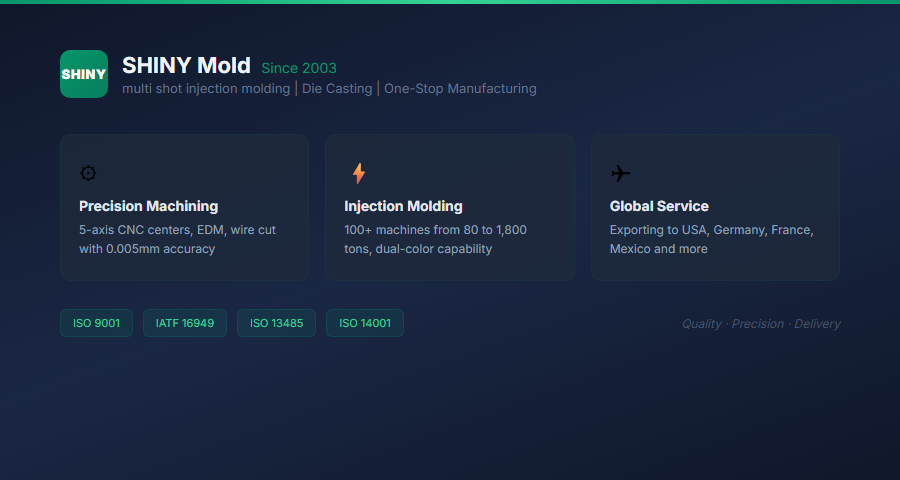
SHINY Mold, officially Dongguan Xinxuan Mold Co., Ltd., is headquartered in Chang'an — Dongguan's premier mould manufacturing hub. Established in 2003, we operate a 23,000+ square metre facility with 400+ employees and USD 5 million in fixed assets.
Our comprehensive plastic injection molding services span: high-precision plastic injection molds, aluminium die-casting molds, and magnesium die-casting molds. With a design library of 5,000+ designs and annual output exceeding 2,000 molds, we serve global clients across automotive, new energy, medical devices, consumer electronics, home appliances, power tools, and lighting industries.
Our production infrastructure includes 100+ injection molding machines (80–1,800 tons), dual-color injection molding, and dedicated product assembly lines. We're certified to ISO 9001, ISO 14001, ISO 13485, and IATF 16949 quality standards. Our export markets include the United States, Canada, Mexico, Germany, France, Poland, and beyond.
What sets SHINY apart: In-house tool room (no outsourcing delays), free DFM analysis, on-site CMM inspection, and responsive engineering support. We handle everything from a 3D STEP file to finished packaged parts — one partner, one quality standard.
Plastic Materials Used in Professional Injection Molding Services
The right material selection is critical to part performance, cost, and manufacturability. Here's an overview of materials commonly used in plastic injection molding services:
| Material | Properties | Applications |
|---|---|---|
| ABS | High impact resistance, excellent surface finish, easy to paint/metallize | Automotive interior, consumer electronics housings |
| PC (Polycarbonate) | Exceptional impact strength, optical clarity, heat resistance | Automotive lenses, safety equipment, LED optics |
| PC/ABS | Best of both — PC strength + ABS processability | Electronics housings, automotive dashboards |
| PP (Polypropylene) | Chemical resistance, living hinge capability, food-safe grades | Food containers, medical devices, caps & closures |
| PA66 / PA66+GF | High mechanical strength, heat resistance, wear resistance | Automotive engine components, gears, structural parts |
| POM (Acetal/Delrin) | Dimensional stability, low friction, high stiffness | Precision gears, fuel system components, bearings |
| PBT | Good electrical insulation, chemical resistance, dimensional stability | Connectors, sensor housings, LED frames, automotive electronics |
| PEEK | Extreme temperature resistance, chemical inertness, biocompatible | Aerospace, medical implants, oil & gas, semiconductor |
| TPE / TPU | Flexible, shock-absorbing, wide hardness range | Overmolded grips, seals, medical device components |
Understanding the Cost of Plastic Injection Molding Services
Mold Investment (One-Time / NRE)
- Complexity-driven pricing: Undercuts, side actions, lifters, hot runners, multi-cavities — all increase mold cost
- Steel selection: P20 (standard production), H13 (high-volume), S136 (mirror polish), Aluminium (prototype/low-volume)
- Lead time impact: Standard 6–10 weeks; expedited 3–5 weeks at +30–50% premium
- Typical mold investment: USD 3,000–30,000+ for production molds, depending on size and complexity
Piece Price (Per Unit)
- Material: Commodity resins (PP, PE) vs. engineering resins (PC, PA, PEEK) — 2x to 10x cost difference
- Part weight: Larger parts = more material + larger machine = higher piece price
- Cycle time: Longer cooling = higher piece price; optimize via Moldflow simulation
- Volume: Higher volumes justify multi-cavity molds and automation, dramatically reducing piece price
- Tolerances: Tighter tolerances = higher scrap rate = higher piece price
Total Cost of Ownership (TCO)
Focus on TCO, not just unit price. A mold that produces 0.5% scrap but lasts 500,000 shots delivers far better value than a cheap mold with 3% scrap and 100,000-shot lifespan. Factor in engineering support quality, communication responsiveness, and after-sales service.
The Injection Molding Services Process: From Inquiry to Delivery
- RFQ Submission — Send your 3D CAD file (STEP/IGES), 2D drawing, material spec, estimated volume, and quality requirements
- DFM Review — The molder reviews your design and provides a manufacturability report with improvement suggestions
- Quotation — Receive a detailed quote: mold cost, piece price, lead time, payment terms
- Mold Design Approval — Review and approve mold design drawings before fabrication begins
- Mold Fabrication — Tool build, typically 6–16 weeks depending on complexity
- T1 Trial & Sampling — First shots produced, inspected against drawing, mold adjustments if needed
- T2 / Pre-Production Sample — Final sample for customer approval before mass production
- Mass Production — Full-volume production with SPC monitoring, in-process inspection, and end-of-line quality checks
- Packaging & Shipment — Custom packaging, palletization, and international logistics coordination
2026 Trends in Plastic Injection Molding Services
Digitalization & Industry 4.0
Leading injection molding services providers are integrating IoT sensors, real-time OEE dashboards, AI-driven process optimization, and digital twin simulation. These technologies reduce scrap rates by 15–30% and improve delivery predictability.
Sustainability & Circular Economy
Bio-based resins, recycled-content materials (rPC, rPP, rABS), all-electric machines for energy efficiency, and closed-loop water recycling are becoming standard differentiators for environmentally conscious injection molding services partners.
Miniaturization & High-Precision Molding
As electronics shrink, the demand for micro-injection molding (parts < 1g, tolerances ±0.01mm) is growing rapidly, especially for medical and semiconductor applications.
Frequently Asked Questions About Plastic Injection Molding Services
What is the typical lead time for injection molding services?
Prototype tooling: 2–4 weeks. Production molds (standard complexity): 6–10 weeks. Complex multi-cavity molds: 10–16 weeks. Expedited tooling available at premium cost.
What is the minimum order quantity (MOQ) for injection molding services?
Standard production: 1,000–5,000 pieces. Low-volume programs (using aluminium tooling or shared cavities): 100–1,000 pieces. Prototype runs: as few as 50–100 pieces.
Can injection molding services include design and engineering support?
Yes. Most professional providers offer free DFM (Design for Manufacturability) analysis with every quotation. This includes wall thickness recommendations, gate location suggestions, and ejection analysis.
Do you handle material selection for injection molding services?
Absolutely. Your injection molding services partner should recommend materials based on your performance requirements, regulatory compliance needs, cost targets, and processing considerations.
How do injection molding services ensure consistent quality?
Look for providers who use Scientific Molding principles, Design of Experiments (DOE), Statistical Process Control (SPC), first-article inspection (FAI), and CPK reporting for critical dimensions. Request a quality plan with your RFQ.
What certifications should a professional injection molding services provider have?
Minimum: ISO 9001. Automotive: IATF 16949. Medical: ISO 13485. Environmental: ISO 14001. Additional industry-specific certifications may apply.
Conclusion
Sourcing plastic injection molding services is a strategic partnership decision, not just a procurement transaction. The right services provider brings engineering expertise, quality systems, production capacity, and global logistics capability to your supply chain — transforming your product concept into a market-ready reality.
In 2026, the most competitive manufacturers are those combining advanced technology with responsive engineering support and transparent quality systems. Whether you're launching a first prototype or scaling to mass production, invest the time to select the right injection molding services partner — it will pay dividends in quality, cost, and speed to market for years to come.