
 Chinese
Plastic Injection: The Complete Guide to Precision Manufacturing in 2026
Plastic injection is the backbone of modern manufacturing. From automotive dashboards and medical syringes to smartphone cases and kitchen appliances, plastic injection moulding produces billions of precision parts every year. Understanding how this technology works — and how to leverage it for your projects — can save you time, reduce costs, and improve product quality dramatically.
This guide covers everything you need to know about plastic injection in 2026: the process fundamentals, material science, mould design principles, quality assurance, and how to select the right manufacturing partner for your needs.

What Is Plastic Injection?
Plastic injection (also known as injection moulding) is a manufacturing process in which molten plastic material is injected under high pressure into a precisely machined steel or aluminium mould cavity. Once cooled and solidified, the mould opens and the finished part is ejected — ready for use in seconds to minutes, depending on part size and wall thickness.
The core advantage of plastic injection is repeatability at scale. Once a mould is built, the same part can be produced thousands — or millions — of times with extraordinary consistency. Modern all-electric injection moulding machines achieve cycle-to-cycle repeatability within ±0.02 seconds and dimensional tolerances as tight as ±0.025 mm.
The Plastic Injection Process: Step by Step
- Clamping — The two halves of the injection mould are pressed together by the clamping unit with force ranging from 5 tons (for tiny parts) to over 4,000 tons (for large automotive panels).
- Injection — Plastic pellets are fed from the hopper into the heated barrel, where a reciprocating screw melts and homogenises the material. The screw then rams the molten plastic into the mould cavity at injection pressures of 500-2,000 bar.
- Dwelling (Packing) — After the cavity fills, additional material is packed in under holding pressure to compensate for shrinkage as the part cools. Proper packing pressure eliminates sink marks and voids.
- Cooling — The molten plastic solidifies inside the water-cooled mould. Cooling time typically accounts for 50-80% of the total cycle time and is the primary factor in production efficiency.
- Mould Opening — Once the part reaches ejection temperature, the mould opens along the parting line.
- Ejection — Ejector pins, plates, or air blasts push the solidified part out of the mould. The mould then closes, and the cycle repeats.
Typical cycle times range from 5-15 seconds for thin-walled consumer goods to 60-120 seconds for thick-walled industrial components. Multi-cavity moulds (2, 4, 8, 16, 32, or even 64 cavities) multiply output proportionally — a 16-cavity mould running a 10-second cycle produces 5,760 parts per hour.
Plastic Injection Materials: Choosing the Right Resin
Material selection is arguably the most consequential decision in any plastic injection project. The wrong material choice can lead to part failure, excessive cost, or regulatory non-compliance. Here are the major families of injection moulding plastics:
Commodity Thermoplastics
| Material | Key Properties | Typical Applications |
|---|---|---|
| PP (Polypropylene) | Excellent chemical resistance, living hinge capability, low density (0.90 g/cm³) | Food containers, automotive bumpers, bottle caps, battery cases |
| PE (Polyethylene) | Low cost, excellent moisture barrier, good impact at low temperatures | Packaging, toys, household goods, pipes and fittings |
| PS (Polystyrene) | Rigid, clear (GPPS) or opaque (HIPS), easy to process | Disposable cutlery, CD cases, packaging inserts |
Engineering Thermoplastics
| Material | Key Properties | Typical Applications |
|---|---|---|
| ABS | Good impact resistance, excellent surface finish, easy to paint/plate | Automotive interior trim, consumer electronics housings, LEGO bricks |
| PC (Polycarbonate) | High impact strength, optical clarity, heat resistance to 135°C | LED lenses, safety goggles, medical devices, electrical enclosures |
| PA (Nylon 6/66) | High strength, excellent wear resistance, good chemical resistance | Gears, bearings, cable ties, automotive under-hood components |
| POM (Acetal/Delrin) | Exceptional dimensional stability, low friction, excellent fatigue resistance | Precision gears, fuel system components, zippers, conveyor belt links |
| PBT | Good electrical insulation, chemical resistance, fast crystallisation (short cycles) | Electrical connectors, relay housings, automotive sensors |
High-Performance Thermoplastics
| Material | Key Properties | Typical Applications |
|---|---|---|
| PEEK | Continuous service to 260°C, outstanding chemical resistance, sterilizable | Aerospace components, medical implants, oil & gas seals |
| PEI (Ultem) | High strength-to-weight ratio, flame retardant (UL94 V-0), transparent amber | Aircraft interiors, medical instrument housings, semiconductor equipment |
| PPS | Inherent flame resistance, excellent chemical resistance, high stiffness | Under-hood automotive, pump components, electrical insulation |
| LCP | Ultra-thin wall capability, excellent flow, low thermal expansion | Micro-connectors, SMT components, fibre optic connectors |
Mould Design: The Heart of Plastic Injection
The injection mould is the single largest investment in any plastic injection project — and the single most important factor in part quality. A well-designed mould runs millions of cycles with minimal maintenance; a poorly designed one produces scrap from day one.
Key Mould Design Elements
- Parting Line — The plane where the two mould halves separate. Optimal placement minimises flash, simplifies ejection, and hides witness lines.
- Gating System — The channel through which molten plastic enters the cavity. Common gate types include edge gates, tunnel (submarine) gates, pin-point gates (three-plate moulds), and hot runner valve gates.
- Cooling System — Conformal cooling channels, baffles, and bubblers that extract heat efficiently and uniformly. Proper cooling design can reduce cycle time by 20-40%.
- Ejection System — Ejector pins, sleeves, stripper plates, or air poppets that push the part out without deformation or marks.
- Venting — Micro-channels (0.02-0.05 mm deep) that allow trapped air to escape, preventing burn marks and short shots.
- Draft Angles — Tapered walls (typically 0.5°-3°) that allow the part to release from the mould without dragging or scoring.
Mould Steel Selection
- P20 (Pre-hardened) — General-purpose steel for low-to-medium production volumes (100,000-500,000 shots)
- H13 (Hot Work) — High-volume production steel (1,000,000+ shots), excellent thermal fatigue resistance
- S136 / 420SS (Stainless) — Mirror-polish capability for optical lenses and medical parts requiring high cosmetic standards
- NAK80 — Excellent polishability, good for high-gloss consumer product moulds
- Aluminium (7075-T6) — Rapid tooling and low-volume bridge production (up to 10,000 shots)
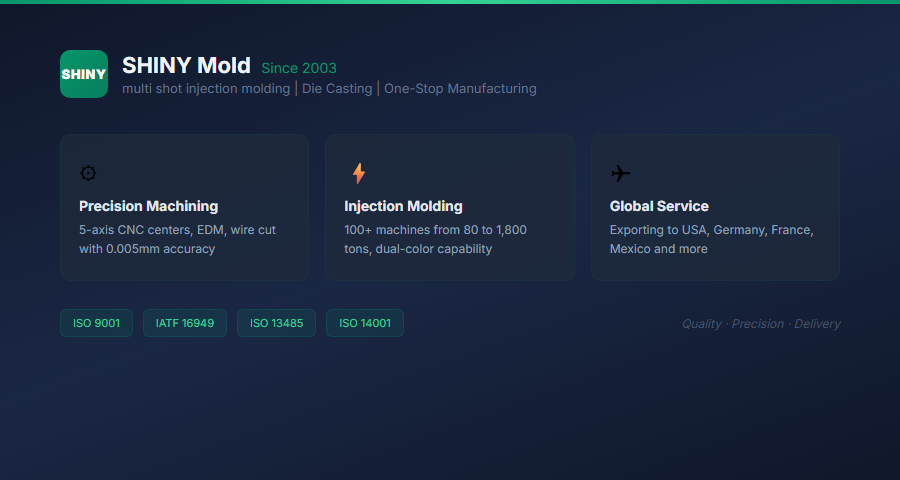
About SHINY Mold — Your Plastic Injection Partner
Founded in 2003 and headquartered in China's mould manufacturing hub — Chang'an, Dongguan — SHINY Mold (Dongguan Xinxuan Mold) is a full-service plastic injection manufacturer with fixed assets of USD 5 million and a facility spanning over 23,000 square metres.
With over 400 skilled professionals and an accumulated library of 5,000+ mould designs, SHINY delivers more than 2,000 moulds annually. Our 100+ injection moulding machines (ranging from 80 to 1,800 tons) include dual-colour (two-shot) injection capability, complemented by dedicated assembly, printing, and packaging lines for end-to-end manufacturing solutions.
SHINY Mold holds ISO 9001, ISO 14001, ISO 13485, and IATF 16949 certifications, serving customers across the automotive, new energy, medical devices, consumer electronics, home appliances, power tools, and lighting industries in the United States, Canada, Mexico, Germany, France, Poland, and other global markets.
From product design review and rapid prototyping through mould fabrication, plastic injection production, and finished product assembly — SHINY Mold provides a seamless, quality-driven manufacturing experience.
Design for Plastic Injection: Best Practices
Good part design is the foundation of successful plastic injection. Following these DFM (Design for Manufacturability) principles reduces tooling cost, improves part quality, and accelerates time-to-market:
Uniform Wall Thickness
Maintain consistent wall thickness throughout your part. Variations cause differential cooling, leading to warpage, sink marks, and internal stresses. As a rule of thumb, keep wall thickness variation within ±25% of nominal. For ABS, nominal wall thickness typically ranges from 1.5-3.0 mm; for PP, 0.8-2.5 mm.
Radius All Sharp Corners
Sharp internal corners create stress concentrations that can cause part failure. Add generous radii (minimum 0.5 mm, ideally 25-75% of wall thickness) to all internal corners. External corners should also be radiused for mould filling and safety.
Incorporate Draft Angles
Every vertical surface parallel to the mould-opening direction needs draft. Minimum 0.5° for polished surfaces, 1°-3° for textured surfaces (more for deeper textures). Insufficient draft causes ejection marks, drag lines, and shortened mould life.
Avoid Undercuts Where Possible
Undercuts require side-actions (sliders, lifters) that add cost and complexity to the mould. Design parts to avoid undercuts where possible by reorienting features, splitting the part, or using pass-through cores.
Design Ribs Correctly
Ribs add stiffness without increasing wall thickness. Keep rib thickness at 40-60% of the adjoining wall thickness to avoid sink marks. Rib height should not exceed 3x wall thickness.
Consider Gate Location
Gate placement affects weld line location, fibre orientation, part warpage, and cosmetic appearance. CAE flow simulation (Moldflow, Moldex3D) optimises gate location before steel is cut.
Quality Control in Plastic Injection
Consistent quality is what separates professional plastic injection manufacturers from the rest. Here are the quality systems and tools used by industry leaders:
Process Control
- Scientific Moulding — Data-driven process development using in-mould pressure sensors and rheology curves to establish robust processing windows, not trial-and-error.
- Design of Experiments (DOE) — Systematic variation of process parameters (temperature, pressure, speed, time) to identify optimal settings and understand interactions.
- Statistical Process Control (SPC) — Real-time monitoring of critical dimensions with control charts (X-bar, R), enabling proactive intervention before defects occur.
Inspection & Measurement
- CMM (Coordinate Measuring Machine) — Automated 3D measurement with micron-level accuracy for dimensional verification against CAD.
- Vision Measurement Systems — High-speed optical inspection for 2D features, flash, and surface defects.
- CT Scanning — Industrial computed tomography for non-destructive internal feature inspection and porosity analysis.
- Material Testing — Melt flow index (MFI), tensile strength, impact resistance (Izod/Charpy), and thermal properties (DSC, TGA) per ASTM/ISO standards.
Documentation & Traceability
- PPAP (Production Part Approval Process) — The automotive industry's standard for validating production parts, including PFMEA, control plans, MSA, and capability studies.
- FAIR (First Article Inspection Report) — Complete dimensional report for the first production run, verifying all drawing requirements are met.
- Material Certifications — Certificates of Analysis (COA) and Certificates of Compliance (COC) for every resin lot.
- Batch Traceability — Lot numbers linking each production run to raw materials, machine parameters, and inspection results.
Cost Factors in Plastic Injection Projects
Understanding the economics of plastic injection helps you plan budgets realistically and identify cost-optimisation opportunities:
Mould Cost (One-Time / NRE)
- Simple single-cavity mould: $3,000-$8,000
- Medium-complexity mould (with sliders): $8,000-$25,000
- Complex multi-cavity mould: $25,000-$100,000+
- Hot runner system: Adds $2,000-$20,000 but eliminates runner scrap
Piece Price (Per-Unit Cost)
- Material cost: Typically 40-60% of piece price for commodity resins, 60-80% for engineering resins
- Machine rate: $15-$60/hour depending on machine tonnage and region
- Labour: Highly automated cells reduce labour to 0.1-0.5 operators per machine
- Secondary operations: Printing, welding, assembly, and packaging add $0.05-$1.00+ per part
- Scrap rate: Well-optimised processes achieve <1% scrap; poorly managed runs can hit 5-10%
Cost Optimisation Strategies
- Increase cavity count for higher volumes (amortises mould cost over more parts)
- Optimise cooling to reduce cycle time (every second saved increases output)
- Use hot runners to eliminate cold-runner material waste
- Select materials matched to requirements — don't over-specify (PEEK when PC would work)
- Automate post-mould operations (robotic part removal, in-line inspection)
2026 Trends in Plastic Injection Manufacturing
Industry 4.0 and Smart Factories
Leading plastic injection facilities are evolving into smart factories. IoT sensors monitor every machine parameter in real time. AI-driven process control automatically adjusts injection speed, holding pressure, and cooling time to compensate for material batch variations and ambient conditions. Digital twin simulation predicts part quality before the mould is even built. The result: OEE improvements of 15-25% and defect reduction of 30-50%.
Sustainable Manufacturing
Sustainability is no longer optional. All-electric injection moulding machines reduce energy consumption by 40-70% compared to hydraulic equivalents. Recycled-content resins (PCR — Post-Consumer Recycled) are increasingly specified by major brands. Bio-based polymers (PLA, PHA, bio-PE) are gaining traction for single-use and packaging applications. Closed-loop water systems and waste heat recovery further reduce environmental footprint.
Multi-Material & Overmoulding
Two-shot (dual-injection) moulding and overmoulding enable complex multi-material parts in a single cycle — think soft-touch grips on rigid tools, seals moulded directly onto connectors, and aesthetic two-tone consumer products. This capability eliminates assembly steps and improves product performance.
Micro and Thin-Wall Moulding
As products shrink, so do their plastic components. Micro injection moulding produces parts weighing less than 0.1 grams with features measured in microns — critical for medical microfluidics, hearing aids, and micro-optics. Thin-wall moulding (wall thickness < 1 mm) enables lightweight consumer electronics housings and packaging with cycle times as low as 2-5 seconds.
Frequently Asked Questions
What's the difference between injection moulding and plastic injection?
They're the same process. "Plastic injection" is the shortened form of "plastic injection moulding" — widely used in industry for brevity. Both terms refer to the manufacturing process of injecting molten plastic into a mould to form parts.
How long does it take to make a plastic injection mould?
Prototype tooling: 2-4 weeks. Standard production mould (single cavity, moderate complexity): 6-10 weeks. Complex multi-cavity moulds with side actions and hot runners: 10-16 weeks. Expedited timelines are available at premium pricing (typically +30-50%).
What's the minimum volume for plastic injection?
Most manufacturers prefer volumes of 1,000+ pieces. For lower volumes (100-1,000), consider aluminium tooling or 3D-printed mould inserts. For prototypes (10-100 pieces), CNC machining or 3D printing may be more economical than injection moulding.
How precise can plastic injection parts be?
Standard commercial tolerances are ±0.1 mm for small parts, ±0.2-0.3 mm for medium parts. Fine-tolerance moulding can achieve ±0.025 mm on critical dimensions with proper process control. The key is designing realistic tolerances — specifying ±0.01 mm everywhere drives up cost unnecessarily.
What files do I need to get a plastic injection quotation?
Provide your 3D CAD model (STEP or IGES format preferred), 2D drawing with critical dimensions and tolerances, material specification, estimated annual volume, and any special requirements (FDA compliance, flame retardancy, colour matching, surface finish).
Can I mould multiple materials in one part?
Yes. Two-shot (dual-injection) moulding and overmoulding produce single parts with two or more materials bonded together. Common examples include toothbrushes (rigid PP handle + soft TPE grip), power tool housings (PC/ABS body + TPE overmould), and automotive seals (rigid substrate + LSR gasket).
Conclusion
Plastic injection remains the most versatile, cost-effective, and scalable manufacturing process for producing high-quality plastic parts. Whether you are developing a single prototype or ramping up to millions of units per year, understanding the process fundamentals — material selection, mould design, DFM principles, quality systems, and cost drivers — empowers you to make informed decisions that improve part quality, reduce cost, and accelerate your time to market.
Success in plastic injection comes from choosing the right partner: one with technical depth, quality certifications, transparent communication, and a genuine commitment to your project's success. In 2026 and beyond, the most competitive manufacturers will be those who combine decades of hands-on expertise with Industry 4.0 technology, sustainable practices, and customer-centric service.