
 Chinese
DIY Injection Molding: Complete Guide to Desktop & Small-Scale Plastic Molding in 2026
With the rise of desktop manufacturing and maker culture, DIY injection molding has become an increasingly popular option for hobbyists, entrepreneurs, and small businesses looking to produce custom plastic parts without the overhead of industrial-scale production.
This comprehensive 2026 guide covers everything you need to know about DIY injection molding: equipment options, mould-making techniques, material selection, process optimisation, and when it makes sense to partner with a professional injection molding service.

What Is DIY Injection Molding?
DIY injection molding refers to small-scale plastic injection molding performed using desktop or benchtop machines, often in home workshops, makerspaces, or small production facilities. Unlike industrial injection molding which uses machines ranging from 50 to 5,000+ tons of clamping force, DIY setups typically operate in the 5-20 ton range.
The key advantages of DIY injection molding include:
- Low capital investment — Desktop machines start around $2,000-$8,000 vs. $50,000+ for industrial equipment
- Rapid prototyping — Produce functional prototypes in production-grade materials
- Small batch production — Economical for runs of 50-5,000 parts
- Design flexibility — Quick iteration without waiting for external suppliers
- Learning opportunity — Hands-on understanding of injection molding principles
Desktop Injection Molding Equipment Options
Benchtop Injection Molding Machines
The market for desktop injection molding machines has matured significantly. Popular options in 2026 include:
| Machine | Clamp Force | Shot Size | Price Range |
|---|---|---|---|
| Desktop Injector Pro | 5-10 tons | 20-50g | $2,500-$5,000 |
| Apex 5-Ton | 5 tons | 15-30g | $3,000-$4,500 |
| Medium Format 20T | 15-20 tons | 50-150g | $8,000-$15,000 |
| Manual Injector | 2-5 tons | 10-25g | $800-$2,000 |
Key Machine Features to Consider
- Clamping force — Determines maximum part size and mould complexity
- Injection pressure — Higher pressure enables better filling of thin walls
- Shot size — Maximum volume of plastic per injection cycle
- Temperature control — Precision barrel heating for consistent melt quality
- Automation features — Semi-automatic vs. fully manual operation
Mould Making for DIY Injection Molding
Mould fabrication is the most critical — and often most challenging — aspect of DIY injection molding. Several approaches are commonly used:
3D Printed Moulds
- Material: High-temperature SLA resins (e.g., High Temp Resin, Engineering Resin)
- Advantages: Low cost, rapid turnaround, complex geometries possible
- Limitations: Limited lifespan (10-100 shots), lower surface finish quality
- Best for: Prototyping, low-volume validation, soft materials (PP, PE)
Aluminium Moulds
- Material: CNC-machined 6061 or 7075 aluminium
- Advantages: Good thermal conductivity, 1,000-10,000+ shot lifespan, excellent surface finish
- Limitations: Higher cost than 3D printed, requires CNC capability
- Best for: Small-medium production runs, engineering materials
Steel Moulds
- Material: P20, H13, or S136 tool steel
- Advantages: Longest lifespan (100,000+ shots), highest precision
- Limitations: Highest cost, requires professional toolroom
- Best for: Production tooling, high-volume applications
Materials for DIY Injection Molding
Desktop machines are best suited for low-temperature, easy-flow materials:
| Material | Melt Temp | Properties | DIY Difficulty |
|---|---|---|---|
| PP (Polypropylene) | 200-240°C | Flexible, chemical resistant | Easy |
| PE (Polyethylene) | 180-220°C | Soft, impact resistant | Easy |
| ABS | 220-260°C | Rigid, good surface | Moderate |
| PS (Polystyrene) | 200-240°C | Clear, brittle | Easy |
| PA (Nylon) | 240-280°C | Strong, wear resistant | Challenging |
| PC (Polycarbonate) | 280-320°C | Impact resistant, clear | Difficult |
About SHINY Mold
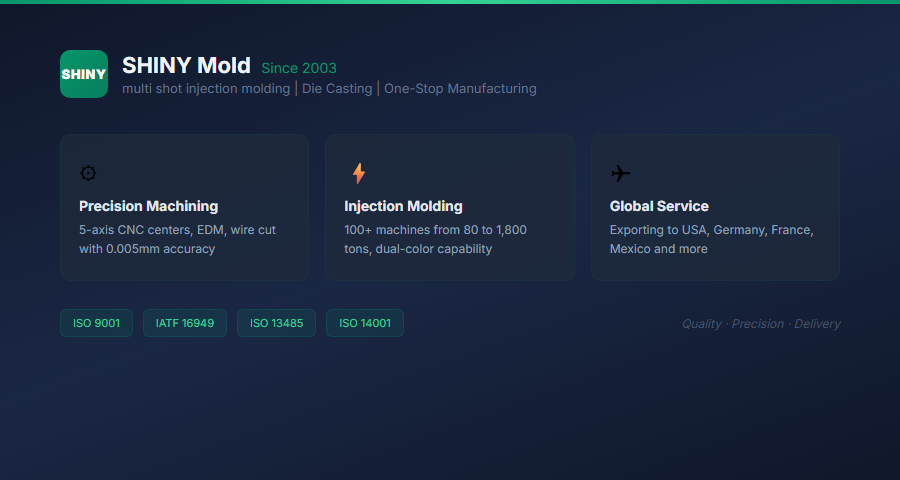
Founded in 2003, SHINY (Dongguan Xinxuan Mold) is headquartered in China's mould manufacturing hub — Chang'an, Dongguan. With fixed assets of USD 5 million, a facility spanning over 23,000 square metres, and a workforce of 400+ employees, SHINY specialises in high-precision plastic injection moulds, aluminium die-casting moulds, and magnesium die-casting moulds.
Backed by a comprehensive library of 5,000+ mould designs, SHINY delivers over 2,000 moulds annually. Our products serve industries including automotive, new energy, medical devices, consumer electronics, home appliances, power tools, and lighting. With 100+ injection moulding machines (80–1,800 tons), dual-colour injection capability, and dedicated assembly lines, SHINY provides end-to-end manufacturing from product design and prototyping to mould development, injection moulding, and finished product assembly.
SHINY is certified under ISO 9001, ISO 14001, ISO 13485, and IATF 16949 quality management systems. Our clients span the United States, Canada, Mexico, Germany, France, Poland, and other European and American markets.
Step-by-Step DIY Injection Molding Process
- Part Design
- Design for mouldability: include draft angles (1-3°), uniform wall thickness, and radiused corners
- Use CAD software to create 3D model (STEP, IGES format)
- Consider material shrinkage (typically 0.5-2% depending on material)
- Mould Design
- Create mould cavity and core geometry
- Design runner system and gate location
- Plan ejection system (pins, air blast, or manual removal)
- Mould Fabrication
- 3D print, CNC machine, or outsource mould production
- Polish cavity surfaces for better finish and release
- Install mould into machine platen
- Machine Setup
- Set barrel temperature profile for your material
- Adjust injection pressure and speed
- Set cooling time based on part thickness
- Production
- Load plastic pellets or granules into hopper
- Run 5-10 shots to stabilise process
- Inspect parts and adjust parameters as needed
When to Choose Professional Injection Molding Services
While DIY injection molding is valuable for prototyping and small batches, certain scenarios call for professional manufacturing partners:
Production Volume
- DIY suitable: 50-5,000 parts (small batches, prototypes)
- Professional recommended: 5,000+ parts (economies of scale favour industrial production)
Part Complexity
- DIY suitable: Simple geometries, single-cavity moulds, 2D or shallow 3D parts
- Professional recommended: Complex parts with undercuts, multi-cavity moulds, overmoulding, tight tolerances (±0.05mm)
Material Requirements
- DIY suitable: Low-temperature materials (PP, PE, PS, ABS)
- Professional recommended: Engineering materials (PC, PA, PBT, PEEK), glass-filled grades, flame-retardant compounds
Quality & Certification
- DIY suitable: Non-critical applications, prototypes, consumer products
- Professional recommended: Automotive, medical, aerospace, food-contact applications requiring ISO certification, PPAP, material traceability
Cost Comparison: DIY vs Professional Injection Molding
| Cost Factor | DIY | Professional Service |
|---|---|---|
| Machine Investment | $2,000-$15,000 | $0 (included in piece price) |
| Mould Cost (Aluminium) | $200-$2,000 (DIY) | $1,500-$5,000 (outsourced) |
| Piece Price (500 parts) | $0.50-$2.00 | $0.30-$1.50 |
| Piece Price (5,000 parts) | $0.50-$2.00 | $0.15-$0.80 |
| Setup Time | Days to weeks | Weeks (standard) to months (production mould) |
Common DIY Injection Molding Problems & Solutions
Short Shots (Incomplete Filling)
Cause: Insufficient injection pressure, low melt temperature, blocked runner
Solution: Increase injection pressure, raise barrel temperature, clean or redesign runner
Flash (Excess Material at Parting Line)
Cause: Insufficient clamping force, worn mould, excessive injection pressure
Solution: Increase clamp force, repair mould, reduce injection pressure
Warping
Cause: Uneven cooling, internal stresses, material shrinkage
Solution: Optimise cooling channel design, adjust packing pressure, use uniform wall thickness
Sink Marks
Cause: Thick sections cooling unevenly, insufficient packing
Solution: Core out thick sections, increase packing pressure, extend cooling time
Bubbles or Voids
Cause: Moisture in material, trapped air, insufficient packing
Solution: Dry material thoroughly, increase injection speed, improve venting
Safety Considerations for DIY Injection Molding
- High temperatures: Barrel and nozzle reach 200-320°C — use heat-resistant gloves and eye protection
- Moving parts: Clamp mechanism can cause crushing injuries — keep hands clear during operation
- Ventilation: Some materials release fumes when heated — ensure adequate ventilation
- Electrical safety: Inspect heaters and wiring regularly for damage
- Material handling: Store pellets in dry conditions to prevent moisture absorption
Getting Started: DIY Injection Molding Checklist
- ✅ Define your part requirements (material, quantity, tolerances)
- ✅ Select appropriate desktop injection molding machine
- ✅ Learn CAD software for part and mould design
- ✅ Choose mould fabrication method (3D print, CNC, outsource)
- ✅ Source quality plastic pellets from reputable supplier
- ✅ Set up safe workspace with ventilation and PPE
- ✅ Practise with simple moulds before attempting complex parts
- ✅ Document process parameters for repeatability
Conclusion
DIY injection molding has opened the world of plastic part manufacturing to hobbyists, makers, and small businesses. With desktop machines becoming more affordable and capable, it's now possible to produce functional prototypes and small production runs in-house.
However, as production volumes increase or part requirements become more demanding, partnering with a professional injection molding service like SHINY Mold offers significant advantages in quality, consistency, and cost-effectiveness. The key is knowing when DIY is appropriate — and when it's time to scale up to professional manufacturing.
Whether you choose DIY or professional injection molding, understanding the fundamentals of the process, materials, and quality systems will help you make better decisions and produce better parts.