
 Chinese
Molds for Plastic: The Complete Guide to Injection Mold Selection in 2026
Choosing the right molds for plastic injection molding is one of the most consequential decisions in any plastic manufacturing project. The mold — often called the "heart" of injection molding — determines part quality, production efficiency, cycle time, and ultimately your per-part cost. A well-designed mold can produce millions of flawless parts; a poorly executed one can drain your budget with defects, downtime, and endless rework.
This comprehensive guide walks you through everything you need to know about molds for plastic in 2026: types of molds, material options, design fundamentals, cost breakdowns, supplier selection criteria, and emerging technologies that are reshaping the industry.

What Are Molds for Plastic Injection Molding?
Molds for plastic (also called injection molds, plastic tooling, or plastic dies) are precision-engineered tools that shape molten plastic into finished parts. A typical injection mold consists of two halves — the fixed (cavity) side and the moving (core) side — that clamp together under high pressure during injection and separate for part ejection.
Key components of molds for plastic include:
- Cavity and Core — The negative space that defines the part's external and internal geometry
- Sprue, Runner, and Gate System — Channels that deliver molten plastic from the machine nozzle to the cavity
- Cooling System — Internal channels circulating coolant (water or oil) to solidify the part quickly and uniformly
- Ejection System — Ejector pins, sleeves, or plates that push the solidified part out of the mold
- Venting System — Micro-grooves that allow trapped air and gases to escape during filling
- Guide Pins and Bushings — Ensure precise alignment of mold halves during closing
Types of Molds for Plastic
Two-Plate Molds
The most common and economical mold type, featuring a single parting line separating the cavity and core:
- Simple construction — Lower manufacturing cost
- Easy maintenance — Straightforward disassembly and cleaning
- Automatic degating — Possible with tunnel (submarine) gates
- Limitation — Gate must be at the parting line; not ideal for parts requiring center gating
- Best for: General-purpose parts, containers, housings, simple geometries
Three-Plate Molds
Feature two parting lines and an intermediate stripper plate, enabling center gating:
- Flexible gate placement — Gate can be at any point on the part surface
- Multi-cavity gating — Ideal for balanced filling of multiple cavities
- Automatic degating — Runner separates from part during mold opening
- Higher cost — 20-40% more expensive than two-plate molds
- Longer cycle time — Additional mold stroke increases cycle time slightly
- Best for: Precision parts, multi-cavity production, parts needing center gating
Hot Runner Molds
Use heated manifolds to keep plastic molten in the runner system, eliminating cold runner waste:
- Zero runner waste — Significant material savings, especially for high-volume production
- Faster cycles — No need to wait for runners to cool and solidify
- Better part quality — Consistent melt temperature and reduced pressure drop
- Higher initial cost — Hot runner system adds 30-100% to mold cost
- More maintenance — Heating elements, thermocouples require periodic service
- Best for: High-volume production, engineering resins, large parts, sensitive materials
Family Molds
Produce multiple different parts (a "family" of components) in a single cycle:
- Reduced tooling cost — One mold instead of multiple separate molds
- Assembly convenience — All parts of an assembly produced simultaneously
- Filling imbalance risk — Parts of different sizes and shapes fill at different rates
- Quality challenges — One defect affects the entire family
- Best for: Product assemblies, low-to-medium volume, prototyping
Stack Molds
Feature multiple parting surfaces stacked in series, effectively multiplying output:
- 2×–4× output — Double or quadruple production without increasing machine size
- Space efficiency — More parts per square foot of factory floor
- Higher complexity — Requires synchronized ejection and hot runner systems
- Best for: Ultra-high-volume production, packaging, disposable products
Mold Materials: Choosing the Right Steel
| Steel Grade | Hardness (HRC) | Expected Life | Best For |
|---|---|---|---|
| P20 (1.2311) | 28–32 | 500,000–1,000,000 shots | General-purpose, medium-volume production |
| 718H (1.2738) | 33–38 | 1,000,000+ shots | High-gloss parts, higher wear resistance |
| H13 (1.2344) | 48–52 | 1,000,000–2,000,000+ shots | High-volume, abrasive materials, hot work |
| S136 (1.2316) | 48–54 | 2,000,000+ shots | Optical parts, mirror finish, medical, PVC |
| NAK80 | 37–43 | 500,000+ shots | High surface finish, transparent parts |
| Aluminum (QC-10) | ~150 HB | 5,000–100,000 shots | Prototyping, bridge tooling, low volume |
Design Considerations for Molds for Plastic
Draft Angles
Draft angles (typically 0.5°–3°) are essential for smooth part ejection and preventing drag marks or deformation. Textured surfaces require additional draft — typically 1° per 0.025mm of texture depth. Insufficient draft is one of the most common causes of ejection problems and mold damage.
Wall Thickness Uniformity
Uniform wall thickness is critical for minimizing warpage, sink marks, and internal stresses. Design guidelines recommend maintaining wall thickness within ±25% of the nominal value. When thicker sections are unavoidable, use coring, ribbing, or gradual transitions to manage shrinkage differentials.
Gate Location
Gate placement significantly influences part quality, appearance, and mechanical properties. Best practices include:
- Position gates at the thickest section to facilitate packing and reduce sink marks
- Avoid gating directly onto cosmetic surfaces whenever possible
- Use Moldflow or Moldex3D simulation to optimize gate location and balance filling
- Consider weld line formation when placing gates for parts with holes or inserts
Cooling System Design
Efficient cooling accounts for 50–80% of cycle time. Optimized cooling design includes:
- Conformal cooling — Channels that follow the part contour (via 3D-printed inserts)
- Baffles and bubblers — For cooling deep cores and slender features
- Turbulent flow — Reynolds number > 10,000 for optimal heat transfer
- Balanced circuits — Uniform cooling across all cavities for consistent part quality
- Proper spacing — Cooling channels spaced 2–3× diameter apart, 1–2× diameter from cavity surface
Ejection System
A well-designed ejection system prevents part damage and ensures reliable automation. Key elements:
- Ejector pin placement on ribs, bosses, and non-cosmetic surfaces
- Blade ejectors for thin-walled sections
- Stripper plates for parts with large projected areas
- Air-assisted ejection for thin, flexible parts
- Return pins and early-return mechanisms for molds with slides
Cost Breakdown: How Much Do Molds for Plastic Cost?
Mold cost varies dramatically based on complexity, size, material, and cavity count. Here's a realistic cost range for molds produced by experienced manufacturers:
| Mold Type | Typical Cost (USD) | Lead Time |
|---|---|---|
| Simple 2-plate, single cavity | $3,000 – $8,000 | 4–6 weeks |
| Medium complexity, 2-cavity | $10,000 – $25,000 | 6–8 weeks |
| Complex multi-cavity (4–8) | $30,000 – $80,000 | 8–12 weeks |
| Hot runner, 16+ cavities | $80,000 – $200,000+ | 12–20 weeks |
| Aluminum prototype mold | $1,500 – $5,000 | 2–4 weeks |
Pro tip: When comparing mold quotes, verify what's included. Some manufacturers quote base mold only; others include Moldflow analysis, material certificates, sample runs, and dimensional reports. The cheapest quote rarely offers the lowest total cost of ownership.
About SHINY Mold — Your Trusted Partner for Molds for Plastic
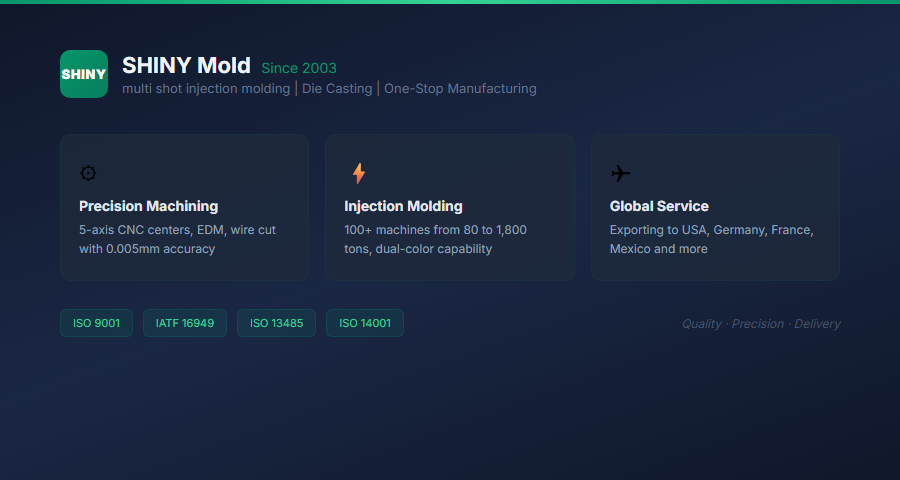
Founded in 2003, SHINY (Dongguan Xinxuan Mold) is headquartered in China's mold manufacturing hub — Chang'an, Dongguan. With fixed assets of USD 5 million, a facility spanning over 23,000 square metres, and a workforce of 400+ employees, SHINY specialises in high-precision molds for plastic injection, aluminium die-casting molds, and magnesium die-casting molds.
Backed by a comprehensive library of 5,000+ mold designs, SHINY delivers over 2,000 molds annually. Our in-house mold manufacturing capabilities include 5-axis CNC machining, EDM (sinker and wire), high-speed milling, precision grinding, and CMM inspection. Our products serve industries including automotive, new energy, medical devices, consumer electronics, home appliances, power tools, and lighting. With 100+ injection molding machines (80–1,800 tons), dual-colour injection capability, and dedicated assembly lines, SHINY provides end-to-end manufacturing from product design and prototyping to mold development, injection molding, and finished product assembly.
SHINY is certified under ISO 9001, ISO 14001, ISO 13485, and IATF 16949 quality management systems. Our clients span the United States, Canada, Mexico, Germany, France, Poland, and other European and American markets. We offer comprehensive DFM (Design for Manufacturability) feedback, Moldflow analysis, PPAP documentation, and lifetime mold maintenance programs.
The Mold Manufacturing Process: From Design to Production
- Design Review & DFM (Week 1–2)
- Part design evaluation for moldability
- DFM report with optimization recommendations
- Gate location, parting line, and ejection proposals
- Mold Design (Week 2–4)
- 3D mold design using SolidWorks, NX, or CATIA
- Moldflow analysis for filling, cooling, and warpage prediction
- Detailed 2D drawings for manufacturing
- Design approval by customer
- Material Procurement (Week 3–5)
- Mold base, steel plates, and standard components ordered
- Cavity/core steel procured from certified mills (Bohler, ASSAB, Daido)
- Hot runner system and custom components ordered
- CNC Machining & EDM (Week 5–9)
- Rough and finish CNC milling of cavity, core, and inserts
- EDM for deep ribs, sharp corners, and intricate details
- Wire EDM for ejector pin holes, insert pockets, and slides
- Assembly & Fitting (Week 9–10)
- Component assembly, alignment, and fitting
- Cooling circuit pressure testing
- Ejection system verification
- Mold Trial — T1 (Week 10)
- First injection molding trial on production machine
- Dimensional inspection (CMM) and visual evaluation
- T1 sample report and modification list
- Mold Adjustment & T2 (Week 11–12)
- Address T1 findings — dimensional corrections, polishing, texture
- Second trial with optimized process parameters
- Process window development and capability study (Cpk)
- Final Approval & Shipment (Week 12)
- Customer sign-off on T2/T3 samples
- Mold surface protection and shipping preparation
- Documentation package: 3D files, 2D drawings, BOM, maintenance manual
Key Technologies Shaping Molds for Plastic in 2026
Conformal Cooling with 3D-Printed Inserts
Metal 3D printing (DMLS/SLM) enables cooling channels that precisely follow the part contour — something impossible with traditional drilling. Conformal cooling reduces cycle times by 20–40%, improves dimensional stability, and virtually eliminates hot spots. For high-volume production, the cycle time savings often pay back the 3D-printed insert cost within months.
In-Mold Sensors and Industry 4.0
Smart molds equipped with cavity pressure sensors, thermocouples, and position transducers provide real-time data via IoT platforms. This enables automatic good/bad part sorting based on cavity pressure curves, predictive maintenance alerts, and closed-loop process control. The result: zero-defect production with minimal human intervention.
CAE Simulation and Digital Twins
Advanced simulation software (Moldflow, Moldex3D, Sigmasoft) now incorporates machine-specific parameters, cooling circuit dynamics, and material behavior modelling. Digital twin technology allows virtual mold commissioning — debugging the mold design and process in software before cutting steel. This dramatically reduces trial-and-error on the shop floor.
High-Speed Milling and 5-Axis Machining
Modern CNC machining centers achieve surface finishes down to Ra 0.1 μm directly from milling, reducing or eliminating the need for EDM and manual polishing. 5-axis simultaneous machining enables complex undercuts, deep ribs, and freeform surfaces in a single setup, cutting manufacturing time by 30–50%.
Sustainable Mold Design
Environmental considerations are influencing mold design: optimized cooling reduces energy consumption, hot runner systems eliminate runner waste, and modular mold designs allow cavities and cores to be replaced without scrapping the entire mold base. Some manufacturers now offer carbon-footprint tracking for each mold produced.
How to Choose the Right Mold Manufacturer
- Evaluate Technical Capability
- Do they have in-house tool design, CNC, EDM, and CMM?
- Do they use Moldflow or equivalent simulation software?
- What is their experience with your specific material and part type?
- Verify Quality Systems
- Certifications: ISO 9001 (minimum), IATF 16949 (automotive), ISO 13485 (medical)
- Do they provide PPAP Level 3, FAIR, SPC reports, and material certifications?
- Check Communication and Project Management
- Is there a dedicated project engineer for your mold?
- How do they handle design changes during manufacturing?
- Do they provide weekly progress updates with photos?
- Review After-Sales Support
- What is the warranty period and coverage?
- Do they offer lifetime mold maintenance and spare parts supply?
- What is their policy on mold modifications after delivery?
- Visit the Facility (If Possible)
- Inspect equipment condition, shop cleanliness, and organization
- Review mold samples and in-progress work
- Meet the engineering team and assess technical depth
Common Mistakes When Procuring Molds for Plastic
Mistake #1: Choosing the Lowest Quote
The cheapest mold often costs the most in the long run — through higher scrap rates, longer cycle times, more frequent maintenance, and shorter tool life. Evaluate total cost of ownership, not just upfront price.
Mistake #2: Skipping Moldflow Analysis
Moldflow simulation typically costs $500–$1,500 but can prevent tens of thousands in rework by identifying filling imbalances, weld lines, air traps, and warpage before any steel is cut.
Mistake #3: Neglecting DFM Feedback
Many manufacturers provide DFM reports; fewer customers actually read and act on them. DFM recommendations regarding draft angles, wall thickness, and gate placement are based on decades of experience — ignoring them is a costly gamble.
Mistake #4: Inadequate Mold Trial Specifications
A proper mold trial should include a dimensional report (all critical dimensions measured), process parameter documentation (for future reference), and capability study (Cpk ≥ 1.33 for critical features). Accepting samples without this data risks quality problems in production.
Mistake #5: Overlooking Maintenance Requirements
Every mold requires periodic maintenance: cleaning, lubrication, inspection of wear components, and polishing. Ask for a maintenance schedule and spare parts list before accepting delivery. A well-maintained mold can last decades; a neglected one can fail in months.
Frequently Asked Questions
How long does it take to make molds for plastic?
Standard lead time: 6–10 weeks for a typical single-cavity mold. Complex multi-cavity molds: 10–16 weeks. Aluminum prototype molds: 2–4 weeks. Expedited options are available at 30–50% premium.
What's the difference between a mold and a die?
In the context of plastics, "mold" (or "mould") is the standard term for injection molding tools. "Die" is more commonly used in metal stamping, die-casting, and extrusion. In injection molding, the terms "mold," "tool," and "tooling" are used interchangeably.
How many parts can a plastic mold produce?
With proper maintenance, P20 steel molds typically produce 500,000–1,000,000 shots; hardened steel (H13, S136) can exceed 2,000,000 shots. Some high-quality automotive molds have produced over 5 million parts before requiring major refurbishment.
Can I change the plastic material after the mold is made?
Yes, with caveats. Changing from one material to another may affect shrinkage rate (requiring dimensional adjustments), processing temperature (requiring cooling system changes), and mold wear rate. Always consult your mold manufacturer before switching materials.
Should I buy molds from China or locally?
Chinese mold manufacturers like SHINY Mold offer 30–60% cost savings versus Western counterparts while delivering comparable or superior quality when properly selected. The key is choosing a manufacturer with relevant certifications (ISO, IATF), proven export experience, and strong English communication. Many successful global brands source their molds for plastic from China while maintaining local molders for production.
Conclusion
Investing in the right molds for plastic is a strategic decision that reverberates through your entire product lifecycle — from time-to-market and piece-part cost to quality consistency and end-customer satisfaction.
In 2026, the best mold manufacturers combine traditional craftsmanship with cutting-edge technology: Moldflow simulation, 5-axis machining, conformal cooling, and IoT-enabled smart mold monitoring. The result is faster launches, lower scrap rates, and molds that keep producing for years — not months.
Whether you're developing a new consumer product, scaling an automotive component, or optimizing an existing part for cost reduction, investing time in mold design, material selection, and partner evaluation will pay dividends throughout your production run. Choose wisely — your mold is the foundation upon which your manufacturing success is built.