
 Chinese
Injection Molding Companies: How to Choose the Right Manufacturing Partner in 2026
Finding the right partner among thousands of injection molding companies is one of the most consequential decisions in product manufacturing. The moulder you choose directly impacts your product quality, unit economics, time-to-market, and long-term supply chain resilience.
This comprehensive guide helps you evaluate injection molding companies across the criteria that matter most: technical capability, quality systems, industry experience, communication, and total cost of ownership.
The Landscape of Injection Molding Companies in 2026
The global injection molding market is valued at over USD 400 billion, served by tens of thousands of injection molding companies across North America, Europe, and Asia. These range from small job shops with a handful of machines to multinational contract manufacturers operating hundreds of presses.
Broadly, injection molding companies fall into four categories:
1. Global Tier-1 Contract Manufacturers
Large multinationals with 50+ presses, global footprints, and full-service offerings (design, prototyping, tooling, molding, assembly, logistics). They serve automotive OEMs, medical device companies, and consumer electronics giants. They typically require high volumes (100,000+ parts/year) and command premium pricing.
2. Regional Full-Service Molders
Companies with 20-100 presses, in-house tool rooms, and strong expertise in specific industries or processes. They offer competitive pricing with more flexibility on volumes (5,000-500,000 parts/year). For most mid-market companies, these are the ideal injection molding companies to partner with.
3. Specialty Molders
Focused on niche processes — insert molding, overmolding, two-shot molding, micro molding, clean-room molding, or liquid silicone rubber (LSR) molding. They command premium pricing but deliver unmatched expertise in their specialty area.
4. Low-Cost / High-Volume Asian Molders
Primarily based in China, Vietnam, and India. These injection molding companies offer significantly lower tooling and piece prices but require careful quality management, longer supply chains, and robust communication protocols.
Key Criteria for Evaluating Injection Molding Companies
1. Technical Capability & Equipment
- Machine Tonnage — What range (e.g., 80-1,800 tons)? Can they run your specific part size?
- Machine Technology — All-electric vs. hydraulic vs. servo-hydraulic. All-electric machines offer ±0.01mm repeatability and 30-50% energy savings.
- Multi-Material Capability — Two-shot (dual-shot) / overmolding / insert molding for complex multi-material parts
- Automation — Robots for part removal, automated inspection, downstream assembly
- In-House Tool Room — 5-axis CNC, EDM (sinker and wire), CMM, surface grinding — enables fast mould maintenance and modifications
- CAE Simulation — Moldflow or Moldex3D for scientific mould design and process optimisation
2. Quality Systems & Certifications
| Certification | Scope | Required For |
|---|---|---|
| ISO 9001:2015 | General quality management | All serious manufacturers (minimum requirement) |
| ISO 13485:2016 | Medical device quality management | Medical, pharmaceutical, and healthcare applications |
| IATF 16949:2016 | Automotive quality management | Automotive OEM and tier-1/2 supply |
| ISO 14001:2015 | Environmental management | Regulatory compliance and customer ESG requirements |
| UL Recognition | Product safety testing | Electrical, electronic, and fire-rated applications |
Beyond certifications, ask injection molding companies about their quality processes:
- Statistical Process Control (SPC) — CPK/PPK data for critical dimensions
- First Article Inspection (FAI) — Detailed dimensional report per AS9102 or customer format
- Process Capability Studies — Design of Experiments (DOE) to establish robust process windows
- Traceability System — Lot-level or serial-level traceability for materials, machine, and process parameters
3. Industry Experience
The best injection molding companies have deep expertise in your specific industry. A moulder who has spent decades producing automotive connector housings understands the nuances of high-temperature LCP moulding, meeting IATF 16949 PPAP requirements, and managing VDA 6.3 process audits — knowledge that a general-purpose moulder cannot replicate overnight.
When evaluating injection molding companies, ask for:
- Case studies of similar parts
- Customer references in your industry
- Examples of design improvements they suggested to reduce cost or improve quality
- Experience with your target material specifications
4. Communication & Project Management
This is the most underrated criterion. Injection molding companies should provide:
- Design for Manufacturability (DFM) Feedback — Detailed engineering analysis with specific recommendations
- Regular Project Updates — Mould progress photos, trial reports, and milestone tracking
- Responsive Technical Support — Answers to technical questions within 24 hours
- English Proficiency — For international clients, clear written and spoken technical English
- Transparent Pricing — Itemised quotations with no hidden charges
SHINY Mold: One of China's Leading Injection Molding Companies
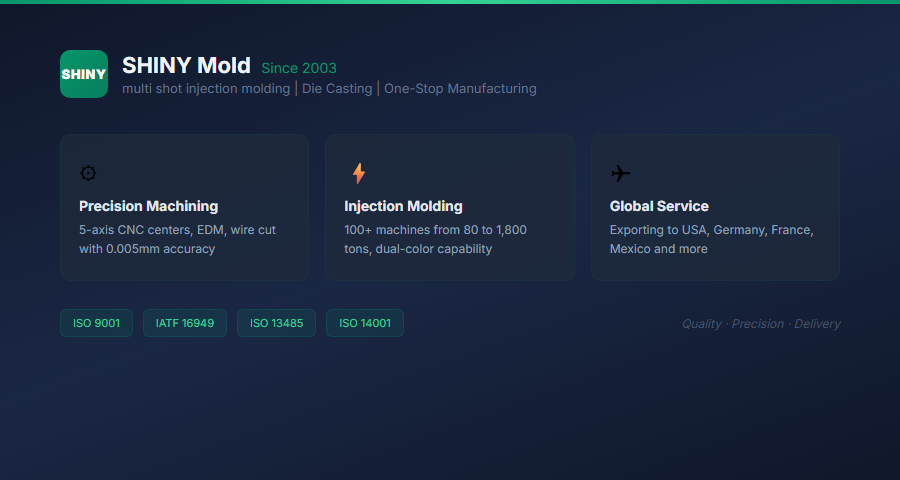
Founded in 2003, SHINY (Dongguan Xinxuan Mold) is headquartered in China's mould manufacturing hub — Chang'an, Dongguan. With fixed assets of USD 5 million, a facility spanning over 23,000 square metres, and a workforce of 400+ employees, SHINY stands among the most capable injection molding companies serving international clients.
SHINY is certified under ISO 9001, ISO 14001, ISO 13485, and IATF 16949. Our 100+ injection moulding machines (80–1,800 tons) include dual-colour capability, clean-room production, and automated assembly lines. With a design library of 5,000+ moulds and annual output exceeding 2,000 moulds, we deliver consistently to clients across the United States, Canada, Mexico, Germany, France, Poland, and other European markets.
From initial DFM and Moldflow simulation through mould fabrication, injection moulding production, and finished product assembly, SHINY provides end-to-end manufacturing solutions for automotive, medical, new energy, consumer electronics, and industrial applications.
Comparing Injection Molding Companies: Asia vs. North America vs. Europe
| Factor | Asian Molders (China) | North American Molders | European Molders |
|---|---|---|---|
| Tooling Cost | $$ (Lowest) | $$$$ (2-4x of Asia) | $$$$$ (3-5x of Asia) |
| Piece Price | $ (Low) | $$$ (2-3x of Asia) | $$$$ (3-4x of Asia) |
| Lead Time | 6-10 weeks (mould) | 8-14 weeks (mould) | 10-16 weeks (mould) |
| Communication | Variable, depends on exporter experience | Excellent, same time zone | Excellent, same time zone |
| Quality Standards | Comparable (IATF/ISO certified exporters) | Excellent (stringent enforcement) | Excellent (stringent enforcement) |
| Shipping & Logistics | 4-6 weeks sea freight | Domestic trucking | Domestic/EU trucking |
Questions to Ask Injection Molding Companies Before Partnering
- What is your machine tonnage range, and which machine suits my part?
- This reveals whether they understand part-specific process requirements or just want to fill machine capacity.
- Do you have an in-house tool room?
- In-house tool maintenance capability dramatically reduces downtime when mould repairs are needed.
- What is your approach to DFM?
- Do they provide written DFM reports with specific recommendations?
- Can you show me examples of similar parts you've produced?
- Look for dimensional complexity, surface finish requirements, and material overlap with your project.
- What quality data do you provide with each shipment?
- Certified dimensional reports, material certifications, CPK data, IMDS entries
- How do you handle design changes during the mould build?
- The best injection molding companies accommodate reasonable changes without punitive costs.
- What is your typical first-trial (T1) success rate?
- Experienced injection molding companies achieve 70-80% T1 acceptance, reducing time-to-market.
Red Flags When Evaluating Injection Molding Companies
- Vague responses — "We can make anything" without specific examples or technical depth
- No certifications — Or "we're working on it" without a clear timeline
- Unwilling to provide references — Legitimate injection molding companies are proud of their customer relationships
- Dramatically low quotes — 50% below competitors indicates substandard materials, shortcuts, or hidden costs
- No English communication — For international clients, a dedicated English-speaking project manager is essential
- No in-house tool room — Outsourced mould maintenance means longer downtime and less control over quality
Cost Structure: What Injection Molding Companies Charge
Tooling (Mould) Cost — One-Time NRE
- Simple single-cavity mould (e.g., cap, simple housing): $2,000 - $8,000 (Asia) / $8,000 - $25,000 (North America)
- Medium-complexity multi-cavity mould (e.g., connector housing, interior trim): $8,000 - $25,000 (Asia) / $25,000 - $80,000 (North America)
- Complex multi-slider mould (e.g., undercut automotive part, medical device): $25,000 - $80,000 (Asia) / $80,000 - $200,000+ (North America)
Piece Price — Per-Part Cost
- Small parts (<50g, commodity resin): $0.05 - $0.30 (Asia) / $0.15 - $0.80 (North America)
- Medium parts (50-500g, engineering resin): $0.30 - $2.00 (Asia) / $0.80 - $5.00 (North America)
- Large parts (>500g, filled resin): $2.00 - $10.00 (Asia) / $5.00 - $25.00 (North America)
Note: The cheapest injection molding companies are rarely the most cost-effective over the product lifecycle when you factor in mould life, scrap rate, defect-related downtime, communication delays, and shipping costs.
2026 Trends Transforming Injection Molding Companies
Digital Transformation & Industry 4.0
Leading injection molding companies are investing in IoT-enabled machines, real-time process monitoring, AI-driven quality prediction, and digital twin simulation. These technologies reduce setup time by 40%, scrap by 30%, and enable transparent real-time production reporting for customers.
Sustainability & Circular Economy
Environmental responsibility is reshaping how injection molding companies operate. Bio-based polymers, post-consumer recycled (PCR) resins, energy-efficient all-electric machines, and closed-loop water and material recycling systems are becoming competitive differentiators.
Near-Shoring & Regional Supply Chains
Geopolitical tensions, shipping volatility, and ESG requirements are driving many companies to diversify supply chains. Chinese injection molding companies with established export experience, international certifications, and strong English communication are positioning themselves as the most cost-effective compromise between Asian pricing and Western quality.
Additive Manufacturing for Mould Inserts
3D-printed conformal cooling channels in mould inserts reduce cycle time by 20-40% and improve dimensional consistency. The best injection molding companies are adopting metal AM to provide this advantage to their customers.
Frequently Asked Questions
How do I find reliable injection molding companies in China?
Look for companies with valid ISO 9001 and relevant industry certifications (IATF 16949 for automotive, ISO 13485 for medical). Verify certifications on the issuing body's website. Request customer references and video calls to tour the facility. SHINY Mold welcomes virtual factory tours and provides full certification documentation.
What is the minimum order quantity (MOQ) for injection molding companies?
MOQ varies widely. Large contract manufacturers may require 10,000+ parts per run. Mid-size injection molding companies typically accept 1,000-5,000 parts. For low-volume or prototype runs, 50-500 parts may be possible with aluminium tooling or soft tooling.
How long does it take to get production parts from injection molding companies?
Prototype tooling: 2-4 weeks. Production mould (single-cavity, standard complexity): 6-10 weeks for Chinese injection molding companies, 8-14 weeks for North American. Include 3-5 weeks for tool trials and approvals before production begins.
Should I use an injection molding company with or without an in-house tool room?
Always prefer injection molding companies with in-house tool rooms. When mould issues arise during production — and they will — in-house capability means 24-48 hour turnaround vs. 1-2 weeks sending the mould to an external tool shop.
Can injection molding companies handle parts that need secondary operations?
Yes. Many full-service injection molding companies provide printing (pad printing, screen printing, laser marking), coating (painting, plating, EMI shielding), ultrasonic welding, hot-stamping, assembly, and packaging. Inquire during the quoting stage.
Conclusion
Selecting from the thousands of injection molding companies operating worldwide is a strategic decision that should be based on technical capability, quality systems, relevant experience, and communication — not just price.
The best injection molding companies for your project are those that combine proven industry expertise, robust quality management, transparent communication, and competitive pricing. Whether you choose a moulder in Asia, North America, or Europe, invest time in thorough evaluation before committing. A well-chosen partner will deliver consistent quality, continuous improvement, and long-term value that far outweighs any initial price difference.
Contact SHINY Mold today to discuss your injection molding project and discover why leading companies across automotive, medical, and industrial sectors trust us as their manufacturing partner.