
 Chinese
Insert Molding: Combining Metal and Plastic for Enhanced Performance
Insert molding is an advanced manufacturing technique that integrates pre-placed metal components directly into injection-molded plastic parts during the molding process. This technology combines the strength and conductivity of metal with the design flexibility of plastic, creating hybrid components that excel in electrical, mechanical, and thermal applications.
From consumer electronics to automotive systems, insert molding enables innovative designs that would be impossible with either material alone. This guide covers everything you need to know about insert molding in 2026.

What Is Insert Molding?
Insert molding (also called metal insert molding or over-molding) places pre-formed metal components into the mold cavity before injection. As molten plastic fills the cavity, it flows around and bonds to the insert, creating a unified component upon cooling.
This process differs from traditional assembly, where separately manufactured parts are joined through fasteners, adhesives, or ultrasonic welding. Insert molding provides:
- Single-piece construction — Eliminates secondary assembly operations
- Superior bond strength — Molecular-level adhesion between plastic and metal
- Design flexibility — Complex geometries achievable
- Cost reduction — Reduced labor and assembly waste
Applications of Insert Molding
Electrical & Electronics
Insert molding excels in electrical applications where secure, conductive pathways are essential:
- **Connectors and terminals** — PCB-mounted components with soldered connections
- **Switches and relays** — Integrated contact systems
- **Battery contacts** — Coin cell holders, spring contacts
- **RF shielding** — EMI/RFI sensitive components
Automotive
Automotive applications leverage insert molding for reliability and functionality:
- **Sensor housings** — Integrated mounting and sealing
- **Fuel system components** — Threaded inserts for fittings
- **Powertrain electronics** — Heat-resistant integrated solutions
- **Lighting systems** — Reflector and mounting integration
Medical Devices
Medical applications demand sterile, unified solutions:
- **Surgical instruments** — Integrated metal tips and handles
- **Diagnostic equipment** — Precision mating surfaces
- **Implant components** — Bio-compatible combinations
Industrial & Consumer
Broad industrial applications include:
- **Fasteners and anchors** — Threaded inserts for plastics
- **Handles and grips** — Ergonomic over-molded solutions
- **Plumbing fixtures** — Valve and fitting integration
- **Power tools** — Motor housing and switch integration
Insert Molding Process Considerations
Insert Design
Successful insert molding requires careful insert design:
- Undercuts and knurling — Mechanical interlock features enhance retention
- Positive lead-in — Tapered features facilitate insertion
- Surface preparation — Clean, oxide-free surfaces improve bonding
- Thermal expansion — Account for differential expansion during cooling
- Location features — Precise positioning for mating surfaces
Mold Design
Mold considerations for insert molding:
- Insert locator pins — Precise positioning within cavity
- Pre-heating options — Temperature control for optimal flow
- Runner balancing — Uniform filling around inserts
- Ejection design — Careful part release consideration
- Ventilation — Air escape around inserts
Material Selection
Material compatibility with inserts affects bond quality:
| Metal Insert | Compatible Plastics | Recommendations |
|---|---|---|
| Brass | PA, PBT, POM, ABS | Excellent adhesion, cost-effective |
| Steel | PA, PBT, PPS | Requires surface treatment |
| Copper | PA, PBT, PEI | High thermal conductivity |
| Stainless Steel | PEEK, PSU, PES | Medical/corrosion applications |
| Aluminum | PA, PBT, PP | Lightweight applications |
Alternative: Over-Molding
Over-molding is a related technique where a second plastic layer is molded over a pre-molded plastic substrate. Common applications include:
- **Soft-touch grips** — TPE overmolded on rigid handles
- **Sealing surfaces** — Integrated gasket functions
- **Aesthetic surfaces** — Multi-color, multi-material design
- **Function integration** — Combined hard/soft components
Quality Considerations
Insert molding demands rigorous quality control:
- Insert positioning — Accuracy within ±0.05mm
- Bond strength — Pull testing to verify adhesion
- Dimensional inspection — Post-mold measurement
- Visual inspection — Flash, voids, surface defects
- Functional testing — Electrical continuity, torque retention
About SHINY Mold
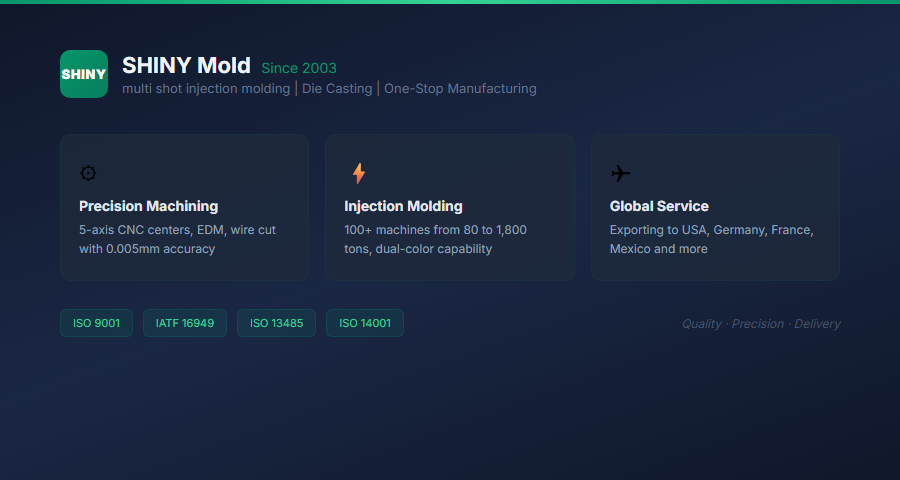
Founded in 2003, SHINY (Dongguan Xinxuan Mold) is headquartered in China's mold manufacturing hub — Chang'an, Dongguan. With fixed assets of USD 5 million, a facility spanning over 23,000 square meters, and a workforce of 400+ employees, SHINY specializes in high-precision plastic injection molds, aluminum die-casting molds, and magnesium die-casting molds.
With over 2,000 molds delivered annually and 100+ injection molding machines (80–1,800 tons), SHINY offers comprehensive insert molding and over-molding capabilities. Our services span from product design and prototyping to mold development, injection molding, and finished product assembly.
SHINY is certified under ISO 9001, ISO 14001, ISO 13485, and IATF 16949 quality management systems, serving clients across the United States, Canada, Mexico, Germany, France, Poland, and other global markets.
Choosing an Insert Molding Partner
Key considerations when selecting an insert molding manufacturer:
Technical Expertise
- Experience with your specific insert types
- In-house insert fabrication vs. customer-supplied
- Insert positioning technology
- Quality control capabilities
Equipment & Capacity
- Appropriate machine tonnage for your parts
- Insert pre-heating capabilities
- Cleanroom options for medical/electronics
- Production volume capacity
Quality Systems
- ISO 9001 certification essential
- IATF 16949 for automotive applications
- ISO 13485 for medical devices
- Process capability studies (Cpk)
Conclusion
Insert molding offers powerful advantages for applications requiring combined metal and plastic properties. By enabling single-piece construction with superior bond strength, this technology reduces assembly costs while improving product reliability and performance.
Successful insert molding requires careful attention to insert design, material selection, mold considerations, and quality control. Partnering with experienced manufacturers who understand these complexities ensures optimal results for your specific application requirements.
FAQ
What is the minimum order quantity for insert molding?
Insert molding MOQs depend on tooling investment and setup complexity. Low-volume prototype runs can begin at 500-1,000 pieces, while production typically requires 5,000+ units to justify custom insert tooling.
What metals can be insert molded?
Most machined metals work: brass, copper, steel, stainless steel, aluminum, and exotic alloys. Surface treatments (plating, coating) may be required for optimal adhesion with certain plastics.
How does insert molding compare to ultrasonic welding?
Insert molding provides stronger bonds (molecular adhesion vs. mechanical interlock), permits more complex geometries, and eliminates welding defects. However, tooling investment is higher.
Can inserts be reused in the molding process?
Some reusable mold inserts (rocker inserts, pintype inserts) exist for high-volume applications, reducing per-part insert costs. However, most applications use single-use stamped/turned components.
What causes insert push-out failures?
Push-out failures typically result from insufficient knurling/undercuts, poor surface preparation, incompatible materials, or inadequate injection pressure. Design review and process validation prevent these issues.