
 Chinese
Custom Injection Molding: Complete Guide to Precision Parts in 2026
Custom injection molding is the definitive manufacturing process for producing high-volume, precision plastic parts tailored to exact specifications. Whether you need functional components for automotive, medical, electronics, or consumer products, custom injection molding delivers the consistency, accuracy, and cost-efficiency that other processes simply cannot match.
This guide walks you through every critical aspect of custom injection molding — from material selection and part design to tooling, process optimization, and finding the right manufacturing partner.
What Is Custom Injection Molding?
Custom injection molding is a manufacturing service where a specialized molder produces plastic parts to a customer's exact design specifications. Unlike standard or catalog parts, custom injection molded parts are designed from scratch for a specific application, requiring unique tooling (moulds) fabricated to the customer's part geometry.
Key characteristics of custom injection molding:
- Tailored Design: Every part is engineered for its specific function, load condition, and environment
- Unique Tooling: Custom moulds are built exclusively for your part design
- High Consistency: Multi-cavity moulds produce identical parts with ±0.02mm repeatability
- Complex Geometries: Undercuts, threads, living hinges, and multi-material parts are achievable
- Material Flexibility: Thousands of engineering plastics available for any performance requirement
When to Choose Custom Injection Molding
Custom injection molding is the right choice when:
- Production volume exceeds 1,000+ pieces annually
- Part complexity requires precision that machining or 3D printing cannot achieve
- Material performance requirements demand engineering resins (heat-resistant, chemical-resistant, structural)
- Cost per part must be minimized through high-volume production
- Multiple identical parts are needed with zero batch variation
The Custom Injection Molding Process
Phase 1: Design & Engineering
- Concept Design — Define part function, materials, and target cost
- DFM (Design for Manufacturability) Review — Moulder provides feedback on mouldability, wall thickness, draft angles, and gate locations
- Moldflow Simulation — CAE analysis predicts fill patterns, weld lines, air traps, and sink marks before tooling
- Mould Design — Tool design finalized with cavity count, surface finish, and cooling layout
Phase 2: Tooling (Mould Fabrication)
- CNC Machining — Steel or aluminium blocks machined to mould cavity geometry
- EDM (Electrical Discharge Machining) — Complex cavity features, deep ribs, and precision details
- Polishing & Texturing — Surface finish applied (mirror polish, VDI texture, bead blast)
- Assembly & Tryout — Mould assembled and T1 trial moulding performed
- Mould Modification — Adjustments based on T1 sample inspection
- Final Validation — T2/T3 samples approved; mould ready for production
Phase 3: Production
- Process Setup — Machine parameters optimized (injection speed, holding pressure, cooling time)
- First Article Inspection (FAI) — CMM inspection of first parts against 3D model and drawing
- Statistical Process Control (SPC) — Critical dimensions monitored in real time
- Mass Production — Continuous moulding with periodic quality checks
- Secondary Operations — Printing, coating, welding, assembly as required
- Packaging & Shipment — Parts packaged to specification and shipped
Materials for Custom Injection Molding
Material selection is one of the most consequential decisions in custom injection molding. The right material determines part performance, appearance, cost, and manufacturability.
| Material | Class | Key Properties | Applications |
|---|---|---|---|
| ABS | Commodity | High impact, good surface finish | Electronics housings, automotive trim |
| PC | Engineering | High impact, optical clarity | Automotive lenses, safety shields |
| PA6/PA66 | Engineering | High strength, wear resistance | Gears, bearings, structural parts |
| POM | Engineering | Low friction, dimensional stability | Precision gears, fuel system parts |
| PBT | Engineering | Electrical insulation, chemical resistance | Connectors, sensor housings |
| PP | Commodity | Chemical resistance, living hinge | Food containers, living hinges |
| PEEK | High-Performance | Extreme temperature, chemical inertness | Aerospace, medical implants |
| GF-reinforced | Compounds | High stiffness, reduced warpage | Structural brackets, automotive |
About SHINY Mold
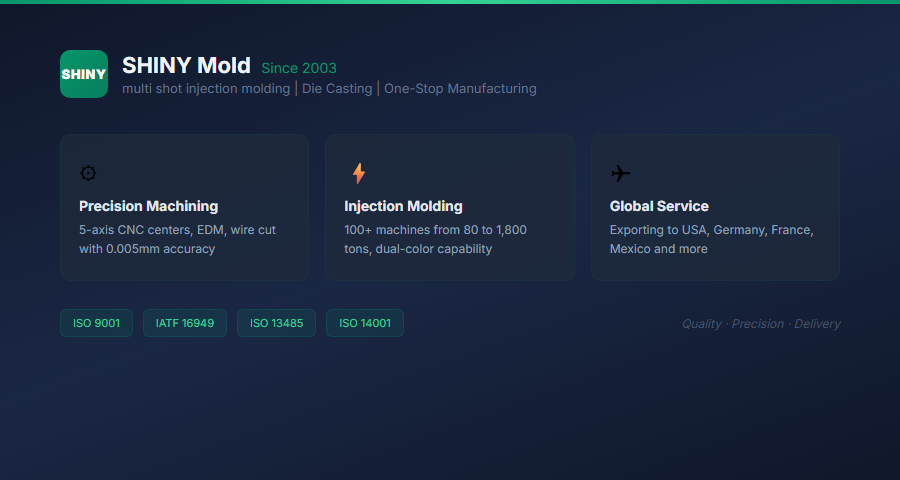
Founded in 2003, SHINY (Dongguan Xinxuan Mold) is headquartered in Chang'an, Dongguan — China's premier mould manufacturing hub. With USD 5 million in fixed assets, a 23,000+ square metre facility, and 400+ employees, SHINY specializes in high-precision plastic injection moulds, aluminium die-casting moulds, and magnesium die-casting moulds.
Leveraging a library of 5,000+ mould designs and producing 2,000+ moulds annually, SHINY serves automotive, new energy, medical, consumer electronics, home appliances, power tools, and lighting industries. With 100+ injection moulding machines (80–1,800 tons), dual-colour injection capability, and dedicated assembly lines, SHINY delivers end-to-end manufacturing: product design → prototyping → mould development → injection moulding → finished product assembly.
SHINY is certified under ISO 9001, ISO 14001, ISO 13485, and IATF 16949. Clients span the United States, Canada, Mexico, Germany, France, Poland, and other global markets.
Tooling Options for Custom Injection Molding
Aluminium Tooling (Prototype / Bridge)
- Lead time: 2–4 weeks
- Cost: USD 3,000–15,000
- Volume capacity: 100–10,000 shots
- Best for: Market validation, prototype testing, low-volume production runs
P20 Steel Tooling (Standard Production)
- Lead time: 6–10 weeks
- Cost: USD 8,000–40,000
- Volume capacity: 50,000–500,000 shots
- Best for: Standard production volumes
H13 / S136 Steel Tooling (High-Volume)
- Lead time: 10–16 weeks
- Cost: USD 20,000–100,000+
- Volume capacity: 500,000+ shots
- Best for: High-volume production, mirror-finish optics, tight-tolerance parts
How to Choose a Custom Injection Molding Partner
- In-House Tool Room
Choose a partner with in-house CNC, EDM, wire cutting, and CMM capabilities. This ensures faster mould tryout cycles, quicker modifications, and full quality control — without the delays of outsourcing tool work.
- Engineering Capability
Look for DFM analysis, Moldflow simulation, and experienced process engineers. A good custom injection molding partner catches design issues before tooling begins, saving costly mould modifications.
- Quality Certifications
ISO 9001 is the baseline. IATF 16949 for automotive, ISO 13485 for medical. These certifications ensure disciplined quality systems and traceability.
- Industry Experience
Ask for case studies and references in your industry. Automotive, medical, and electronics each have distinct quality and documentation requirements.
- Communication & Transparency
Choose a partner who provides regular project updates, shares inspection reports, and responds promptly. Language barriers and time zone differences should be manageable, not blockers.
Cost Optimization Strategies for Custom Injection Molding
Design for Manufacturability
Invest in a DFM review before tooling. Common DFM improvements that reduce cost:
- Optimize wall thickness to reduce material weight
- Add proper draft angles (0.5°–2°) to avoid ejection damage
- Consolidate multiple parts into a single moulded component
- Design gate locations to minimize flow length and pressure drop
Multi-Cavity Tooling
If your annual volume exceeds 50,000 pieces, a 2-cavity, 4-cavity, or 8-cavity mould dramatically reduces piece price. The additional tooling cost is typically recovered within months.
Material Selection
Work with your molder to identify cost-effective alternatives. For non-structural parts, commodity resins (PP, PE, ABS) often suffice at a fraction of the cost of engineering resins (PC, PA, POM).
Process Optimization
Scientific Moulding, DOE-based process development, and SPC reduce scrap rates from 5% to under 1%, directly improving your cost per good part.
2026 Trends in Custom Injection Molding
AI-Driven Process Optimization
Leading moulders are deploying AI and machine learning to optimize injection parameters in real time, reducing defect rates and cycle times without human trial-and-error.
Conformal Cooling Technology
3D-printed mould inserts with conformal cooling channels (following the part geometry) reduce cooling time by 20–40%, directly improving throughput and profitability.
Bio-Based & Recycled Materials
Sustainability mandates are driving adoption of bio-based polymers and recycled-content resins in custom injection molding, particularly in automotive and consumer goods.
Medical-Grade Moulding
Growing demand for disposable medical devices ( syringes, diagnostic kits, drug delivery components) is expanding the medical custom injection molding sector, with strict requirements for cleanroom production, ISO 13485 certification, and USP Class VI materials.
Common Custom Injection Molding Defects & Solutions
| Defect | Root Cause | Solution |
|---|---|---|
| Sink Marks | Insufficient holding pressure or short hold time | Increase holding pressure and time |
| Warpage | Non-uniform cooling, high wall thickness variation | Redesign cooling, add uniform wall thickness |
| Short Shot | Low melt temperature, insufficient injection pressure | Raise melt temperature, increase injection pressure |
| Flash | Excessive injection pressure, worn mould | Reduce pressure, repair or replace mould |
| Burn Marks | Trapped air, high injection speed, poor venting | Improve venting, reduce injection speed |
Conclusion
Custom injection molding is the most powerful process for producing high-quality, high-volume plastic parts to precise specifications. Success depends on three pillars: excellent part design (informed by DFM), precision tooling, and a skilled manufacturing partner with the engineering capability and quality systems to deliver consistent results.
In 2026, the best custom injection molding partners combine traditional craftsmanship with Industry 4.0 technologies — real-time SPC, AI-driven optimization, and digital traceability — to deliver parts that meet the most demanding quality standards at competitive prices.
Whether you're launching a new product, sourcing components for an existing assembly, or transitioning from another manufacturing process, investing the time to find the right custom injection molding partner will pay dividends in part quality, cost efficiency, and long-term reliability.