
 Chinese
Custom Injection Molding: Tailored Solutions for Your Manufacturing Needs in 2026
In today's rapidly evolving manufacturing landscape, custom injection molding has become an indispensable solution for companies seeking unique, high-quality plastic components tailored to their exact specifications. Whether you're developing an innovative consumer product, a precision medical device, or a specialized automotive component, custom injection molding offers the flexibility, precision, and scalability your project demands.
This comprehensive guide explores everything you need to know about custom injection molding in 2026: from design considerations and material selection to finding the right manufacturing partner and ensuring quality at every step.
What Is Custom Injection Molding?
Custom injection molding is a specialized manufacturing process where molten thermoplastic material is injected into a precision-machined mold designed specifically for your unique part geometry. Unlike standard or off-the-shelf solutions, custom molding creates components that perfectly match your exact dimensional requirements, material specifications, and performance criteria.
The custom molding process typically involves:
- Design Collaboration — Working with engineers to optimize your part design for manufacturability (DFM)
- Custom Mold Creation — Precision machining of molds tailored to your specific geometry
- Material Selection — Choosing the optimal thermoplastic for your application requirements
- Production — Manufacturing parts to your exact specifications and volume requirements
- Quality Assurance — Rigorous testing and inspection to ensure conformance
When to Choose Custom Injection Molding
Custom injection molding is the ideal solution when:
- Your part has unique geometry that cannot be achieved with standard components
- You require specific material properties (biocompatibility, chemical resistance, etc.)
- Brand differentiation demands distinctive design elements
- Production volumes justify the tooling investment (typically 1,000+ units)
- Integration of multiple functions into a single part reduces assembly complexity
Key Advantages of Custom Injection Molding
Design Freedom
Custom molding removes the constraints of standard parts. Complex geometries, integrated features, undercuts, threads, and multi-material combinations become achievable — limited only by engineering physics, not catalog availability.
Material Flexibility
From commodity resins to high-performance engineering thermoplastics, custom molding allows you to select materials optimized for your specific application requirements: UV stability for outdoor use, biocompatibility for medical devices, flame retardancy for electrical applications, or food-grade certification for packaging.
Cost Efficiency at Scale
While custom tooling requires upfront investment, per-part costs decrease dramatically as volume increases. For production runs exceeding 10,000 units, custom injection molding typically offers the lowest unit cost among manufacturing alternatives.
Consistent Quality
Once a custom mold is validated, it produces identical parts with exceptional consistency — shot after shot, year after year. This repeatability is essential for industries with strict quality requirements.
Brand Differentiation
Custom components enable unique product designs that distinguish your brand in the marketplace. Proprietary shapes, integrated features, and custom colors create competitive advantages that standard parts cannot provide.
Custom Mold Design Considerations
Part Design Optimization
Effective custom molding begins with Design for Manufacturing (DFM) analysis. Key considerations include:
- Wall thickness uniformity — Consistent walls prevent warping and sink marks
- Draft angles — Tapered surfaces facilitate part ejection (typically 0.5-2°)
- Corner radii — Rounded corners improve material flow and reduce stress concentration
- Gate location — Strategic gate placement minimizes weld lines and flow marks
- Rib design — Properly designed ribs add strength without causing sink marks
Mold Type Selection
The complexity and volume of your project determines the optimal mold type:
- Prototype molds (aluminum, soft steel) — Fast, low-cost, ideal for design validation (100-1,000 parts)
- Production molds (hardened steel) — Long tool life, high precision, optimized for high-volume production (100,000+ parts)
- Multi-cavity molds — Multiple parts per cycle, reducing per-part cost for high volumes
- Family molds — Multiple different parts in one mold, ideal for assemblies
Surface Finish Options
Custom molding offers a range of surface finishes to meet your aesthetic and functional requirements:
- High-gloss polish (SPI A-1 to A-3)
- Matte finish (SPI B-1 to D-3)
- Textured surfaces (VDI, Mold-Tech patterns)
- Spark-eroded textures
Material Selection Guide for Custom Parts
Choosing the right material is critical for custom injection molding success. Here's a practical guide to common engineering materials:
| Application | Recommended Materials | Key Properties |
|---|---|---|
| Automotive | PP, PA, PBT, TPE | Heat resistance, durability |
| Medical Devices | PC, PEEK, PSU, PEI | Biocompatibility, sterilization |
| Consumer Electronics | ABS, PC, PC/ABS, PMMA | Appearance, impact strength |
| Food Contact | PP, PE, POM | FDA compliance, chemical resistance |
| Industrial | POM, PA, PPS, PEEK | Wear resistance, strength |
Low-Volume Custom Injection Molding
Not every project requires millions of parts. Low-volume custom injection molding (typically 100-10,000 units) serves specialized needs:
- New product launches — Market testing before committing to high-volume production
- Niche markets — Specialized products with limited but steady demand
- Replacement parts — Legacy products where original tooling is unavailable
- Custom machinery components — Industrial equipment with unique requirements
Modern rapid tooling techniques have significantly reduced the cost and lead time for low-volume custom molding, making it accessible to startups and small businesses.
About SHINY Mold
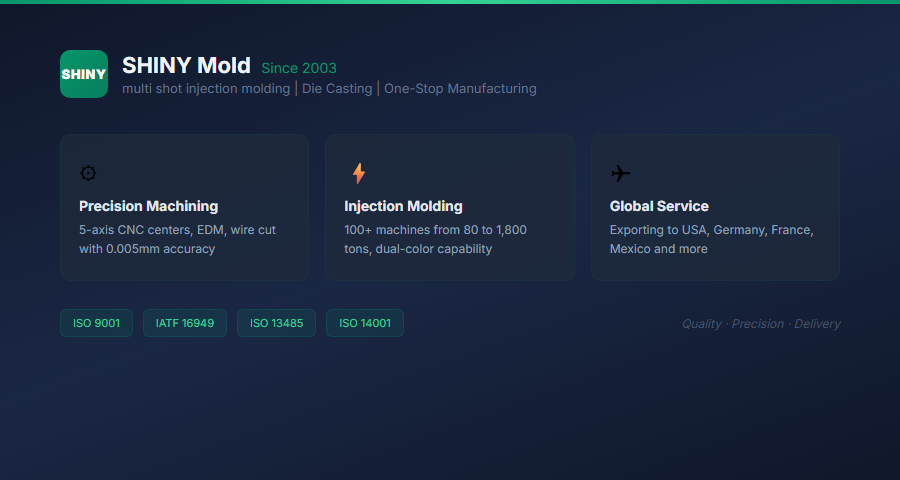
Founded in 2003, SHINY (Dongguan Xinxuan Mold) is headquartered in China's mold manufacturing hub — Chang'an, Dongguan. With fixed assets of USD 5 million, a facility spanning over 23,000 square meters, and a workforce of 400+ employees, SHINY specializes in high-precision plastic injection molds, aluminum die-casting molds, and magnesium die-casting molds.
Backed by a comprehensive library of 5,000+ mold designs, SHINY delivers over 2,000 molds annually. Our products serve industries including automotive, new energy, medical devices, consumer electronics, home appliances, power tools, and lighting. With 100+ injection molding machines (80–1,800 tons), dual-color injection capability, and dedicated assembly lines, SHINY provides end-to-end manufacturing from product design and prototyping to mold development, injection molding, and finished product assembly.
SHINY is certified under ISO 9001, ISO 14001, ISO 13485, and IATF 16949 quality management systems. Our clients span the United States, Canada, Mexico, Germany, France, Poland, and other European and American markets.
How to Choose a Custom Injection Molding Partner
Technical Capabilities
Evaluate the manufacturer's equipment and expertise:
- Range of injection molding machine sizes (tonnage)
- CNC machining precision for mold manufacturing
- CAE mold flow analysis capabilities
- Multi-material and dual-color molding capability
- In-house toolroom vs. outsourced mold making
Quality Management
Verify relevant certifications and quality systems:
- ISO 9001:2015 — Foundation of quality management
- IATF 16949:2016 — Essential for automotive supply chain
- ISO 13485:2016 — Required for medical device manufacturing
Engineering Support
The best custom molding partners provide engineering expertise, not just manufacturing capacity:
- DFM review and recommendations
- Material selection guidance
- Prototype development support
- Tolerance analysis and process capability studies
Communication and Responsiveness
Clear communication is essential for custom projects:
- English proficiency for international projects
- Regular progress updates and transparent timelines
- Responsive technical support
- Digital project management tools
Custom Injection Molding Process Timeline
A typical custom injection molding project follows this timeline:
| Phase | Duration | Key Activities |
|---|---|---|
| Design Review | 1-2 weeks | DFM analysis, material selection |
| Mold Design | 1-2 weeks | 3D modeling, mold flow simulation |
| Mold Manufacturing | 4-8 weeks | CNC machining, EDM, assembly |
| T1 Sampling | 1 week | First article inspection, dimensional check |
| Process Validation | 1-2 weeks | Parameter optimization, capability study |
| Production | Ongoing | Manufacturing, inspection, delivery |
Cost Factors in Custom Injection Molding
Tooling Investment
Custom mold costs vary significantly based on:
- Part complexity and size
- Number of cavities
- Mold material (aluminum vs. hardened steel)
- Special features (hot runners, side actions, unscrewing cores)
- Surface finish requirements
Per-Part Cost
Unit cost depends on:
- Material selection and consumption
- Cycle time (determined by part geometry and material)
- Machine size and hourly rate
- Secondary operations required
- Production volume (higher volume = lower unit cost)
Conclusion
Custom injection molding offers unparalleled flexibility for creating unique, high-quality plastic components tailored to your exact specifications. By understanding the design considerations, material options, and partner selection criteria outlined in this guide, you can make informed decisions that maximize the value of your custom molding investment.
The key to success lies in partnering with experienced manufacturers who combine technical excellence with responsive communication and proven quality management systems. With the right partner, custom injection molding transforms your design concepts into production reality — efficiently, consistently, and cost-effectively.
FAQ
What is the minimum order quantity for custom injection molding?
MOQs vary by manufacturer and project complexity. Some providers offer low-volume services (100-1,000 pieces) using prototype tooling, while production molds typically require minimums of 1,000-10,000 pieces to justify tooling investment.
How long does it take to create a custom mold?
Simple single-cavity molds can be completed in 2-4 weeks. Complex multi-cavity molds with advanced features may require 8-12 weeks. Rapid tooling for prototyping can reduce lead time to 1-2 weeks.
Can I make design changes after the mold is built?
Minor changes (such as adding metal-safe features) are often possible through mold modification. Major design changes may require new tooling. This is why thorough DFM review before mold construction is essential.
How do I ensure my custom parts meet specifications?
Work with certified manufacturers (ISO 9001, IATF 16949, ISO 13485), request first article inspection reports, process capability studies (Cpk), and establish clear acceptance criteria before production begins.