
 Chinese
Injection Molding Cost Estimation: Complete Guide to Calculate Your Parts in 2026
Accurate injection molding cost estimation is essential for making informed manufacturing decisions. Whether you're prototyping a new product or scaling to mass production, understanding the cost structure helps you optimize design, select materials wisely, and choose the right production partner.
This guide provides a comprehensive framework for estimating injection molding costs in 2026, covering mold investment, piece-price calculation, volume breakpoints, and proven cost-reduction strategies.
Key Cost Components in Injection Molding
Injection molding costs consist of two primary components:
- Mold Cost (CAPEX / NRE) — One-time cost to design and fabricate the injection mold
- Piece Price (OPEX) — Recurring cost per molded part, covering material, machine time, labor, and overhead
Additionally, some projects incur secondary operation costs (printing, coating, assembly) and quality assurance costs (inspection, testing, certification).
Mold Cost Estimation
Mold cost varies dramatically based on complexity, size, material, and cavity count. Below is a typical range for 2026:
| Mold Type | Typical Cost (USD) | Application |
|---|---|---|
| Prototype / 3D Printed Mold | $500 – $3,000 | 10–100 parts, concept validation |
| Aluminium Mold (Low Volume) | $3,000 – $15,000 | 1,000–10,000 parts |
| Standard Steel Mold (Single Cavity) | $8,000 – $30,000 | Medium-volume production |
| Multi-Cavity Steel Mold (2–8 cavities) | $25,000 – $80,000 | High-volume production |
| Complex Mold (Sliders, Lifters, Unscrewing) | $50,000 – $200,000+ | Automotive, medical, complex geometries |
Factors Affecting Mold Cost
- Part Size & Complexity — Larger parts require larger molds; complex geometries require more machined features
- Mold Material — P20 (standard), H13 (high-volume), S136 (corrosion-resistant), aluminium (prototype)
- Surface Finish — Standard polish vs. high-gloss / VDI 3400 texture (adds 15–30% cost)
- Cavity Count — Multi-cavity molds cost more upfront but reduce piece price
- Hot Runner vs. Cold Runner — Hot runner systems add $5,000–$30,000 but eliminate sprue/runner waste
- Lead Time — Expedited mold fabrication (3–4 weeks) typically carries a 20–40% premium
Piece Price Estimation
Piece price is calculated based on the following formula:
Piece Price = (Material Cost + Machine Cost + Labor Cost + Overhead) × (1 + Margin)

Where:
- Material Cost = Part Volume × Material Density × Material Price per kg + Runner/Sprue Waste
- Machine Cost  = Machine Hourly Rate × Cycle Time / 3600 / Cavity Count
- Labor Cost    = Operator Hourly Rate / (Parts per Hour × Efficiency)
- Overhead      = Shared costs (facility, QC, packaging, logistics)
Typical Machine Hourly Rates (2026, China)
| Machine Tonnage | Hourly Rate (USD) | Suitable Part Size |
|---|---|---|
| 80–150 tons | $25 – $45 | Small parts (<100g) |
| 150–350 tons | $40 – $70 | Medium parts (100–500g) |
| 350–800 tons | $65 – $120 | Large parts (500g–2kg) |
| 800–1800 tons | $100 – $200+ | Very large parts (>2kg) |
About SHINY Mold
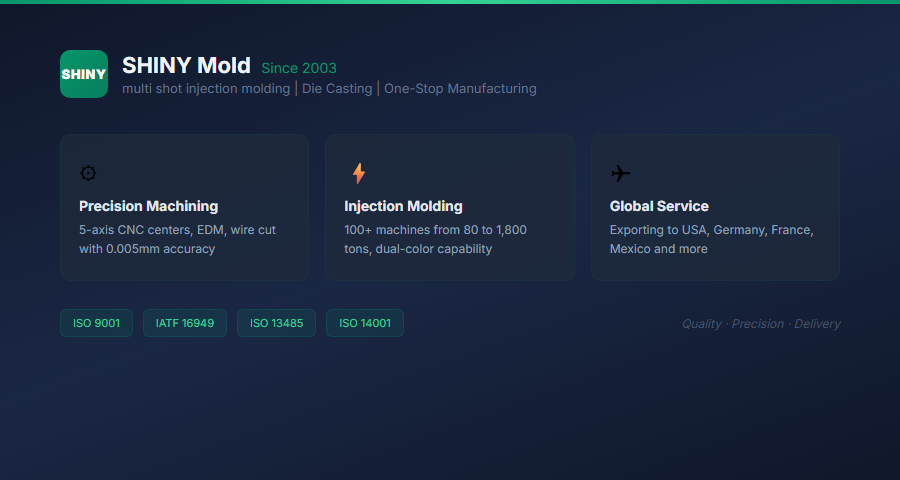
Founded in 2003, SHINY (Dongguan Xinxuan Mold) is headquartered in China's mould manufacturing hub — Chang'an, Dongguan. With fixed assets of USD 5 million, a facility spanning over 23,000 square metres, and a workforce of 400+ employees, SHINY specialises in high-precision plastic injection moulds, aluminium die-casting moulds, and magnesium die-casting moulds.
Backed by a comprehensive library of 5,000+ mould designs, SHINY delivers over 2,000 moulds annually. Our products serve industries including automotive, new energy, medical devices, consumer electronics, home appliances, power tools, and lighting. With 100+ injection moulding machines (80–1,800 tons), dual-colour injection capability, and dedicated assembly lines, SHINY provides end-to-end manufacturing from product design and prototyping to mould development, injection moulding, and finished product assembly.
SHINY is certified under ISO 9001, ISO 14001, ISO 13485, and IATF 16949 quality management systems. Our clients span the United States, Canada, Mexico, Germany, France, Poland, and other European and American markets.
Volume Breakpoints & Economies of Scale
Injection molding exhibits strong economies of scale. The piece price decreases significantly as volume increases, primarily because the mold cost is amortized over more parts.
| Production Volume | Mold Amortization per Part | Typical Piece Price Range |
|---|---|---|
| 100 parts | Very High | $5.00 – $50.00+ |
| 1,000 parts | High | $1.00 – $10.00 |
| 10,000 parts | Moderate | $0.30 – $3.00 |
| 100,000 parts | Low | $0.10 – $1.00 |
| 1,000,000+ parts | Negligible | $0.05 – $0.50 |
Cost Optimization Strategies
- Design for Manufacturability (DFM) — Simplify part geometry, eliminate undercuts, optimize wall thickness to reduce mold complexity and cycle time
- Optimize Cavity Count — Calculate the break-even point for multi-cavity molds based on volume and timeline
- Material Selection — Consider regrind allowance, standard resins vs. specialty compounds, and regional material availability
- Consolidate Secondary Operations — Choose a full-service molder to reduce logistics costs and quality risks
- Order in Economic Batch Quantities (EBQ) — Align order size with optimal machine setup and material batch sizes
- Negotiate Mold Ownership — Owning the mold gives you flexibility to switch suppliers and amortize cost across multiple production runs
Conclusion
Accurate injection molding cost estimation requires a holistic understanding of mold investment, piece-price drivers, volume economics, and optimization strategies. By partnering with an experienced injection molding service provider like SHINY Mold, you gain access to DFM expertise, transparent cost breakdowns, and end-to-end manufacturing capabilities that help you bring high-quality products to market on time and on budget.
Contact SHINY Mold today to request a detailed cost estimate for your injection molding project.