
 Chinese
Plastic Molding: The Complete Guide to Manufacturing Precision Parts in 2026
Plastic molding is one of the most versatile and widely used manufacturing processes in modern industry. From automotive components and medical devices to consumer electronics and home appliances, plastic molded parts are everywhere. Understanding the plastic molding process — its techniques, materials, design considerations, and cost drivers — is essential for engineers, product designers, and procurement professionals seeking to bring high-quality plastic parts to market.
This comprehensive guide covers everything you need to know about plastic molding in 2026: the major techniques, materials, design best practices, quality standards, and how to select the right manufacturing partner for your project.

What Is Plastic Molding?
Plastic molding is a manufacturing process that shapes liquid or soft plastic into solid parts using a mould (also spelled mold). The mould is a hollow cavity — typically made of steel or aluminium — that gives the plastic its intended shape as it cools and solidifies. Plastic molding enables the mass production of complex geometries with high precision and repeatability, at costs that drop significantly as volume increases.
The global plastic molding market is valued at over USD 250 billion and continues to grow at 4-5% annually, driven by demand from automotive lightweighting, medical device miniaturisation, and consumer electronics innovation.
Major Plastic Molding Techniques
1. Injection Molding
Injection molding is the dominant plastic molding technique, accounting for approximately 35% of all plastic part production by weight. Molten plastic is injected under high pressure into a mould cavity, where it cools, solidifies, and takes the shape of the cavity.
Key advantages: High precision (±0.02mm), excellent surface finish, complex geometries, high production rates, minimal post-processing.
2. Blow Molding
Blow molding stretches molten plastic over a mould cavity using compressed air, creating hollow parts.
3. Compression Molding
Compression molding presses heated plastic material into an open mould cavity using hydraulic pressure.
4. Rotational Molding
Rotational molding rotates a mould while heating it, allowing plastic powder to melt and coat the inside of the cavity evenly.
5. Extrusion Molding
Extrusion molding forces molten plastic through a die to create continuous profiles with constant cross-sections.
The Injection Molding Process: Step by Step
- Clamping — The mould closes and clamping force is applied.
- Injection — Molten plastic is injected into the mould cavity at high pressure.
- Dwelling — Additional material compensates for shrinkage.
- Cooling — The part solidifies inside the mould.
- Mould Opening — The moving half separates.
- Ejection — The part is pushed out by ejector pins.
Materials Used in Plastic Molding
| Material | Temp Resistance | Key Applications |
|---|---|---|
| ABS | -20 to 80°C | Electronics, automotive interior |
| PP | 0 to 100°C | Food containers, packaging |
| PC | -40 to 130°C | Safety glasses, automotive lenses |
| PA6/PA66 | -30 to 150°C | Gears, bearings, automotive |
| PEEK | -60 to 250°C | Aerospace, medical implants |
About SHINY Mold
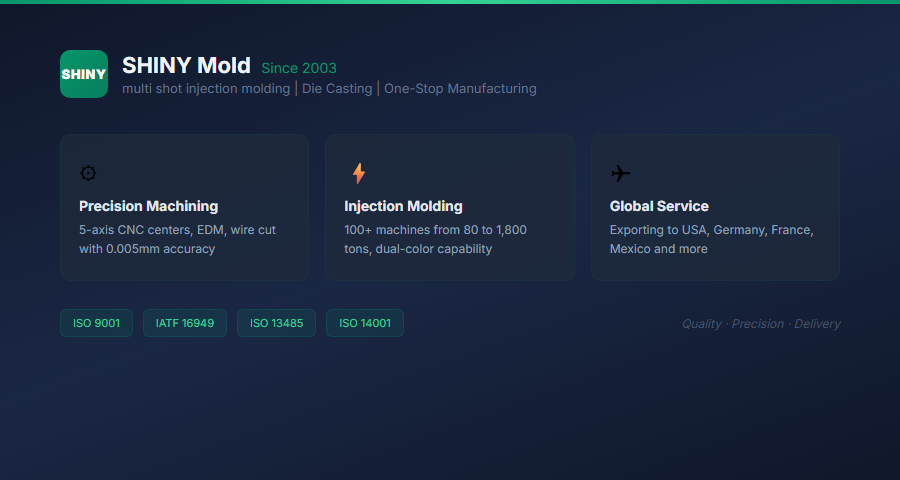
Founded in 2003, SHINY (Dongguan Xinxuan Mold) is headquartered in China's mould manufacturing hub — Chang'an, Dongguan. With fixed assets of USD 5 million, a facility spanning over 23,000 square metres, and a workforce of 400+ employees, SHINY specialises in high-precision plastic injection moulds, aluminium die-casting moulds, and magnesium die-casting moulds.
Backed by a comprehensive library of 5,000+ mould designs, SHINY delivers over 2,000 moulds annually. Our products serve industries including automotive, new energy, medical devices, consumer electronics, home appliances, power tools, and lighting. With 100+ injection moulding machines (80-1,800 tons), dual-colour injection capability, and dedicated assembly lines, SHINY provides end-to-end manufacturing from product design and prototyping to mould development, injection moulding, and finished product assembly.
SHINY is certified under ISO 9001, ISO 14001, ISO 13485, and IATF 16949 quality management systems. Our clients span the United States, Canada, Mexico, Germany, France, Poland, and other European and American markets.
Quality Standards in Plastic Molding
- ISO 9001:2015 — Foundation of quality management
- IATF 16949:2016 — Mandatory for automotive supply chain
- ISO 13485:2016 — Required for medical device manufacturing
- First Article Inspection (FAI) — Complete dimensional verification
- Statistical Process Control (SPC) — Real-time monitoring
Cost Drivers in Plastic Molding
Mould (Tooling) Cost
- Mould material — Aluminium (USD 3,000-15,000) to S136 steel (USD 50,000+)
- Cavity count — Multi-cavity increases tooling cost but reduces piece price
- Lead time — Standard 6-10 weeks, expedited 3-5 weeks at premium
Piece Price
- Material cost — Commodity resins USD 1.5-3.5/kg, engineering resins USD 5-50/kg
- Cycle time — Each second costs money; cooling optimisation is key
- Machine cost — Larger machines cost more per hour
Choosing the Right Plastic Molding Partner
- Technical Capability — In-house tool room, CAE simulation, machine range
- Quality System — ISO 9001 minimum, IATF 16949 for automotive
- Industry Experience — Track record in your target industry
- Communication — DFM feedback, project management, transparency
2026 Trends in Plastic Molding
Industry 4.0 Integration
IoT sensors, real-time monitoring, AI-driven defect detection, and digital twin simulation improve OEE by 15-25%.
Sustainability
Bio-based polymers, recycled-content resins, and energy-efficient all-electric machines are becoming competitive options.
Multi-Material Molding
Dual-shot and overmoulding enable complex multi-material parts in a single cycle.
Frequently Asked Questions
What is the minimum order quantity (MOQ)?
Production MOQ: 1,000+ pieces. Low-volume: 100-1,000 with aluminium tooling. Prototype: 25-100 pieces.
How long does it take to produce a mould?
Prototype: 2-4 weeks. Production: 6-10 weeks. Complex multi-cavity: 10-16 weeks.
What files do I need to provide for a quotation?
3D CAD model, 2D drawing with tolerances, material specification, estimated annual volume, quality requirements.
Conclusion
Plastic molding is the backbone of modern manufacturing. By understanding the techniques, materials, design principles, and cost drivers outlined in this guide, you can make informed decisions and choose a manufacturing partner that delivers quality, precision, and value.
If you're looking for a reliable plastic molding partner, SHINY Mold — with over two decades of experience, 400+ employees, 100+ injection moulding machines, and ISO/IATF certifications — is ready to support your project from concept to mass production.