
 Chinese
Automotive Injection Molding: Precision Solutions for the Electric Vehicle Era
As the automotive industry undergoes its most dramatic transformation in a century — driven by electrification, autonomous driving, and lightweighting — automotive injection molding has never been more critical. Modern vehicles contain over 3,000 plastic components, from interior trim and dashboard assemblies to under-hood parts, electrical connectors, and structural composites.
This guide explores how automotive injection molding is evolving to meet the demands of next-generation vehicles, the materials and processes driving innovation, and what automakers should look for in a moulding partner.

Why Automotive Injection Molding Matters More Than Ever
The shift to electric vehicles (EVs) has fundamentally changed the requirements for automotive plastic components:
- Weight Reduction — Every kilogram saved extends EV range. High-strength, lightweight plastics replace metal in brackets, housings, and structural components.
- Thermal Management — Battery packs, inverters, and electric motors generate heat. Engineering plastics with high thermal conductivity and flame resistance are essential.
- EMI Shielding — EVs are packed with electronics. Injection-moulded parts with integrated EMI shielding protect sensitive systems from interference.
- Aesthetic Differentiation — Without the distinctive sound and vibration of internal combustion engines, interior quality and tactile feel are primary brand differentiators.
- Sustainability — Automakers face pressure to reduce carbon footprint. Bio-based polymers, recycled-content resins, and design-for-recycling are becoming standard.
Key Applications of Automotive Injection Molding
1. Interior Components
Dashboard assemblies, center consoles, door panels, pillar trims, seat components, and interior lighting housings. These parts demand excellent surface finish (for painting or foil lamination), low VOC emissions, and compliance with FMVSS (Federal Motor Vehicle Safety Standards) flammability requirements.
2. Exterior Components
Grilles, bumper fascias, claddings, mirror housings, emblems, and aerodynamic elements. UV resistance, weatherability, and dimensional stability across temperature extremes are critical.
3. Under-Hood & Electrical Components
Connectors, sensor housings, fuse boxes, cable harness clips, cooling system components, and battery module parts. High-temperature resistance (150°C+), chemical resistance, and dimensional stability under thermal cycling are mandatory.
4. Lighting Components
Headlamp lenses, taillight housings, interior ambient lighting, and LED bezels. Optical clarity, UV stability, and precision mating with sealing gaskets define quality in this application.
5. Structural & Functional Components
Brackets, clips, fasteners, air intake manifolds, and composite structural parts. Glass-fibre-reinforced and carbon-fibre-reinforced plastics deliver metal-like strength at a fraction of the weight.
Materials for Automotive Injection Molding
| Material | Key Properties | Automotive Applications |
|---|---|---|
| PP (Polypropylene) | Chemical resistance, low density, low cost | Bumper fascias, interior trim, battery trays |
| ABS | Good impact resistance, excellent surface finish | Interior panels, dashboard, console trim |
| PC (Polycarbonate) | High impact, optical clarity, heat resistance | Headlamp lenses, transparent covers |
| PA6 / PA66 (Nylon) | High strength, wear resistance, heat resistance | Connectors, under-hood parts, clips |
| PBT | Good electrical properties, chemical resistance | Connectors, sensor housings, LED frames |
| LCP | Ultra-high temperature resistance, dimensional stability | High-speed connectors, micro-components |
| PC/ABS Alloy | Balance of impact, heat, and processability | Interior structural parts, painted exterior |
| GF-PA (Glass-Fibre Nylon) | High stiffness, strength, dimensional stability | Structural brackets, under-hood components |
Quality Standards for Automotive Injection Molding
Automotive injection molding suppliers must meet rigorous quality standards. The foundational certification is IATF 16949:2016 (replacing ISO/TS 16949), which mandates:
- Advanced Product Quality Planning (APQP) — Structured process for product development and validation
- Production Part Approval Process (PPAP) — Documented evidence that the manufacturing process consistently produces parts meeting requirements
- Failure Mode and Effects Analysis (FMEA) — Systematic identification and mitigation of potential failure modes
- Statistical Process Control (SPC) — Real-time monitoring of critical dimensions and process parameters
- Measurement System Analysis (MSA) — Verification that inspection equipment and methods produce reliable data
- Control Plan — Documented plan specifying process controls, inspection methods, and response actions
Additional automotive-specific requirements include:
- IMDS (International Material Data System) — Mandatory for material composition reporting to automotive OEMs
- REACH / RoHS Compliance — Restriction of hazardous substances
- VDA 6.3 — German automotive quality standard for process audits
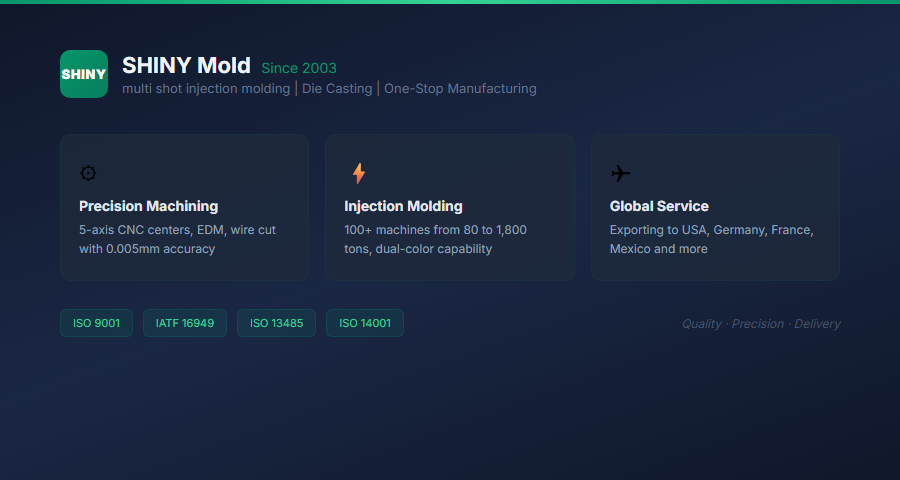
SHINY Mold: Trusted Automotive Injection Molding Partner
Founded in 2003, SHINY (Dongguan Xinxuan Mold) is headquartered in China's mould manufacturing hub — Chang'an, Dongguan. With fixed assets of USD 5 million, a facility spanning over 23,000 square metres, and a workforce of 400+ employees, SHINY specialises in high-precision plastic injection moulds, aluminium die-casting moulds, and magnesium die-casting moulds.
SHINY is certified under ISO 9001, ISO 14001, ISO 13485, and IATF 16949 quality management systems. Our automotive injection molding capabilities include 100+ injection moulding machines (80–1,800 tons), dual-colour injection, insert molding, overmolding, and clean-room molding for sensitive electronic components.
From design review and Moldflow simulation to mould fabrication, injection molding, and finished product assembly, SHINY provides end-to-end automotive manufacturing solutions. Our clients include leading automotive suppliers in the United States, Germany, France, and other European markets.
Automotive Injection Molding Process: Best Practices
1. Design for Manufacturability (DFM)
Early collaboration between part designer and moulding engineer prevents costly downstream issues. Key DFM considerations for automotive parts:
- Uniform wall thickness (prevents sink marks and warpage)
- Adequate draft angles (enables clean ejection)
- Proper fillets and radii (reduces stress concentration)
- Gating and ejection strategy (minimises visible marks on Class-A surfaces)
- Tolerance stack-up analysis (ensures assembly fit)
2. Moldflow / Moldex3D Simulation
CAE simulation is mandatory for automotive injection molding. Simulation predicts fill pattern, weld line locations, air traps, sink marks, and warpage before the first mould is cut. This reduces T1 (first trial) issues and shortens time-to-market.
3. Scientific Moulding
Scientific Moulding is a systematic approach to process development that decouples machine, mould, and material variables. The result is a robust process window where parts consistently meet specifications even as ambient conditions and material batches vary.
4. In-Process Quality Control
Automotive moulding demands 100% inspection of critical characteristics. Modern approaches include:
- Vision Inspection Systems — High-resolution cameras detect surface defects, short shots, flash, and colour variations
- CMM (Coordinate Measuring Machine) — Dimensional verification of critical features
- Functional Testing — Connectors are mated with gauges; sealing surfaces are leak-tested
- Traceability — Every part is traceable to machine, mould, material lot, and cycle time
Electric Vehicle (EV) Specific Injection Molding Requirements
EVs introduce new challenges and opportunities for injection moulding:
Battery System Components
- Battery Module Housings — Flame-retardant PC/ABS or PBT, often with EMI shielding coating
- Cell Spacers & Insulators — High-temperature PET or PBT with excellent electrical insulation
- Thermal Management Components — Liquid-cooling plates with overmoulded seals, requiring tight flatness tolerances
Power Electronics & Charging
- Inverter Housings — Aluminium die-cast or thermally conductive PPS (polyphenylene sulfide)
- Charging Port Assemblies — UV-stable, flame-retardant PC or PA66 with integrated EMI shielding
- High-Voltage Connectors — PBT or LCP with CTI (Comparative Tracking Index) > 600V
Lightweight Structural Components
- Composite Brackets — Glass-fibre or carbon-fibre reinforced PA6/PA66, replacing stamped steel
- Seat Structures — Glass-fibre PP with integrated metal inserts via insert molding
- Door Modules — Integrated carrier plates with snap-fits, clips, and cable routing features
Cost Optimization Strategies for Automotive Injection Molding
- Consolidate Parts via Overmolding / Insert Molding
- Multiple stamped metal parts + fasteners can often be replaced by a single overmoulded plastic assembly, reducing part count, assembly time, and total cost.
- Optimise Wall Thickness
- Thicker walls increase material cost and cycle time. Target the minimum wall thickness that meets structural and functional requirements.
- Use Family Moulds for Low-Volume Components
- Multiple related parts (left/right mirror housings, for example) can be moulded in a single tool, amortising tooling cost across parts.
- Consider Regrind Usage
- Non-critical interior parts can incorporate 10-20% regrind (recycled sprues and runners) without compromising properties, reducing material cost.
- Design for Automation
- Design parts with features that enable automated assembly (snap-fits, self-locating features) rather than screws or adhesive.
How to Select an Automotive Injection Molding Partner
- IATF 16949 Certification — Non-negotiable for automotive supply. Verify the certificate is current and covers the relevant scope.
- Automotive Project Experience — Ask for case studies: similar parts, similar volumes, similar quality requirements.
- In-House Tool Room — Mould maintenance and modification speed directly impact your production uptime. In-house tool capability is a major advantage.
- Engineering Support — Can they run Moldflow simulation? Do they provide DFM feedback? Will they jointly optimise the design for cost and quality?
- Supply Chain Transparency — Do they use approved material suppliers with full traceability? Can they provide IMDS entries and material certifications?
- Financial Stability — Automotive programmes run for 5-10 years. Your moulding partner must be financially stable to support the full programme lifecycle.
Future Trends in Automotive Injection Molding
Industry 4.0 & Smart Moulding
IoT sensors on moulding machines, real-time process monitoring, AI-driven process optimisation, and digital twin simulation are becoming standard among tier-1 automotive suppliers. These technologies reduce setup times, minimise defects, and provide the traceability automotive OEMs demand.
Sustainable Materials
Bio-based polymers (bio-PA, bio-PP), chemically recycled resins, and design-for-disassembly are gaining traction as automakers commit to carbon-neutral manufacturing. Leading moulders are developing expertise in processing these challenging materials.
Structural Composites
Carbon-fibre and glass-fibre reinforced thermoplastic composites are enabling structural metal replacement in seat structures, door modules, and chassis components. Injection-compression moulding and long-fibre overmolding are key enabling technologies.
Additive Manufacturing for Tooling
Conformal cooling channels — impossible to machine with traditional methods — can be 3D-printed into mould inserts using metal AM. This reduces cycle time by 20-40% and improves part quality by eliminating hot spots.
Frequently Asked Questions
What is the typical lead time for automotive injection moulding tools?
Single-cavity prototype tool: 3-4 weeks. Production tool (single-cavity, standard complexity): 8-12 weeks. Multi-cavity or complex tools with sliders/lifters: 12-20 weeks. Expedited programmes are possible at premium cost.
What is PPAP and when is it required?
PPAP (Production Part Approval Process) is the standard automotive industry process for approving production parts. Level 3 PPAP (including part submission warrant, samples, and full documentation package) is typically required for production release.
Can SHINY Mold handle production volumes of 100,000+ parts/year?
Yes. With 100+ injection moulding machines and automated material handling, SHINY routinely handles high-volume automotive programmes. Multi-cavity moulds and automated downstream equipment ensure cost-effective volume production.
Does SHINY provide material certification and traceability?
Yes. Every production lot is fully traceable to material batch, machine, mould, and process parameters. Material certifications (RoHS, REACH, UL) and IMDS entries are provided with every shipment.
What is the minimum order quantity (MOQ) for automotive injection molding?
For production parts, MOQ typically starts at 1,000 pieces. For prototype validation, low-volume runs of 50-500 pieces are possible using aluminium tooling or soft tooling.
Conclusion
Automotive injection molding is at the forefront of the mobility revolution. As vehicles become smarter, lighter, and electrified, the demands on plastic components — and the moulders who produce them — continue to rise.
Choosing the right automotive injection molding partner is a strategic decision. Beyond competitive piece price, you need a partner with IATF 16949 certification, proven automotive experience, in-house engineering capability, and the financial stability to support multi-year programmes.
SHINY Mold combines decades of precision mould-making expertise with state-of-the-art injection molding capabilities, serving leading automotive suppliers across North America and Europe. From initial design review to high-volume production and assembly, we deliver the quality, transparency, and reliability your automotive programme demands.
Ready to discuss your automotive injection molding project? Contact SHINY Mold today.