
 Chinese
Custom Plastic Injection Molding: The Complete Guide to Precision Manufacturing in 2026
Custom plastic injection molding is the backbone of modern manufacturing. From automotive components to medical devices, from consumer electronics to industrial parts — nearly every plastic product you touch was likely made through this process. But what exactly is custom injection molding, and how do you get started with your own project?
This comprehensive guide covers everything you need to know about custom plastic injection molding in 2026: the process, design principles, material selection, cost factors, and how to choose a reliable manufacturing partner.
What Is Custom Plastic Injection Molding?
Custom plastic injection molding is a manufacturing process where molten plastic is injected under high pressure into a precisely machined steel or aluminum mold cavity. Once the plastic cools and solidifies, the mold opens and the finished part is ejected.
The "custom" aspect means the mold (or tool) is designed and manufactured specifically for your part geometry — as opposed to standardized or off-the-shelf components. This gives you complete control over the part's shape, dimensions, material properties, surface finish, and functional characteristics.
How It Works: Step by Step
- Design & Engineering — Your part is designed (often as a 3D CAD model) and analyzed for manufacturability (DFM — Design for Manufacturing)
- Mold Design — A custom mold tool is designed based on your part geometry, with considerations for material flow, cooling, ejection, and cycle time
- Mold Fabrication — The mold is precision-machined from tool steel or aluminum using CNC milling, EDM, and other processes
- Mold Assembly & Try-Out — The mold is assembled, installed in an injection molding machine, and tested with initial sample runs
- Production — Once approved, the mold goes into full production, producing parts with consistent quality
- Quality Inspection — Parts are inspected for dimensional accuracy, material properties, and cosmetic quality
- Secondary Operations — If needed: assembly, printing, packaging, or other finishing
Benefits of Custom Plastic Injection Molding
1. Precision & Consistency
Injection molding produces parts with exceptional repeatability — tolerances of ±0.05mm are achievable. Every part from the same mold will be virtually identical, making it ideal for mass production where consistency matters.
2. Complex Geometries
Custom molds can incorporate complex features: threads, undercuts, side holes, snap fits, bosses, ribs, and living hinges — all molded in a single cycle. This reduces assembly requirements and part counts.
3. Wide Material Selection
Over 25,000 plastic grades are available for injection molding. From commodity materials (PP, PE, PS) to engineering plastics (ABS, Nylon, PC, POM) to high-performance materials (PEEK, PPSU, LCP) — there's a material for virtually every application.
4. High Production Efficiency
Once tooled, cycle times range from 5-90 seconds depending on part size and material. A single mold can produce hundreds of thousands to millions of parts over its lifetime.
5. Surface Finish Options
Molds can be textured, polished, or engraved to achieve specific surface finishes — from mirror-gloss to matte, leather-grain to custom textures.
6. Cost-Effective at Scale
While the initial tooling investment is significant ($5,000-100,000+), per-part costs drop dramatically at higher volumes, making injection molding the most economical choice for production runs exceeding 1,000 units.
Key Design Considerations for Custom Injection Molding
Draft Angles
All vertical walls in an injection molded part need a slight taper (draft angle) — typically 1-3 degrees — to allow the part to release from the mold. Without draft, parts will stick and the mold or part can be damaged.
Wall Thickness
Uniform wall thickness is critical for quality injection molding. Ideal ranges vary by material:
| Material | Min Wall (mm) | Max Wall (mm) | Recommended (mm) |
|---|---|---|---|
| ABS | 0.8 | 3.2 | 1.5-2.5 |
| Polypropylene (PP) | 0.6 | 3.8 | 1.2-2.5 |
| Polycarbonate (PC) | 1.0 | 3.5 | 1.5-3.0 |
| Nylon (PA66) | 0.4 | 3.0 | 1.0-2.5 |
| POM (Delrin) | 0.6 | 3.0 | 1.0-2.5 |
Ribs & Bosses
Ribs add strength without increasing wall thickness. A good rule of thumb: ribs should be 50-70% of the nominal wall thickness at their base. Bosses for screw holes should have proper design to avoid sink marks.
Radii & Fillet
Sharp corners create stress concentration points and can impede material flow. Internal corners should have a minimum radius of 0.5-1.0 times the wall thickness.
Undercuts
Features that would prevent a part from ejecting straight out of the mold require side actions or lifters. These add mold complexity and cost, so minimizing undercuts is usually wise for the first design iteration.
Material Selection for Custom Plastic Injection Molding
Choosing the right material is critical. Here's a practical guide to common materials:
Commodity Plastics (Cost-Effective)
- Polypropylene (PP) — Excellent chemical resistance, fatigue resistance (living hinges), low cost. Ideal for containers, hinges, automotive interior parts.
- Polyethylene (PE) — Good impact resistance, low friction. Ideal for caps, bottles, toys.
- Polystyrene (PS) — Rigid, clear or colored, easy to process. Ideal for housings, disposables.
- ABS — Tough, rigid, good surface finish. Industry standard for consumer electronics, automotive trim, appliances.
Engineering Plastics (Higher Performance)
- Nylon (PA6, PA66) — High strength, wear resistance, chemical resistance. Ideal for gears, bearings, structural parts.
- Polycarbonate (PC) — Exceptional impact strength, transparency. Ideal for safety equipment, windows, medical devices.
- POM (Delrin/Acetal) — Low friction, high stiffness, excellent dimensional stability. Ideal for precision mechanical parts.
- PBT/PET — Good electrical properties, dimensional stability. Ideal for connectors, electrical components.
High-Performance & Specialty Materials
- PEEK — Extreme temperature resistance (260°C continuous), chemical resistance. For aerospace, medical, oil & gas.
- LCP (Liquid Crystal Polymer) — Exceptionally high strength, thin-wall capability. For electronics, SMT connectors.
- TPE/TPU — Flexible, rubber-like properties. For overmolding, grips, seals.
- Glass-filled materials — Enhanced stiffness, reduced warpage. For structural applications.
Cost Factors in Custom Plastic Injection Molding
Initial Investment: Mold Cost
Mold cost is typically the largest upfront expense and varies based on:
- Part complexity — Simple 2-plate molds vs. multi-slide, hot-runner molds
- Cavity count — Single cavity vs. multi-cavity (higher throughput but more expensive mold)
- Mold material — Aluminum (prototype, lower volume) vs. tool steel (production, high volume)
- Features — Side actions, lifters, unscrewing mechanisms add complexity and cost
Typical mold cost ranges:
- Prototype aluminum mold: $1,000-8,000
- Production single-cavity steel mold: $5,000-30,000
- Complex multi-cavity production mold: $30,000-150,000+
Per-Part Cost
Unit price depends on:
- Material cost — From $1-2/kg (PP) to $50-100/kg (PEEK)
- Cycle time — Longer cycles = higher machine time cost
- Part weight — More material = higher material cost
- Secondary operations — Assembly, printing, packaging
- Quantity — Higher volume = lower per-part cost
Applications of Custom Plastic Injection Molding
Custom injection molding serves virtually every industry:
Automotive
Dashboard components, interior trim, engine covers, lighting housings, connectors, fluid reservoirs, and EV battery components.
Medical & Healthcare
Surgical instruments, diagnostic equipment housings, drug delivery devices, implantable components (with medical-grade materials), laboratory disposables.
Consumer Electronics
Smartphone cases, laptop housings, wearable device components, remote controls, headphone frames.
Industrial & Machinery
Gears, bearings, pump housings, valve components, conveyor parts, tool housings, electrical enclosures.
Consumer Goods
Kitchenware, toys, sports equipment, personal care products, furniture components, packaging.
How to Choose a Custom Plastic Injection Molding Partner
Selecting the right manufacturer is crucial for project success. Here's what to look for:
1. Technical Capability
- Mold design and fabrication in-house or trusted partner
- Machine range (clamp force from 30 to 1,800+ tons)
- Material processing experience across your material types
- Secondary operations capability (assembly, printing, packaging)
2. Quality Certifications
Look for ISO 9001 (quality management), ISO 13485 (medical devices), IATF 16949 (automotive), and ISO 14001 (environmental management).
3. Engineering Support
A good partner provides Design for Manufacturing (DFM) reviews, material recommendations, and optimization suggestions before cutting steel.
4. Communication & Support
English-speaking project managers, responsive communication, clear milestone tracking, and transparent pricing.
5. Lead Times
Typical mold fabrication lead times range from 2-8 weeks depending on complexity. Production lead times depend on quantity, material availability, and current capacity.
About SHINY Mold — Your Custom Injection Molding Partner
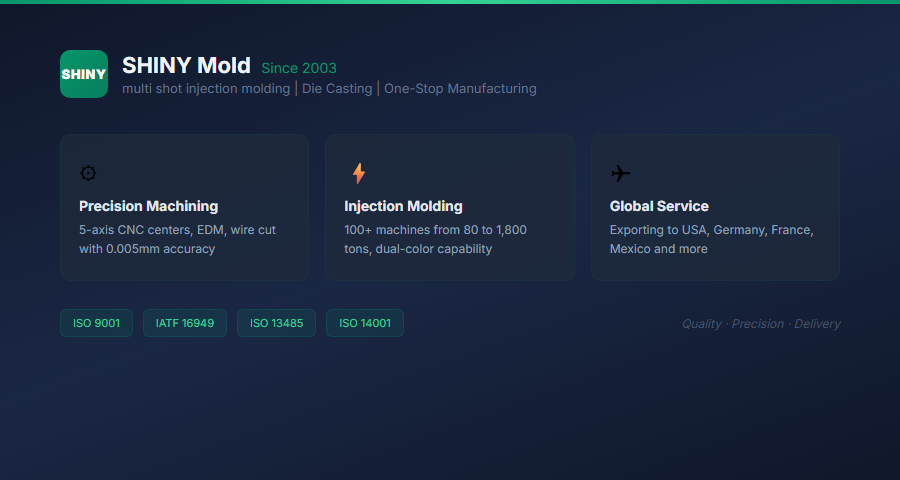
Founded in 2003, SHINY (Dongguan Xinxuan Mold Co., Ltd.) has been a trusted name in custom plastic injection molding for over two decades. From our 23,000+ square meter facility in Dongguan, China, we serve clients across automotive, medical, electronics, industrial, and consumer goods industries worldwide.
Our facility is equipped with 100+ injection molding machines ranging from 80 to 1,800 tons of clamp force, capable of producing parts from tiny precision components to large structural panels. Our mold design library includes over 5,000 proven designs, allowing us to respond rapidly to new project requirements.
SHINY is certified under ISO 9001 (2015), ISO 14001 (2015), ISO 13485 (2016), and IATF 16949 (2016) — ensuring that every project meets rigorous quality standards. From prototype tooling to high-volume production, SHINY delivers precision, reliability, and value.
Contact SHINY Mold for your custom injection molding project — where precision meets partnership.
Prototype Tooling vs. Production Tooling
Prototype (Bridge) Tooling
- Mold material: Aluminum or mild steel
- Mold life: 500-50,000 shots
- Lead time: 2-4 weeks
- Cost: 20-40% of production tooling
- Best for: Market testing, functional prototypes, small production runs
Production Tooling
- Mold material: Hardened tool steel (H13, S136, 1.2343, etc.)
- Mold life: 500,000-5,000,000+ shots
- Lead time: 4-10 weeks
- Cost: Higher upfront investment
- Best for: Large production runs, tight tolerances, regulated industries
The Custom Injection Molding Process: Step by Step
- Project Briefing — Share your part design (STEP, STP, or IGES files preferred) with requirements: material, volume, quality standards, timeline
- DFM Analysis — The manufacturer reviews your design for manufacturability and suggests improvements
- Quotation & Mold Design — Receive pricing, mold design proposal, and production timeline
- Tooling Approval — Approve the mold design and begin fabrication
- First Articles — Receive sample parts for dimensional validation and functional testing
- Production Approval — Approve samples and release for production
- Mass Production & Shipment — Parts are produced, inspected, and shipped
Common Custom Injection Molding Challenges & Solutions
Warpage
Cause: Uneven cooling, non-uniform wall thickness, material shrinkage. Solution: Uniform wall design, proper cooling channel layout, glass-filled materials for critical dimensions.
Sink Marks
Cause: Thick sections cool slower than surrounding thin areas. Solution: Core out thick sections, reduce wall thickness variations, optimize gate location.
Flash
Cause: Mold parting line gaps, excessive injection pressure. Solution: Proper mold maintenance, adequate clamp force, precise vent depth.
Short Shots
Cause: Insufficient material injection, poor flow. Solution: Increase injection pressure, enlarge gates, improve venting, select higher-flow materials.
Future Trends in Custom Plastic Injection Molding
1. Industry 4.0 & Smart Manufacturing
Real-time process monitoring, automated quality control with machine vision, and AI-driven process optimization are transforming injection molding efficiency.
2. Sustainable Materials & Processes
Bio-based plastics (PLA, PHA), recycled-content materials (rPET, rPP), and lightweighting through design optimization are driving the industry toward greener manufacturing.
3. Additive Manufacturing for Molds
3D-printed mold inserts with conformal cooling channels dramatically reduce cycle times by improving heat transfer in complex geometries.
4. Micro-Molding
Demand for miniature components in medical devices, electronics, and optics is driving innovations in micro-injection molding with sub-milligram shot accuracy.
Conclusion
Custom plastic injection molding remains the most versatile, cost-effective manufacturing process for producing high-quality plastic parts at scale. Success requires thoughtful part design, careful material selection, and — most importantly — a reliable manufacturing partner with the right capabilities and experience.
Whether you're prototyping a new product concept or scaling up to mass production, understanding the fundamentals of custom injection molding will help you make informed decisions that save time, reduce costs, and deliver better results.
Frequently Asked Questions
What is the difference between custom injection molding and standard injection molding?
Custom injection molding involves designing and fabricating a unique mold specifically for your part geometry. Standard injection molding uses existing molds for off-the-shelf components. Custom molding gives you complete control over part design, material, and quality.
How much does custom plastic injection molding cost?
Cost varies widely based on part size, complexity, material, and quantity. Mold tooling typically ranges from $1,000-150,000+. Per-part costs range from $0.10-10.00+ depending on volume and material. Contact SHINY Mold for a project-specific quote.
What files do I need to get a custom injection molding quote?
3D CAD files (STEP, STP, IGES, or native CAD formats) are preferred. A 2D drawing with critical dimensions and tolerances is helpful. Include material specifications, quality requirements, and estimated annual volume.
How long does custom mold fabrication take?
Prototype aluminum molds: 2-4 weeks. Production steel molds: 4-10 weeks. Complex molds with multiple actions or cavities may require longer lead times.
Can I make design changes after the mold is made?
Minor changes can sometimes be made by welding and re-machining the mold. Major changes typically require a new mold. Thorough DFM review and sample approval before production help avoid costly late-stage changes.