
 Chinese
Custom Plastic Molding: Complete Guide to Tailored Manufacturing Solutions in 2026
Custom plastic molding is the backbone of modern manufacturing — enabling businesses to create precisely engineered plastic components that meet exact specifications for shape, size, material, and performance. From medical devices to automotive parts, consumer electronics to industrial equipment, custom molded plastics are everywhere.
But what does the custom plastic molding process actually involve? How do you go from a concept to a production-ready molded part? And what should you consider when selecting a molding partner?
This comprehensive guide walks you through everything you need to know about custom plastic molding in 2026 — covering design principles, material selection, tooling strategies, cost factors, and how to choose the right manufacturer for your project.

What Is Custom Plastic Molding?
Custom plastic molding refers to the manufacturing process of creating plastic parts designed to a customer's specific requirements — as opposed to standard or off-the-shelf components. The most common method is custom injection molding, where molten plastic is injected into a precision-machined mold cavity under high pressure.
Key Characteristics of Custom Molding
- Unique tooling: Each project requires a dedicated mold designed for that specific part
- Design flexibility: Virtually any geometry can be molded, including complex features like undercuts, threads, and internal structures
- Material versatility: Hundreds of engineering-grade thermoplastics and thermosets available
- Production scalability: From prototype runs of 100 parts to annual volumes exceeding 10 million
- Cost efficiency at scale: Per-part cost decreases dramatically as volume increases
Custom vs. Standard Plastic Parts
| Factor | Custom Molding | Standard Parts |
|---|---|---|
| Design freedom | Unlimited | Limited to catalog |
| Tooling cost | $5,000-$100,000+ | None |
| Per-part cost | $0.10-$50+ (volume dependent) | Fixed retail price |
| Lead time | 4-12 weeks | Immediate |
| Minimum order | 500-5,000 pieces | 1 piece |
| Quality control | Full traceability | Varies |
The Custom Plastic Molding Process: Step by Step
Step 1: Project Definition & Requirements
Every successful custom molding project begins with clear requirements:
- Function: What does the part do? What loads, temperatures, and environments must it withstand?
- Geometry: Overall dimensions, wall thickness, features (bosses, ribs, snap-fits)
- Material requirements: Strength, flexibility, chemical resistance, UV stability, transparency
- Regulatory: FDA, UL, RoHS, REACH, medical-grade certifications
- Volume: Annual demand and total project lifecycle
- Budget: Tooling budget and target per-part cost
Step 2: Design for Manufacturability (DFM)
DFM analysis identifies and resolves potential manufacturing issues before tooling investment:
Critical DFM Considerations
- Uniform wall thickness: Variation ≤20% prevents sink marks and warpage
- Draft angles: 1-3° minimum for ejection (polished surfaces can use less)
- Radii: All internal corners need fillets (min 0.5mm) to reduce stress concentration
- Gate location: Affects weld lines, flow patterns, and cosmetic appearance
- Ejection strategy: Part must release cleanly from the mold
- Material flow: Long thin sections may need flow analysis to prevent short shots
Professional molders provide DFM feedback as part of their service — this is one of the most valuable reasons to work with an experienced custom molding partner.
Step 3: Material Selection
Choosing the right material is critical. Here are the most common categories for custom molded parts:
General Purpose Materials
- PP (Polypropylene): Chemical resistant, lightweight, low cost — ideal for containers, caps, and consumer goods
- PE (Polyethylene): Impact resistant, flexible — HDPE for rigid parts, LDPE for flexible
- PS (Polystyrene): Rigid, transparent options, easy to process — packaging, disposable items
Engineering Materials
- ABS: Tough, good surface finish — enclosures, automotive interior, consumer electronics
- PA (Nylon): High strength, wear resistant — gears, bearings, mechanical components
- PC (Polycarbonate): Transparent, impact resistant — lenses, safety equipment, medical devices
- POM (Acetal/Delrin): Excellent dimensional stability — precision mechanical parts
- PBT: Good electrical properties — connectors, electrical components
High-Performance Materials
- PEEK: Extreme temperature resistance (up to 250°C), chemical resistant — aerospace, medical implants
- PPS: Dimensional stability, chemical resistance — automotive under-hood, industrial
- LCP: Thin-wall capability, high flow — miniaturized electronics connectors
- PEI (Ultem): High strength at temperature, flame retardant — aerospace, automotive
Glass-Filled Variants
Most engineering materials are available with 10-40% glass fiber reinforcement for increased stiffness, dimensional stability, and heat resistance. Trade-offs include increased abrasiveness (shorter mold life) and anisotropic properties.
Step 4: Mold Design & Construction
The mold is the most critical and expensive component of custom plastic molding:
Types of Molds
- Prototype/soft tooling: Aluminum molds, 100-10,000 shots — $2,000-$15,000
- Production tooling: Hardened steel (P20, H13, S136), 500,000+ shots — $15,000-$150,000+
- Multi-cavity: 2-64+ cavities for high-volume production — increases throughput but also cost
- Family molds: Multiple different parts in one mold — cost-effective for low-volume assemblies
Mold Features
- Hot runner vs. cold runner: Hot runners eliminate waste but add $5,000-$30,000 to mold cost
- Side actions (lifters/sliders): For external undercuts — adds complexity and cost
- Unscrewing mechanisms: For molded threads — mechanical or hydraulic
- Conformal cooling: 3D-printed cooling channels — reduces cycle time 20-40%
- Mold surface finish: From SPI A-1 (mirror) to SPI D-3 (rough texture)
Step 5: Sampling & Validation
Before production, sample parts are molded and validated:
- T1 samples: First-off parts for dimensional and visual assessment
- Dimensional inspection: CMM, optical measurement, or 3D scanning
- Material testing: Melt flow index, tensile testing if required
- Process optimization: Adjusting temperature, pressure, and timing parameters
- PPAP (if automotive): Production Part Approval Process documentation
Step 6: Production & Quality Control
Once validated, production runs with ongoing quality controls:
- Process monitoring: Real-time tracking of injection pressure, temperature, cycle time
- SPC (Statistical Process Control): Tracking key dimensions over time
- In-process inspection: Visual checks at defined intervals
- Final inspection: AQL sampling per customer requirements
- Traceability: Lot tracking from raw material to shipped parts
Cost Factors in Custom Plastic Molding
Tooling Costs
The mold represents the largest upfront investment:
| Mold Type | Cost Range | Lifecycle | Best For |
|---|---|---|---|
| Aluminum prototype | $2,000-10,000 | 100-5,000 shots | Prototyping, market testing |
| Single cavity steel | $10,000-40,000 | 500,000+ shots | Low-medium volume |
| Multi-cavity steel | $30,000-150,000+ | 1,000,000+ shots | High volume production |
| High-cavitation (32+) | $100,000-500,000+ | 5,000,000+ shots | Commodity parts |
Per-Part Costs
Part cost depends on several factors:
- Material cost: $2-50/kg depending on grade (commodity vs. high-performance)
- Cycle time: 10-120 seconds — directly impacts machine time cost
- Cavitation: More cavities = lower per-part cost (after amortizing tooling)
- Part weight: Heavier parts use more material and may need larger machines
- Secondary operations: Assembly, painting, printing, machining add cost
- Quality requirements: Medical/aerospace grade = more inspection = higher cost
Cost Optimization Strategies
- Design for manufacturability: Good DFM can reduce tooling cost 20-40% and cycle time 15-30%
- Material substitution: Evaluate if a lower-cost material meets requirements
- Family molds: Combine related parts in one mold for low-volume items
- Cavitation optimization: Match cavity count to annual volume for best economics
- Overmolding alternatives: Consider assembly vs. multi-shot molding for lower volumes
- Supply consolidation: Partner with a molder who can handle multiple part numbers
Common Custom Plastic Molding Techniques
Injection Molding
The most versatile and widely used method for custom plastic parts. Suitable for virtually any thermoplastic, any volume, and most geometries.
Overmolding / Two-Shot Molding
Molding a second material over a first substrate — commonly used for soft-grip handles, sealed enclosures, and multi-color parts. Requires specialized tooling and machines.
Insert Molding
Molding plastic around a pre-placed insert (metal threaded inserts, electrical contacts, reinforcement). Combines assembly steps into a single operation.
Gas-Assist Molding
Nitrogen gas injected into thick sections to create hollow parts — reduces weight, eliminates sink marks, and shortens cycle time for large structural parts.
Micro-Molding
Precision molding of parts weighing less than 1 gram with features down to 0.1mm — used in medical devices, micro-electronics, and watch components.
Structural Foam Molding
Low-pressure process producing lightweight, rigid parts with a cellular core — ideal for large structural components like pallets, tanks, and housings.
About SHINY Mold
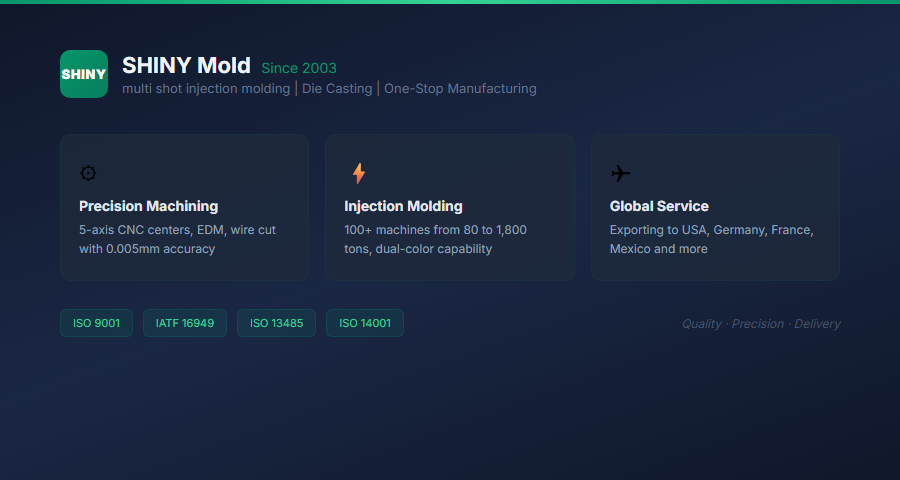
Since 2003, SHINY (Dongguan Xinxuan Mold) has been a trusted partner for custom plastic molding. Operating from our 23,000+ sqm facility in Dongguan, China, we run 100+ injection molding machines ranging from 80 to 1,800 tons — handling everything from micro-molded components to large structural parts.
Our mold design library of 5,000+ proven designs accelerates project timelines. SHINY holds ISO 9001, ISO 14001, ISO 13485 (medical), and IATF 16949 (automotive) certifications — ensuring every custom molded part meets the highest quality standards.
Whether you need prototype tooling for 500 parts or production tooling for 5 million, SHINY provides full-service custom molding — from DFM analysis through production and delivery.
How to Choose a Custom Plastic Molding Partner
Technical Capabilities
- Machine range: Do they have machines appropriate for your part size and material?
- Engineering support: Can they provide DFM analysis and design optimization?
- Material expertise: Experience with your required material grade
- Secondary operations: In-house assembly, painting, printing capabilities
- Testing capabilities: Dimensional, material, and functional testing
Quality Systems
- ISO certifications: Relevant to your industry (9001 baseline, 13485 medical, 16949 automotive)
- Process control: SPC implementation, process documentation
- Traceability: Lot and batch tracking systems
- Corrective action: Documented CAPA process for quality issues
Production Flexibility
- Volume range: Can they handle both low-volume prototype and high-volume production?
- Scheduling: Lead times for tooling and production
- Surge capacity: Ability to scale up for demand increases
- Inventory management: Kanban, safety stock, VMI programs
Communication & Support
- Project management: Dedicated point of contact, regular updates
- Language capability: English-speaking engineering team for international customers
- Time zone: Responsiveness during your business hours
- Reporting: Regular quality and production reports
Common Mistakes in Custom Plastic Molding Projects
1. Skipping DFM Analysis
Investing in tooling without DFM review is the most common and expensive mistake. A simple DFM analysis can prevent costly mold modifications ($5,000-$50,000+ per change) and production issues.
2. Over-Specifying Tolerances
Not every dimension needs ±0.05mm tolerance. Over-tolerancing increases cost and reduces yield. Apply tight tolerances only where function demands it.
3. Ignoring Material Drying Requirements
Hygroscopic materials (nylon, PC, PET, TPU) must be dried before processing. Improper drying causes cosmetic defects and reduced mechanical properties.
4. Designing Without Draft
Zero draft makes part ejection difficult or impossible, causing drag marks, sticking, and potential part damage. Always include at least 0.5-1° draft.
5. Choosing Price Over Capability
The lowest molding quote often means the lowest quality. Evaluate total value — including engineering support, quality systems, and long-term reliability.
Industries Served by Custom Plastic Molding
- Automotive: Interior trim, under-hood components, lighting housings, sensor enclosures
- Medical: Device housings, surgical instrument handles, diagnostic components, drug delivery
- Consumer Electronics: Enclosures, connectors, buttons, structural frames
- Industrial: Valve bodies, pump components, gear housings, cable management
- Packaging: Caps, closures, dispensers, custom containers
- Aerospace: Interior components, ducting, lightweight structural elements
- Appliances: Housings, handles, internal components, control panels
Conclusion
Custom plastic molding remains the most versatile and cost-effective manufacturing method for producing plastic components to exact specifications. Success depends on three factors: thoughtful design (DFM), the right material selection, and a capable manufacturing partner.
Whether you're developing your first custom molded part or optimizing an existing production program, the principles in this guide will help you make informed decisions, avoid common pitfalls, and achieve the best possible results from custom plastic molding.
The investment in good design, proper tooling, and an experienced molding partner pays dividends throughout the entire product lifecycle — from first article samples through millions of production parts.
FAQ
How much does custom plastic molding cost?
Tooling ranges from $2,000 (prototype aluminum) to $150,000+ (multi-cavity production steel). Per-part costs range from $0.10 for simple high-volume parts to $50+ for complex low-volume components. Request quotes with your 3D model for accurate pricing.
What is the minimum order quantity for custom plastic molding?
Typically 500-5,000 pieces for production runs. Prototype molding can be as low as 50-100 pieces. The mold investment makes very small quantities uneconomical — consider 3D printing or CNC machining for quantities under 100.
How long does custom plastic molding take?
Tooling: 4-8 weeks for standard molds, 2-4 weeks for prototype molds. Production: 2-4 weeks after T1 sample approval. Total project timeline from PO to first production: typically 6-12 weeks.
Can I use custom plastic molding for medical devices?
Yes, with a molder holding ISO 13485 certification. Medical molding requires validated processes, cleanroom capability (Class 7 or 8), full traceability, and biocompatible materials. Not all custom molders offer medical-grade production.
What file format do I need for custom plastic molding?
3D CAD files in STEP, IGES, or native format (SolidWorks, Creo, etc.). 2D drawings with tolerances and material specifications are also needed. STL files (used for 3D printing) are NOT suitable for injection molding — they lack the precision and feature definition required.