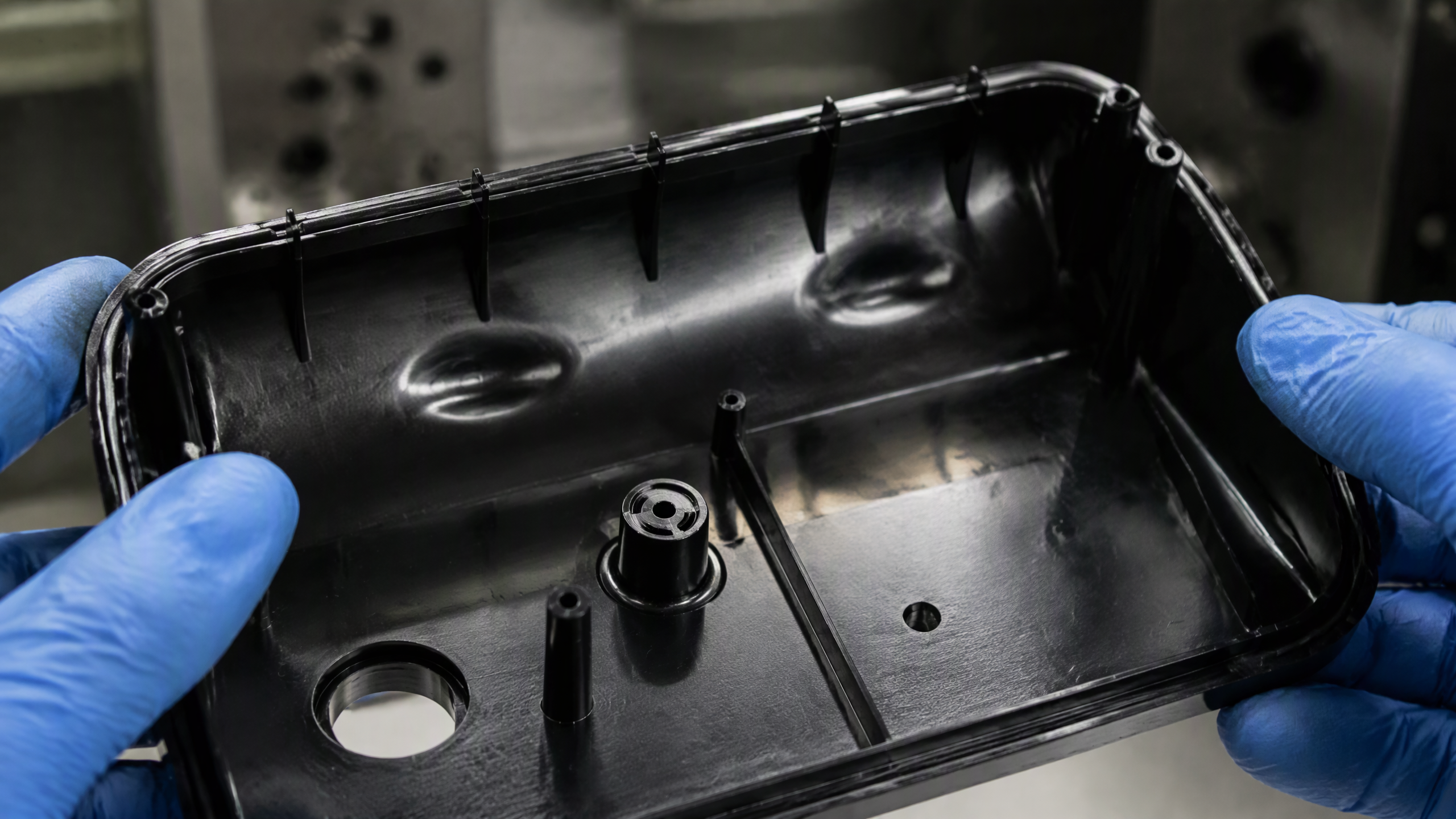
When a product team needs 500 functional plastic parts in three weeks, traditional steel tooling is not an option. A standard production mold takes 6 to 12 weeks to build and costs anywhere from $15,000 to $80,000. For validation builds, bridge production, or early market entry, that timeline and investment are hard to justify. This is where rapid injection molding steps in.
Rapid injection molding compresses the tooling timeline by using aluminum molds, simplified mold designs, and streamlined CNC machining processes. Instead of waiting months, product teams can receive first-shot samples in 7 to 15 days. The parts are molded from the same production-grade thermoplastics, meaning they perform identically to parts from a steel mold. The trade-offs are in mold lifespan and complex features, not in part quality.
In this guide, the engineering team at Shiny Mold draws on over 23 years of mold-making experience to explain what rapid injection molding is, when it makes sense, how it compares to full production tooling, and what design choices help buyers get the most value from a rapid mold project. For a broader overview of injection molding capabilities, visit our Injection Molding page.

What Is Rapid Injection Molding?
Rapid injection molding is a manufacturing process that produces injection-molded plastic parts using tooling built quickly and economically. The defining characteristic is speed: a rapid mold goes from design approval to first shots in days, not weeks. The process uses the same injection molding machines and the same thermoplastic resins as full production, so the parts that come out are functionally identical to those produced later in high-volume runs.
The speed comes from three main differences in how the mold is built:
Aluminum Mold Material
Instead of hardened tool steel (such as P20 or H13), rapid molds are typically machined from 6061-T6 or 7075-T6 aluminum. Aluminum machines roughly three times faster than steel, which dramatically cuts mold-building time. Aluminum also has excellent thermal conductivity, roughly four times that of steel, which translates to faster cooling cycles during molding. The trade-off is durability: an aluminum mold typically lasts 1,000 to 10,000 shots depending on the resin and part geometry, compared to 100,000 to over 1,000,000 shots for a hardened steel mold.
Simplified Mold Design
Rapid molds often use manual inserts instead of automated slides or lifters. Side actions that would normally require complex mechanical mechanisms are handled by loadable inserts that the operator swaps between cycles. This simplification reduces machining time but increases per-part cycle time slightly. For the quantities rapid molding targets (typically 100 to 5,000 parts), this trade-off is well worth it.
Streamlined Workflow
Rapid mold builders use standardized mold bases and focus on machining only the core and cavity inserts. This eliminates custom mold-base fabrication and reduces assembly time. The overall workflow from DFM (Design for Manufacturability) review to first shots is compressed to 7 to 15 business days.
How Rapid Injection Molding Works
The rapid injection molding process follows the same fundamental steps as conventional injection molding, but each step is optimized for speed. Understanding the workflow helps buyers plan their project timeline effectively.
Step 1: DFM Review and Quote (1 to 2 Days)
The process begins with a Design for Manufacturability review. The mold engineer examines the CAD model for draft angles, wall thickness uniformity, undercuts, and gating considerations. In rapid molding, the DFM review also identifies features that can be simplified to speed up tooling without compromising part function. The engineer provides feedback and a firm quote within 24 to 48 hours.
Step 2: Mold Design and CNC Machining (3 to 8 Days)
Once the design is approved, the mold designer creates the mold layout focusing on the core and cavity inserts. The CNC machining of aluminum inserts begins immediately. Because aluminum cuts faster and wears tooling less, the machining time for a typical mold insert set is 2 to 4 days, compared to 2 to 3 weeks for steel inserts of similar complexity.
Step 3: Mold Assembly and First Shots (1 to 3 Days)
The machined inserts are mounted in a standard mold base, cooling lines are connected, and the mold is loaded onto the injection molding machine. First-shot sampling typically happens within 24 hours of mold completion. The molding technician runs initial shots at the recommended processing parameters for the chosen resin and inspects the parts for short fills, flash, sink marks, and other defects.
Step 4: Sampling and Quality Check (1 to 2 Days)
Sample parts are measured against the CAD model using CMM (Coordinate Measuring Machine) or optical measurement. The engineer reviews the results and makes any necessary mold adjustments. Once the parts meet specification, production runs begin.

Rapid Injection Molding vs. Traditional Production Molding
Buyers often ask whether they should invest in rapid tooling or go straight to production tooling. The answer depends on quantity, timeline, budget, and the stage of product development. Here is a practical comparison based on our experience at Shiny Mold:
| Factor | Rapid Injection Molding | Production Injection Molding |
|---|---|---|
| Mold Material | Aluminum (6061/7075) | Hardened Steel (P20/H13/S7) |
| Tooling Lead Time | 7 to 15 days | 4 to 12 weeks |
| Mold Cost | $2,000 to $15,000 | $15,000 to $80,000+ |
| Mold Lifespan | 1,000 to 10,000 shots | 100,000 to 1,000,000+ shots |
| Best For | 100 to 5,000 parts | 10,000+ parts |
| Part Quality | Production-grade (same resin) | Production-grade |
| Complex Features | Limited (manual inserts) | Full (slides, lifters, hot runners) |
The key insight is that rapid injection molding produces parts of identical material quality to production molding. The difference lies entirely in the mold. This means a part molded from rapid tooling can be used for functional testing, clinical trials, market validation, or even early customer delivery without any compromise in material properties.
When to Choose Rapid Injection Molding
Based on hundreds of projects completed at our facility in Dongguan, China, we recommend rapid injection molding in the following scenarios:
1. Prototype Validation: When you need functional parts from the actual production material to test fit, form, and function. 3D-printed prototypes cannot match the mechanical properties, surface finish, or dimensional accuracy of molded parts. Rapid molding bridges that gap.
2. Bridge Production: When production tooling is still weeks away but customers need parts now. Rapid molds can supply parts for early orders while the production mold is being built. This approach can save a product launch.
3. Low-Volume Production: When annual demand is between 100 and 5,000 units, investing in production tooling may never reach a positive ROI. Rapid molding provides production-grade parts at a fraction of the tooling cost.
4. Market Testing: Before committing to a full production mold, teams can use rapid molded parts to test market response. If the product succeeds, they invest in production tooling. If the design needs changes, modifying an aluminum mold is far cheaper than reworking a steel mold.
5. Regulatory Submissions: For medical devices and other regulated products, rapid molded parts can be used for biocompatibility testing, clinical evaluations, and regulatory submissions. The parts are identical to production parts, so test data transfers directly.
Materials and Design Guidelines for Rapid Molding
Rapid injection molding supports virtually all thermoplastic resins, including ABS, PC, PC/ABS, Nylon (PA6, PA66), POM, PP, PE, PEEK, and glass-filled variants. However, glass-filled or mineral-filled resins wear aluminum molds faster, reducing tool life. For highly abrasive resins, steel inserts can be used in high-wear areas of an otherwise aluminum mold.
Design guidelines that help rapid mold projects succeed:
- Draft angles: Minimum 1 degree per side for smooth ejection. Aluminum molds are softer than steel, so adequate draft prevents galling and surface damage during part ejection.
- Wall thickness: Maintain uniform wall thickness between 1.0 mm and 3.0 mm. Variations should transition gradually to prevent sink marks and flow issues.
- Undercuts: Minimize undercuts. When unavoidable, plan for manual inserts or hand-loaded cores. Each manual operation adds cycle time, so keep them to one or two per part.
- Parting line: Design a straight parting line when possible. Complex parting lines require more machining time and increase mold cost.
- Gating: Accept edge or sub-gate designs for rapid molds. Hot runner systems are possible but add cost and lead time, partially defeating the purpose of rapid tooling.

Quality Assurance in Rapid Molding
A common concern is whether rapid molded parts meet the same quality standards as production parts. The answer is yes, provided the molder follows disciplined quality processes. At Shiny Mold, every rapid molding project includes:
- Incoming material inspection: Resin lots are checked for moisture content and melt flow index before molding.
- In-process monitoring: Cycle time, injection pressure, melt temperature, and cooling time are monitored and recorded for every production run.
- Dimensional verification: Critical dimensions are measured using CMM or optical measurement equipment on a sampling basis, typically every 25 to 50 parts.
- Visual inspection: Parts are inspected for flash, short shots, sink marks, weld lines, and surface defects.
- Documentation: Each project receives an inspection report with measured dimensions, tolerance compliance, and process parameters.
For projects requiring traceability, Shiny Mold provides material certificates, process parameter records, and first-article inspection (FAI) reports in accordance with ISO 9001 quality management practices.
Frequently Asked Questions
How many parts can a rapid injection mold produce?
A typical aluminum rapid mold produces 1,000 to 10,000 parts, depending on the resin, part geometry, and mold maintenance. Softer resins like polypropylene yield higher mold life, while glass-filled nylons reduce it. With proper maintenance, some aluminum molds have exceeded 15,000 shots in our experience.
Is rapid injection molding the same as 3D printing?
No. Rapid injection molding uses CNC-machined aluminum molds and real thermoplastic resins on standard injection molding machines. 3D printing builds parts layer by layer from photopolymers or filaments. Rapid molded parts have the strength, finish, and dimensional accuracy of production parts, while 3D-printed parts are typically weaker and less precise.
Can rapid molds produce parts with tight tolerances?
Yes. Aluminum molds can hold tolerances of plus or minus 0.05 mm (0.002 inches) on precision features, comparable to steel molds. For tighter tolerances, the mold can be adjusted after first shots by selectively machining the cavity or core. The ability to fine-tune an aluminum mold is actually faster than reworking steel.
What is the difference between rapid injection molding and rapid prototyping?
Rapid prototyping refers to any fast method of creating a prototype, including 3D printing, CNC machining, and casting. Rapid injection molding is specifically a production-capable process that uses real molds and materials. The term "rapid" refers to the tooling timeline, not the molding process itself.
How much does rapid injection molding cost?
Rapid injection molding tooling typically costs $2,000 to $15,000 depending on part size, complexity, and number of cavities. Part prices depend on resin type, part weight, and quantity, generally ranging from $0.50 to $15 per part for quantities of 100 to 5,000 units. For an accurate quote, submit your CAD file to the Shiny Mold engineering team.
Can rapid molds be modified after production starts?
Yes, and this is one of the key advantages. Aluminum is easier to machine than steel, so design changes, gate relocations, or dimensional adjustments can be made quickly and at lower cost. This flexibility is valuable during product development iterations.
Conclusion
Rapid injection molding fills the gap between prototyping and full-scale production. It delivers real molded parts, in real production materials, on a timeline that keeps product development moving. For teams that need 100 to 5,000 functional parts without waiting months for steel tooling, it is the most practical and cost-effective choice.
The key to a successful rapid molding project is working with an experienced mold maker who understands the trade-offs between speed, cost, and quality. At Shiny Mold, our engineering team has built thousands of rapid molds for medical, automotive, consumer electronics, and industrial applications. We help buyers navigate material selection, design optimization, and quality planning to ensure that rapid does not mean rushed. To discuss your project, visit our industry page or contact us directly.