
 Chinese
Precision Injection Molding: Complete Guide to High-Accuracy Plastic Manufacturing in 2026
Precision injection molding is a specialized manufacturing process that produces plastic parts with extremely tight tolerances — typically within ±0.01mm to ±0.05mm. In 2026, precision molding has become the gold standard for industries where component accuracy directly impacts product performance, safety, and reliability.
Whether you're developing medical devices, automotive sensors, electronic connectors, or optical components, understanding what precision injection molding entails — and how to select the right manufacturing partner — is critical to your project's success.

What Is Precision Injection Molding?
Precision injection molding goes beyond standard injection molding by focusing on dimensional accuracy, repeatability, and surface finish. While conventional molding might hold tolerances of ±0.1mm to ±0.25mm, precision molding achieves tolerances of ±0.01mm to ±0.05mm through:
- High-precision mold fabrication — Using advanced CNC, EDM, and wire cutting equipment with micron-level accuracy
- Strict process control — Real-time monitoring of temperature, pressure, injection speed, and cooling parameters
- High-quality mold steels — Premium tool steels with minimal thermal expansion and wear resistance
- Temperature-controlled manufacturing — Climate-controlled shop floors to eliminate thermal variation
- Comprehensive inspection — CMM, optical measurement, and surface profilometry for every critical dimension
Key Tolerances in Precision Injection Molding
| Parameter | Standard Molding | Precision Molding |
|---|---|---|
| Linear dimensions | ±0.10–0.25 mm | ±0.01–0.05 mm |
| Flatness | 0.05–0.15 mm | 0.01–0.03 mm |
| Roundness | 0.05–0.10 mm | 0.005–0.02 mm |
| Surface finish (Ra) | 0.8–1.6 μm | 0.1–0.4 μm |
| Gate vestige | ≤0.20 mm | ≤0.05 mm |
Industries That Depend on Precision Injection Molding
Medical Devices
Precision injection molding is essential for manufacturing surgical instruments, diagnostic components, drug delivery systems, and implantable devices. With ISO 13485 certification and clean room molding capabilities, precision molders ensure components meet strict FDA and EU MDR requirements. Typical parts include catheter hubs, syringe components, hearing aid housings, and micro-fluidic devices with tolerances as tight as ±0.01mm.
Automotive Electronics
Modern vehicles contain hundreds of precision-molded components — from sensor housings and connector bodies to ECU enclosures and camera mounts. As the automotive industry transitions to electric and autonomous vehicles, the demand for precision connectors, battery cell spacers, and LiDAR housings has grown exponentially. IATF 16949 certification and PPAP documentation are non-negotiable requirements.
Consumer Electronics
Smartphones, tablets, wearables, and IoT devices require precision-molded parts for camera modules, SIM card trays, charging ports, button assemblies, and internal brackets. Aesthetic surface finishes (SPI A1 polish) and tight dimensional control are critical for seamless assembly and premium product feel.
Optics & Photonics
Lens housings, light guides, prism mounts, and fibre optic connectors require some of the tightest tolerances in injection molding — often within ±0.005mm. Material selection is critical: low-shrinkage optical-grade polymers and meticulously controlled molding conditions are required to achieve consistent optical performance.
About SHINY Mold — Your Precision Injection Molding Partner
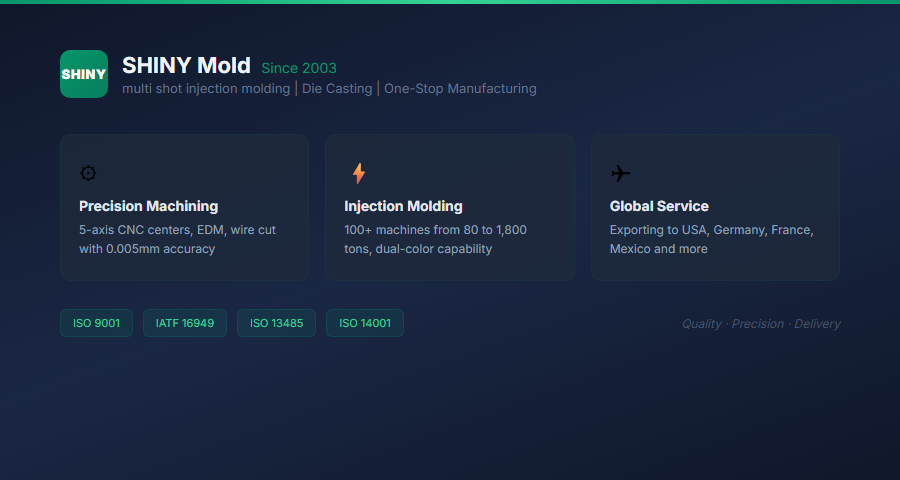
Founded in 2003, SHINY (Dongguan Xinxuan Mold) is headquartered in Chang'an, Dongguan — the heart of China's mold manufacturing industry. With fixed assets of USD 5 million, a 23,000+ square metre facility, and over 400 skilled employees, SHINY specializes in high-precision plastic injection molds, aluminium die-casting molds, and magnesium die-casting molds.
Our facility features 100+ injection molding machines ranging from 80 to 1,800 tons, dual-colour injection capability, and dedicated clean room molding areas. With a design library of 5,000+ successful mold designs and annual output of 2,000+ molds, we serve clients across automotive, new energy, medical devices, consumer electronics, home appliances, power tools, and lighting industries.
SHINY is certified under ISO 9001:2015, ISO 14001:2015, ISO 13485:2016, and IATF 16949:2016. Our precision injection molding capabilities have been trusted by clients from the United States, Canada, Mexico, Germany, France, Poland, and throughout Europe. We combine Chinese manufacturing efficiency with international quality standards.
Mold Design for Precision Injection Molding
Steel Selection
Precision molds are typically made from hardened tool steels such as:
- H13 (DIN 1.2344) — Hot work steel, excellent for high-cavity precision molds
- S136 / 420SS — Stainless mold steel, corrosion-resistant for medical applications
- NAK80 — Pre-hardened steel with excellent polishability for optical-grade surfaces
- ASP23 / PM Steels — Powder metallurgy steel for extreme wear resistance in high-volume tools
Cooling System Design
Uniform cooling is critical for dimensional stability. Precision molds employ:
- Conformal cooling channels — 3D-printed or gun-drilled channels that follow the cavity contour
- High-thermal-conductivity inserts — Beryllium copper or AMPCO alloys at hot spots
- Thermal pin (heat pipe) technology — Efficient heat transfer in deep core areas
- Oil or water temperature controllers — ±1°C precision for consistent mold temperature
Gate Design
Gate type and location directly affect part dimensions and cosmetic quality:
- Valve gates — Provide the best control for precision parts, eliminate gate vestige
- Submarine (tunnel) gates — Automatic de-gating for high-volume production
- Edge gates with optimized land length — Reduce shear stress and material degradation
Process Parameters for Precision Molding
Precision injection molding requires meticulous control of every process parameter:
| Parameter | Precision Molding Range | Why It Matters |
|---|---|---|
| Melt temperature | ±2°C of setpoint | Directly affects viscosity, shrinkage, and crystallinity |
| Injection speed | Multi-stage profile control | Prevents flow marks and ensures consistent cavity fill |
| Packing pressure | Multi-stage, ±1 bar accuracy | Controls sink marks and dimensional stability |
| Cooling time | CAE-optimized, ±0.5s | Prevents warpage and ensures crystallization consistency |
| Back pressure | 5–15 bar | Ensures melt homogeneity and consistent shot weight |
Quality Assurance in Precision Injection Molding
Inspection Equipment
Precision molders invest heavily in metrology equipment:
- Coordinate Measuring Machines (CMM) — Bridge and arm types for 3D dimensional verification
- Optical Comparators & Vision Systems — Non-contact measurement for complex geometries
- Surface Profilometers — Ra, Rz, and peak-count measurement for surface finish verification
- X-Ray & CT Scanning — Internal defect detection for critical components
Statistical Process Control (SPC)
Real-time SPC with CPK monitoring ensures every production run stays within specification. For precision parts, the industry standard is CPK ≥ 1.67 (meaning the process is statistically capable of meeting tolerances with minimal variation).
Cost Factors for Precision Injection Molding
Precision injection molding typically costs 20–50% more than standard molding due to:
- Higher mold cost — Precision ground components, tighter fits, additional cooling features, and finer surface finish add 30–60% to tooling costs
- Slower cycle times — Longer cooling and holding times to ensure dimensional stability
- More frequent maintenance — Precision molds require more frequent inspection and refurbishment
- Stringent inspection — 100% dimensional inspection for critical dimensions adds quality assurance cost
- Controlled environment — Climate-controlled shop floors (temperature ±1°C, humidity controlled)
How to Choose a Precision Injection Molding Partner
- Verify certification — ISO 9001 minimum; ISO 13485 for medical; IATF 16949 for automotive
- Assess mold-making capabilities — Does the partner make precision molds in-house or outsource?
- Check measurement equipment — CMM, vision systems, and surface testers should be readily available
- Review past projects — Ask for examples of precision parts with tolerance documentation
- Evaluate process control — Does the shop use real-time monitoring and SPC?
- Assess material expertise — Experience with engineered plastics (PEEK, LCP, PPSU, Ultem) is critical
- Communication and support — DFM feedback and regular project updates demonstrate commitment
Frequently Asked Questions
What's the tightest tolerance achievable in precision injection molding?
With advanced tooling and process control, precision injection molding can achieve tolerances of ±0.005mm for certain dimensions. However, practical working tolerances of ±0.01mm to ±0.03mm are more common and cost-effective for most production parts.
Is precision injection molding more expensive?
Yes — expect 20–50% higher mold costs and 10–20% higher per-part costs compared to standard molding. The investment is justified when dimensional accuracy directly impacts product function, assembly fit, or regulatory compliance.
What materials are best for precision molding?
Low-shrinkage, amorphous polymers are preferred for precision parts, including PC, ABS, PC/ABS blends, PSU, PES, and PEI (Ultem). Semi-crystalline materials (POM, PA, PBT, PEEK) can also achieve precision tolerances with proper mold design and process optimization.
How do I verify a molder's precision capabilities?
Request dimensional inspection reports from past projects, ask for a mold trial with your material, and review CPK data. A reputable precision molder will be transparent about their capabilities and limitations.
Conclusion
Precision injection molding is the manufacturing method of choice when standard tolerances aren't enough. From medical devices to automotive electronics and optical components, precision molding delivers the accuracy, repeatability, and quality that critical applications demand.
With over 20 years of experience in precision tooling, SHINY Mold combines advanced manufacturing equipment, certified quality systems, and a skilled engineering team to deliver precision injection molding solutions that meet the most demanding specifications. Contact SHINY Mold today to discuss your precision molding requirements.