
 Chinese
Injection Molding Material Selection: Complete Guide to Choosing the Right Plastic in 2026
Choosing the right material for injection molding is one of the most critical decisions in product development. The material you select determines not only the part's performance, durability, and appearance — but also the mold design, processing parameters, and total cost of ownership.
With hundreds of thermoplastic grades available — each with distinct mechanical, thermal, chemical, and aesthetic properties — material selection can feel overwhelming. This guide breaks down the key factors, compares common materials, and provides a structured approach to making the right choice for your injection molded parts in 2026.

Key Factors in Injection Molding Material Selection
1. Mechanical Properties
Start with the functional requirements of your part:
- Tensile strength & modulus — How much load must the part bear?
- Impact resistance — Will the part experience drops, shocks, or collisions?
- Fatigue resistance — Will the part undergo repeated loading cycles?
- Hardness & wear resistance — Will the part slide, rub, or abrade against other components?
- Flexural modulus — Does the part need to bend or remain rigid?
2. Thermal Properties
- Melting temperature (Tm) — Processing temperature requirement
- Glass transition temperature (Tg) — For amorphous plastics, the temperature at which the material transitions from rigid to rubbery
- Continuous use temperature — Maximum temperature the part can endure long-term
- Heat deflection temperature (HDT) — Temperature at which the material deflects under load
- Thermal expansion coefficient — Important for precision assemblies
3. Chemical Resistance
Will the part be exposed to chemicals, oils, solvents, cleaning agents, or UV radiation? Different plastics have vastly different chemical resistance profiles. For example:
- PP — Excellent chemical resistance, good for chemical containers
- PTFE (Teflon) — Outstanding chemical and temperature resistance
- ABS — Poor resistance to organic solvents and strong acids
- Polycarbonate — Good resistance but susceptible to stress cracking from certain chemicals
4. Aesthetic Requirements
- Transparency — Clear parts require amorphous plastics (PC, PMMA, PS, PETG)
- Colorability — Some resins (ABS, PS, PP) are easier to color than others
- Surface finish — High-gloss requires different mold polishing than textured surfaces
- UV stability — Outdoor applications need UV-stabilized grades or UV-resistant plastics (ASA, weathered ABS)
5. Regulatory & Compliance Requirements
- Food contact (FDA, EU 10/2011) — Require food-safe grades (PP, PE, specific ABS, PET)
- Medical (USP Class VI, ISO 10993) — Medical-grade resins with traceability
- Flame retardancy (UL94) — Electronics and automotive require V-0 or V-2 rated materials
- RoHS, REACH — Environmental compliance for European markets
6. Cost Considerations
Material cost is only part of the equation. Consider:
- Resin price per kg — Commodity vs. engineering vs. high-performance plastics
- Density — Lighter materials may cost more per kg but less per part
- Scrap rate — Some materials are more process-stable than others
- Regrind compatibility — Can you reuse sprues and runners?
- Cycle time — Some materials cool faster, reducing cycle time and cost per part
Common Injection Molding Materials: Comparison Table
| Material | Typical Applications | Key Properties | Cost (Relative) |
|---|---|---|---|
| PP (Polypropylene) | Automotive interiors, packaging, consumer goods | Chemical resistance, low density, flexible | $ (Low) |
| ABS | Consumer electronics, automotive interior, LEGO bricks | Good impact resistance, easy to process, paintable | $$ (Low-Medium) |
| PC (Polycarbonate) | Safety glasses, lighting covers, electronic housings | High transparency, high impact strength, heat resistance | $$$ (Medium-High) |
| PA6 / PA66 (Nylon) | Gears, bearings, automotive under-hood | High strength, wear resistance, absorbs moisture | $$$ (Medium-High) |
| POM (Acetal/Delrin) | Precision gears, fasteners, zippers | Low friction, high stiffness, excellent dimensional stability | $$$ (Medium-High) |
| PET | Beverage bottles, food containers, electronic parts | Good clarity, chemical resistance, recyclable | $$ (Medium) |
| PEEK | Aerospace, medical implants, oil & gas | Extreme temperature resistance, chemical resistance | $$$$$ (Very High) |
| TPE / TPU | Soft-touch grips, seals, gaskets, phone cases | Flexible, rubber-like, overmoldable | $$$ (Medium-High) |
| PS (Polystyrene) | Disposable cutlery, CD cases, model kits | Low cost, transparent (GPPS), brittle | $ (Low) |
| ASA | Outdoor automotive, garden tools, exterior trim | UV resistance, weathering, similar to ABS | $$$ (Medium-High) |
Material Selection Process: A Step-by-Step Approach
Step 1: Define Functional Requirements
Create a comprehensive list of requirements:
- Mechanical loads (static, dynamic, impact)
- Operating temperature range
- Chemical exposure environment
- Aesthetic requirements (color, transparency, texture)
- Regulatory requirements (FDA, UL, RoHS)
- Expected product lifespan
Step 2: Shortlist Candidate Materials
Based on the requirements, identify 3-5 candidate materials. Use material databases (CAMPUS, Prospector, or supplier databases like SABIC, Covestro, BASF) to filter materials by properties.
Step 3: Evaluate Processing Considerations
Not all materials process the same way:
- Melt temperature — Higher temperatures require more energy and more robust mold materials
- Mold shrinkage — Affects tolerance and mold design; crystalline plastics (PP, PA, POM) shrink more than amorphous (ABS, PC, PS)
- Moisture sensitivity — Nylon absorbs moisture and must be dried before processing
- Corrosive nature — Some flame-retardant grades are corrosive to molds; stainless steel molds may be required
Step 4: Prototype & Test
Before finalizing material selection, prototype with the actual material. Test under real-world conditions:
- Thermal cycling
- Chemical exposure
- Mechanical load testing
- Long-term aging (UV, heat, humidity)
Step 5: Make the Final Selection
Balance performance, cost, and manufacturability. Often, the "best" material is not the highest-performance one, but the one that meets all requirements at the lowest total cost.
About SHINY Mold — Your Injection Molding Partner
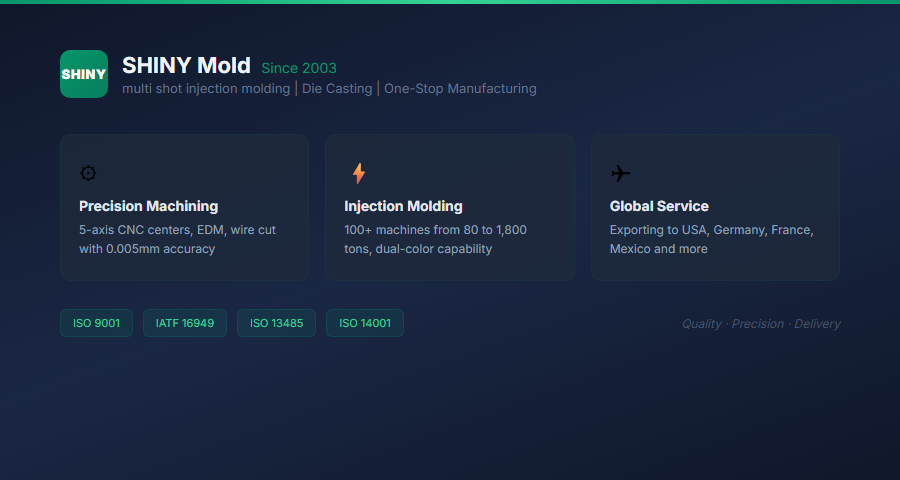
Founded in 2003, SHINY (Dongguan Xinxuan Mold) is headquartered in Chang'an, Dongguan — China's premier mold manufacturing hub. With fixed assets of USD 5 million, a 23,000+ square metre facility, and 400+ skilled employees, SHINY specializes in high-precision plastic injection molds, aluminum die-casting molds, and magnesium die-casting molds.
Our facility features 100+ injection molding machines ranging from 80 to 1,800 tons, dual-colour injection capability, and dedicated clean room molding areas. With a design library of 5,000+ successful mold designs and annual output of 2,000+ molds, we serve clients across automotive, new energy, medical devices, consumer electronics, home appliances, power tools, and lighting industries.
SHINY is certified under ISO 9001:2015, ISO 14001:2015, ISO 13485:2016, and IATF 16949:2016. Our export markets include the United States, Canada, Mexico, Germany, France, Poland, and throughout Europe. We provide material selection guidance, DFM analysis, moldflow simulation, and full production support.
Specialized Material Grades for Specific Industries
Automotive
- PP+EPDM — Dashboard skins, interior soft-touch surfaces
- PC+ABS — Interior trim, center consoles
- PA66+GF — Under-hood connectors, coolant reservoirs
- PBT — Electronic connectors, sensor housings
- ASA — Exterior trim, mirror housings, cowl covers
Medical Devices
- Medical-grade PC — Surgical instrument handles, dialysis housings
- PP (medical grade) — Syringe barrels, IV components
- PEEK (medical) — Spinal implants, trauma plates
- TPU (medical) — Catheters, medical tubing connectors
- Silicone (LSR) — Respiratory masks, sealing gaskets
Consumer Electronics
- ABS — Laptop housings, keyboard frames
- PC/ABS — Smartphone cases, tablet backs
- LCP — High-frequency connectors, antenna components
- PBT — Circuit breaker housings, connector bodies
Food & Beverage
- PP (FDA compliant) — Food containers, microwave-safe bowls
- PET (food grade) — Beverage bottles, food trays
- HDPE — Milk jugs, detergent bottles
- Tritan (copolyester) — BPA-free reusable bottles
Common Material Selection Mistakes to Avoid
1. Choosing Based on Price Alone
The cheapest resin may cost you more in the long run through higher scrap rates, shorter product lifespan, or warranty claims. Always consider total cost of ownership.
2. Ignoring Processing Differences
Some materials require different mold temperatures, drying procedures, or screw designs. Failing to account for these can lead to inconsistent part quality.
3. Over-Specifying
Using a high-performance material (e.g., PEEK) when a commodity plastic (e.g., PP) would suffice wastes money without adding value. Right-specify, don't over-specify.
4. Neglecting Supplier Support
Material suppliers differ in technical support, color matching, and consistency. Choose suppliers who provide DFM input, material testing data, and responsive technical support.
5. Forgetting About End-of-Life
In 2026, sustainability matters. Consider recyclability, bio-based alternatives, and compliance with extended producer responsibility (EPR) regulations in your target markets.
2026 Trends in Injection Molding Materials
Bio-Based and Recycled Content Resins
Brand owners are under pressure to reduce carbon footprint. Bio-based plastics (PLA, bio-PE, bio-PET) and resins with high recycled content (rABS, rPC, rPA) are gaining adoption — even in technically demanding applications.
High-Heat Polymers for EV Applications
Electric vehicles require materials that can withstand higher under-hood temperatures (due to absence of forced convection from an engine). PPA, PPS, and high-temperature nylons are seeing increased demand.
Conductive Plastics
For EMI shielding in 5G devices and EVs, conductive plastics (PP, PC, or PA with carbon fiber or stainless steel fiber) eliminate the need for separate shielding components.
Low-Carbon Material Certification
Material suppliers now provide product carbon footprint (PCF) data. In Europe especially, specifying low-PCF materials helps meet corporate sustainability targets and regulatory requirements.
Frequently Asked Questions
How do I know if a material is suitable for injection molding?
Check the material's melt flow rate (MFR) or melt flow index (MFI). Higher MFR means the material flows more easily, making it suitable for thin-wall or complex-geometry parts. Also verify the material is available in injection molding grade (not extrusion or blow molding grade).
Can I change material after the mold is made?
Sometimes — but not always. Different materials have different shrinkage rates, requiring mold adjustments. Amorphous plastics (ABS, PC) are more forgiving than crystalline plastics (PP, PA, POM). Consult your mold maker before switching materials post-mold completion.
What is the difference between virgin, regrind, and recycled material?
Virgin = 100% new material. Regrind = Ground-up sprues, runners, and rejected parts from your own process, reused in new parts (typically up to 20-30%). Recycled = Post-consumer or post-industrial recycled material from external sources.
How much does material cost affect the total part cost?
For high-volume, small parts (e.g., bottle caps), material cost dominates — often 60-80% of total part cost. For large parts or low volumes, mold amortization and machine time matter more. A DFM review will clarify the cost breakdown for your specific part.
Where can I get material data sheets and processing guides?
Visit the websites of major resin suppliers: SABIC, Covestro, BASF, DuPont, LG Chem, Chi Mei, Formosa Plastics, or Slovay. They provide comprehensive technical data sheets (TDS), processing guides, and safety data sheets (SDS) for free download.
Conclusion
Injection molding material selection is both an art and a science. The right material balances functional performance, aesthetic requirements, regulatory compliance, manufacturability, and cost — a multi-dimensional optimization problem.
In 2026, material selection is further influenced by sustainability requirements, supply chain considerations, and rapidly evolving material technologies. Working with an experienced injection molding partner who understands material behavior, mold design interactions, and processing optimization is invaluable.
At SHINY Mold, we support our clients through every step of material selection — from initial specification and DFM feedback to moldflow simulation and production optimization. With ISO 9001, IATF 16949, and ISO 13485 certifications, we ensure your material choice delivers the performance your product deserves.