
 Chinese
Plastic Injection Molding Services: How to Choose the Right Manufacturer in 2026
Finding the right plastic injection molding services provider is one of the most consequential decisions in any product development project. The manufacturer you choose directly impacts product quality, time-to-market, production costs, and ultimately your competitive position.
This guide provides a practical framework for evaluating and selecting plastic injection molding services, with specific criteria tailored to different industries and project requirements.
What Do Plastic Injection Molding Services Include?
Comprehensive plastic injection molding services extend far beyond simply running a machine. A full-service provider typically offers:
- Product Design Support — DFM (Design for Manufacturing) analysis, material recommendations, and design optimization for moldability
- Prototyping — Rapid prototyping through 3D printing, CNC machining, or rapid tooling for design validation
- Mold Design & Manufacturing — Custom mold engineering, CAE mold flow analysis, and precision CNC machining
- Injection Molding Production — From low-volume pilot runs to high-volume mass production
- Secondary Operations — Assembly, painting, printing, welding, and packaging
- Quality Assurance — Incoming material inspection, in-process monitoring, final inspection, and documentation
Key Evaluation Criteria
1. Technical Capabilities & Equipment
The foundation of any plastic injection molding service is its equipment. Key questions to ask:
- What is the range of machine tonnage? (A provider with 80-1,800 ton machines can handle everything from micro-parts to large structural components)
- Do they have dual-color/multi-material injection capability?
- What CAE analysis tools do they use for mold design validation?
- What is their CNC machining precision capability?
- Do they have cleanroom facilities for medical or optical applications?
2. Quality Management System
Certifications aren't just badges — they represent systematic approaches to quality:
- ISO 9001:2015 — Essential baseline for any reputable manufacturer
- IATF 16949:2016 — Mandatory for automotive supply chain participation
- ISO 13485:2016 — Required for medical device manufacturing
- ISO 14001:2015 — Demonstrates environmental responsibility commitment
Ask potential partners about their SPC (Statistical Process Control) capabilities, Cpk tracking, and inspection equipment (CMM, vision systems, etc.).
3. Industry Experience & Track Record
Experience in your specific industry matters enormously. A manufacturer experienced in automotive applications understands the rigorous PPAP requirements, while one focused on medical devices knows the nuances of cleanroom production and regulatory documentation.
4. Production Capacity & Scalability
Consider both current capacity and future scalability. Can the manufacturer handle your projected volume growth? Do they have backup machines and workforce flexibility? What is their typical lead time for capacity expansion?
5. Communication & Project Management
Effective communication is often the difference between a smooth project and a costly disaster. Evaluate responsiveness, English proficiency (for international projects), project management tools, and willingness to provide regular progress updates.
About SHINY Mold
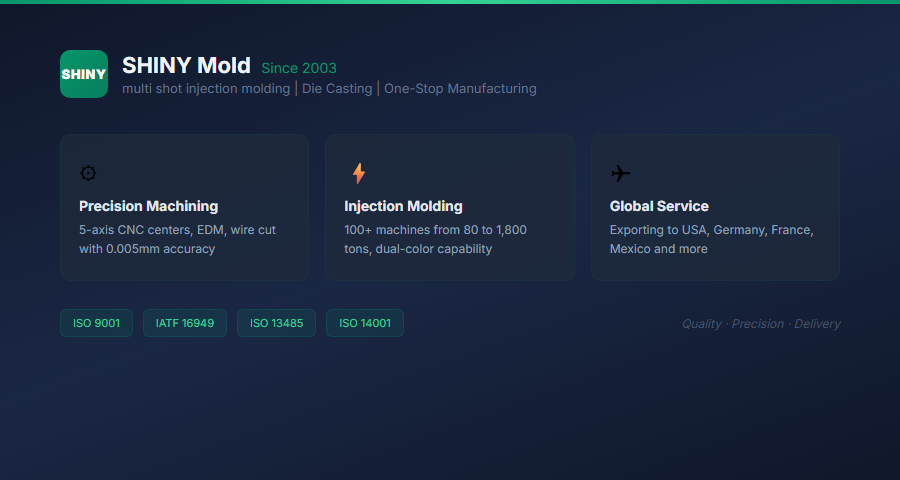
Founded in 2003, SHINY (Dongguan Xinxuan Mold) is headquartered in China's mold manufacturing hub — Chang'an, Dongguan. With fixed assets of USD 5 million, a facility spanning over 23,000 square meters, and a workforce of 400+ employees, SHINY specializes in high-precision plastic injection molds, aluminum die-casting molds, and magnesium die-casting molds.
Backed by a comprehensive library of 5,000+ mold designs, SHINY delivers over 2,000 molds annually. Our products serve industries including automotive, new energy, medical devices, consumer electronics, home appliances, power tools, and lighting. With 100+ injection molding machines (80–1,800 tons), dual-color injection capability, and dedicated assembly lines, SHINY provides end-to-end manufacturing from product design and prototyping to mold development, injection molding, and finished product assembly.
SHINY is certified under ISO 9001, ISO 14001, ISO 13485, and IATF 16949 quality management systems. Our clients span the United States, Canada, Mexico, Germany, France, Poland, and other European and American markets.
Cost Factors in Plastic Injection Molding Services
Understanding the cost structure helps you evaluate quotes and identify the best value:
Tooling Investment
Mold costs range from $5,000 for simple single-cavity molds to $100,000+ for complex multi-cavity molds with hot runner systems. While lower-cost tooling options exist, investing in quality tooling typically delivers better part quality, longer mold life, and lower per-piece costs over the production run.
Material Costs
Engineering thermoplastics vary significantly in price — from $1-2/kg for commodity resins (PP, PE) to $10-30+/kg for specialty materials (PEEK, LCP). Material selection should be driven by application requirements, not cost alone.
Per-Part Production Cost
Driven by cycle time, machine size, labor, and overhead. High-cavity molds and optimized processes reduce per-part costs significantly for high-volume production.
Red Flags When Evaluating Manufacturers
- Unwilling to provide facility tours or video calls
- No quality certifications or vague claims about compliance
- Quotes significantly below market average (often indicates corner-cutting)
- Lack of clear communication about timelines and deliverables
- No references or case studies from your industry
- Inability to provide detailed mold flow analysis reports
Conclusion
Selecting the right plastic injection molding services partner requires thorough evaluation across multiple dimensions — technical capability, quality management, industry experience, production capacity, and communication. By applying the framework outlined in this guide, you can make an informed decision that balances quality, cost, and timeline for your specific project requirements.
The best manufacturers don't just produce parts — they serve as strategic partners who contribute engineering expertise, process optimization, and quality assurance that improves your product and reduces your total cost of ownership.
FAQ
What is the minimum order quantity for plastic injection molding?
MOQs vary by manufacturer. Some providers offer low-volume services (500-1,000 pieces), while others specialize in high-volume production (50,000+ pieces). The key is finding a provider whose sweet spot matches your project requirements.
How long does it take to get a custom injection molded part?
From mold design approval to first article: typically 4-8 weeks for standard molds. Rapid tooling can deliver parts in 1-2 weeks for prototyping. Full production typically begins 1-2 weeks after first article approval.
Can injection molding produce complex geometries?
Absolutely. Modern mold design techniques including side actions, lifters, unscrewing cores, and collapsible cores enable the production of extremely complex geometries including undercuts, internal threads, and multi-wall structures.