
 Chinese
Injection Molding: The Complete Guide to Process, Materials & Applications in 2026
In the world of modern manufacturing, injection molding stands as one of the most versatile and widely-used production methods for creating plastic parts at scale. From the smartphone in your pocket to the dashboard of your car, injection-molded components are everywhere — and the industry continues to evolve at a remarkable pace.
This comprehensive guide covers everything you need to know about injection molding in 2026: the fundamental process, advanced technologies, material selection strategies, quality management systems, and practical advice for choosing the right manufacturing partner.

What Is Injection Molding?
Injection molding is a manufacturing process that involves injecting molten thermoplastic or thermosetting material into a precision-machined mold cavity under high pressure. Once the material cools and solidifies, the mold opens to release the finished part. This process excels at producing complex geometries with exceptional consistency, making it the preferred choice for mass production across virtually every industry.
The basic injection molding cycle consists of four key phases:
- Clamping — The two halves of the mold are securely closed and held under pressure by the clamping unit
- Injection — Molten plastic is forced into the mold cavity through a gate and runner system
- Cooling — The plastic solidifies as it cools against the mold surfaces
- Ejection — The mold opens and the finished part is ejected
Modern injection molding machines can produce parts weighing from less than a gram to over 50 kilograms, with cycle times ranging from a few seconds to several minutes depending on part complexity and material requirements.
Key Technologies Driving Injection Molding Innovation
Computer-Aided Engineering (CAE) and Mold Flow Analysis
Today's injection molding projects begin long before any steel is cut. Advanced CAE tools such as Moldflow, Moldex3D, and Sigmasoft enable engineers to simulate the entire injection process digitally. These simulations predict potential defects including weld lines, air traps, sink marks, and warpage — allowing designers to optimize gate locations, cooling channel layouts, and wall thickness distributions before committing to tooling.
The integration of topology optimization with mold design has further advanced the field. Engineers can now create conformal cooling channels that follow the contours of the mold cavity, reducing cooling times by 20-40% while improving part quality and dimensional consistency.
Five-Axis CNC Machining for Precision Molds
The quality of an injection-molded part is fundamentally determined by the precision of the mold itself. State-of-the-art five-axis CNC machining centers achieve surface finishes as fine as Ra 0.2 μm — essential for optical-grade components and high-gloss surfaces in consumer electronics and automotive applications. Modern CNC equipment maintains positional accuracy within ±0.003mm across the entire mold base.
All-Electric and Hybrid Injection Machines
The shift toward all-electric and hybrid servo-hydraulic machines represents one of the most significant trends in injection molding. Electric machines offer 30-60% lower energy consumption, faster response times, cleaner operation, and higher repeatability — making them ideal for precision applications in medical devices, optics, and electronics.
Materials Selection Guide
Choosing the right material is one of the most critical decisions in any injection molding project. Here's a practical overview of the most commonly used engineering thermoplastics:
| Material | Key Properties | Typical Applications |
|---|---|---|
| PC (Polycarbonate) | High impact strength, optical clarity | Automotive lenses, electronic housings |
| PP (Polypropylene) | Chemical resistance, living hinges | Food packaging, automotive battery cases |
| ABS | Balanced properties, excellent finish | Consumer electronics, automotive trim |
| POM (Delrin) | Dimensional stability, low friction | Precision gears, fuel system parts |
| PA (Nylon) | High strength, wear resistance | Bearings, electrical connectors |
| PBT | Electrical properties, chemical resistance | LED housings, automotive sensors |
Industry Applications
Automotive
The automotive industry is the largest consumer of injection-molded parts. From interior trim panels and dashboard components to under-hood functional parts and EV battery housings, injection molding delivers the volume, consistency, and cost-efficiency that modern automotive manufacturing demands. The shift toward electric vehicles has created new demand for lightweight structural components that only advanced molding techniques can produce efficiently.
Medical Devices
Medical injection molding demands the highest levels of precision and cleanliness. Cleanroom-manufactured components include surgical instruments, IV systems, diagnostic housings, and drug delivery devices — all produced under FDA and ISO 13485 regulatory oversight.
Consumer Electronics
Smartphones, laptops, wearables, and smart home devices rely on injection-molded enclosures and internal components. The trend toward thinner, more complex designs pushes the boundaries of micro-molding and multi-material molding capabilities.
Industrial & Packaging
From precision industrial components to high-volume packaging solutions, injection molding serves virtually every manufacturing sector with cost-effective, high-quality production capabilities.
Quality Standards & Certification
Reputable injection molding manufacturers maintain comprehensive quality management certifications:
- ISO 9001:2015 — Foundation of quality management systems
- IATF 16949:2016 — Automotive quality management standard
- ISO 13485:2016 — Medical device quality management
- ISO 14001:2015 — Environmental management system
About SHINY Mold
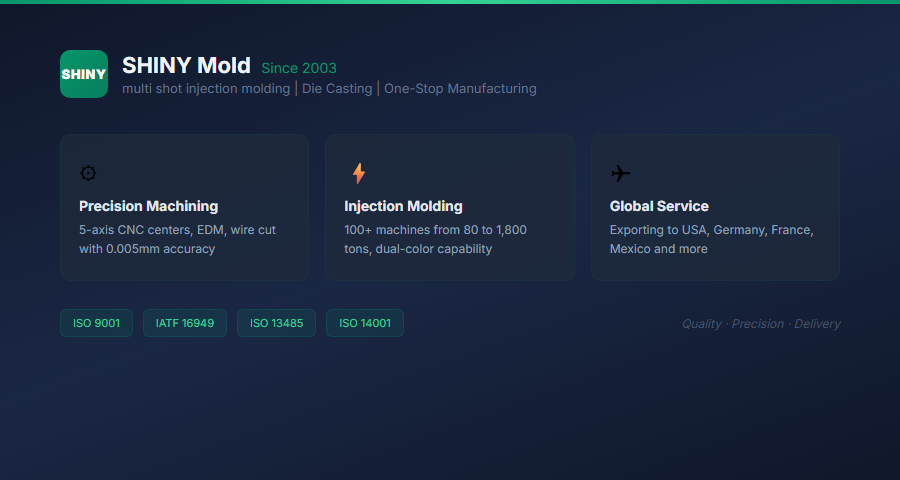
Founded in 2003, SHINY (Dongguan Xinxuan Mold) is headquartered in China's mold manufacturing hub — Chang'an, Dongguan. With fixed assets of USD 5 million, a facility spanning over 23,000 square meters, and a workforce of 400+ employees, SHINY specializes in high-precision plastic injection molds, aluminum die-casting molds, and magnesium die-casting molds.
Backed by a comprehensive library of 5,000+ mold designs, SHINY delivers over 2,000 molds annually. Our products serve industries including automotive, new energy, medical devices, consumer electronics, home appliances, power tools, and lighting. With 100+ injection molding machines (80–1,800 tons), dual-color injection capability, and dedicated assembly lines, SHINY provides end-to-end manufacturing from product design and prototyping to mold development, injection molding, and finished product assembly.
SHINY is certified under ISO 9001, ISO 14001, ISO 13485, and IATF 16949 quality management systems. Our clients span the United States, Canada, Mexico, Germany, France, Poland, and other European and American markets.
2026 Trends in Injection Molding
Industry 4.0 & Smart Manufacturing
IoT sensors, AI-driven process optimization, and real-time monitoring are transforming injection molding into a data-driven smart manufacturing process. Predictive maintenance reduces unplanned downtime by up to 50%, while digital twin technology enables virtual process optimization before physical implementation.
Sustainability & Circular Economy
Environmental responsibility is driving adoption of recycled materials, bio-based polymers, closed-loop recycling systems, and energy-efficient all-electric machines. Leading manufacturers are setting ambitious targets for carbon neutrality and waste reduction.
Multi-Material & Advanced Molding
Two-shot molding, over-molding, insert molding, and structural foam technologies enable parts with multiple materials in a single cycle — eliminating secondary assembly while creating unique functional and aesthetic possibilities.
How to Choose the Right Injection Molding Partner
- Technical Capability — Evaluate equipment inventory, CAE capabilities, and experience with your specific materials and processes
- Quality Management — Verify certifications (ISO 9001, IATF 16949, ISO 13485) and quality control processes
- Industry Experience — Look for proven success in your application area
- Production Capacity — Ensure sufficient equipment and workforce for your volume requirements
- Comprehensive Services — Consider partners offering end-to-end capabilities from design through assembly
Conclusion
Injection molding remains the backbone of modern plastic manufacturing, and its capabilities continue to expand through advances in materials science, digital manufacturing, and sustainability practices. Whether you're developing a consumer product, an automotive component, or a medical device, understanding the injection molding process and selecting the right manufacturing partner are essential for project success.
By partnering with experienced, certified manufacturers who combine cutting-edge technology with proven quality systems, companies can leverage the full potential of injection molding to bring innovative products to market faster, more efficiently, and with consistently superior quality.
Frequently Asked Questions
What is the typical lead time for injection molding?
Simple molds can be completed in 3-4 weeks, while complex multi-cavity molds may require 8-16 weeks. Rapid tooling methods can reduce initial lead times to 1-2 weeks for low-volume validation.
What factors affect injection molding cost?
Key cost drivers include mold complexity, number of cavities, material selection, part geometry, and annual volume requirements. For high-volume applications (>100,000 units), multi-cavity molds significantly reduce per-piece costs.
How do I ensure quality consistency?
Quality consistency requires robust process design, comprehensive monitoring (Scientific Molding, DOE, Cpk, SPC), regular mold maintenance, and incoming material inspection. Working with certified manufacturers (ISO 9001, IATF 16949, ISO 13485) provides additional assurance.