
 Chinese
What is Nylon Injection Molding?
Nylon injection molding is a specialized manufacturing process that uses injection molding machines to produce precision parts from nylon (polyamide) resins — primarily PA6 and PA66. Nylon is one of the most widely used engineering thermoplastics, valued for its exceptional mechanical strength, wear resistance, chemical resistance, and thermal stability. In 2026, the global nylon market continues to expand driven by demand from automotive lightweighting, medical devices, consumer electronics, and industrial applications.

Why Choose Nylon for Injection Molding?
Nylon offers a unique combination of properties that make it ideal for demanding applications:
- High Mechanical Strength: Nylon parts exhibit excellent tensile strength and impact resistance, capable of replacing metal components in many structural applications.
- Outstanding Wear & Abrasion Resistance: Nylon's low coefficient of friction makes it perfect for gears, bushings, bearings, and sliding components.
- Chemical & Oil Resistance: Resists hydrocarbons, oils, greases, and many solvents — critical for automotive under-hood and industrial applications.
- Thermal Stability: PA66 can withstand continuous service temperatures up to 185°C, with short-term peaks to 240°C.
- Lightweight: Nylon parts weigh approximately 80% less than equivalent metal components, supporting lightweight design goals.
- Dimensional Stability: Glass-filled nylon grades offer exceptional dimensional stability with minimal creep under load.
PA6 vs PA66: Key Differences for Injection Molding
| Property | PA6 (Nylon 6) | PA66 (Nylon 66) |
|---|---|---|
| Melting Point | 220°C | 260°C |
| Continuous Service Temp | ~150°C | ~185°C |
| Tensile Strength | 75-85 MPa | 85-95 MPa |
| Impact Resistance | Excellent | Good |
| Moisture Absorption | Higher (~9.5%) | Lower (~8.5%) |
| Processing Ease | Easier, wider window | Requires higher temp control |
| Cost | Slightly lower | Slightly higher |
| Typical Applications | Automotive interior, consumer goods, industrial parts | Under-hood automotive, electrical, structural components |
Nylon Injection Molding Process Parameters
Successful nylon injection molding requires careful control of processing parameters:
Drying Requirements
Nylon is hygroscopic and must be dried before processing. Moisture content must be below 0.2% (ideally 0.1%). Typical drying conditions: 80-90°C for PA6, 90-100°C for PA66, for 4-6 hours. Using a dehumidifying dryer is recommended for consistent results.
Melt Temperature
- PA6: 230-280°C (recommended: 250-270°C)
- PA66: 280-310°C (recommended: 290-300°C)
- Glass-filled grades: 10-15°C higher than base resin
Mold Temperature
- Unfilled nylon: 60-90°C
- Glass-filled nylon: 80-120°C
- Higher mold temperatures improve crystallinity, surface finish, and dimensional stability
Injection Pressure & Speed
Nylon requires high injection pressure (1000-1800 bar) due to its relatively low melt flow index. Fast injection speeds are typically recommended to prevent premature freezing of the melt front. Packing pressure should be 50-80% of injection pressure to minimize sink marks and warpage.
Common Challenges & Solutions in Nylon Molding
Even experienced molders face challenges with nylon injection molding. Here are the most common issues and their solutions:
| Defect | Cause | Solution |
|---|---|---|
| Sink Marks | Insufficient packing or cooling | Increase pack pressure, extend pack time, optimize gate location |
| Flash | Low clamp force or high injection speed | Increase clamp force, reduce injection speed, check mold alignment |
| Warpage | Uneven cooling or molecular orientation | Optimize cooling channel layout, balance fill, use glass-filled grade |
| Bubbles/Voids | Moisture contamination | Ensure proper drying (moisture <0.1%), check dryer performance |
| Short Shot | Low injection pressure or insufficient material | Increase injection pressure, raise melt temperature, check gate size |
| Brittle Parts | Degradation or insufficient drying | Reduce melt temperature, verify drying, reduce residence time |
Mold Design Considerations for Nylon Parts
Designing molds for nylon injection molding requires specific considerations:
- Gate Design: Tunnel gates, edge gates, and tab gates work well. Gate should be positioned to minimize flow orientation and warpage. Gate diameter: 0.8-2.0mm for unfilled nylon, 1.5-3.0mm for glass-filled.
- Draft Angles: Minimum 0.5° per side, recommend 1-3° for easy ejection. Glass-filled grades require higher draft angles (2-3°).
- Venting: Adequate venting is critical — vent depth 0.015-0.02mm for unfilled, 0.01-0.015mm for glass-filled. Inadequate venting causes burns, short shots, and poor weld line strength.
- Cooling System: Efficient cooling is essential. Use turbulent flow cooling channels (Reynolds number >4000). Cooling time typically accounts for 50-70% of total cycle time.
- Shrinkage: PA6: 0.7-1.8%, PA66: 1.0-2.5%. Glass-filled grades: 0.3-0.8%. Accounting for anisotropic shrinkage is critical for tight-tolerance parts.
SHINY Mold: Your Nylon Injection Molding Expert
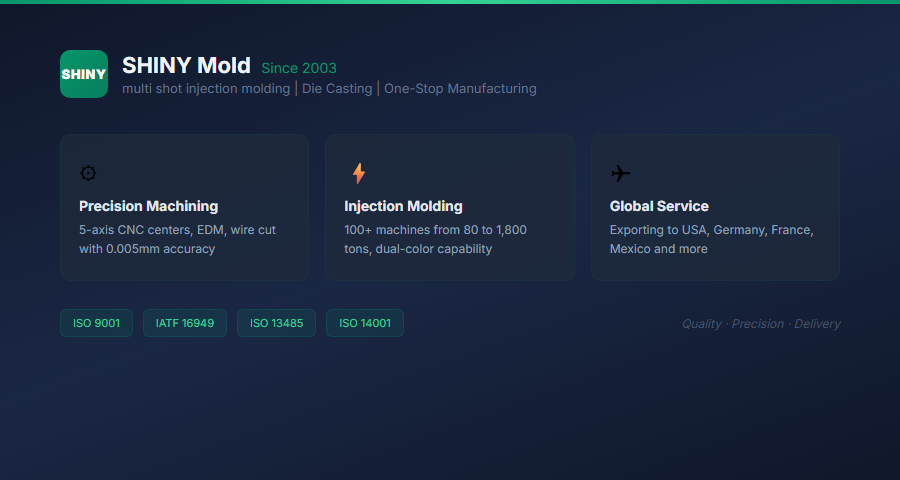
Founded in 2003 in Chang'an, Dongguan — the heart of China's mold manufacturing industry — SHINY Mold (Dongguan Xinxuan Precision Molds Co., Ltd.) has been a leading provider of precision nylon injection molding services for over two decades. Our 23,000+ square meter facility and 400+ skilled professionals deliver excellence across every project.
Why SHINY Mold for nylon injection molding?
- ISO 9001, ISO 14001, ISO 13485, and IATF 16949 certified — comprehensive quality management for automotive, medical, and industrial applications
- 100+ injection molding machines from 80 to 1,800 tons, capable of producing nylon parts weighing from 0.1g to 8,000g
- Extensive nylon experience: Years of processing PA6, PA66, PA6/6T, PA12, and glass/carbon fiber-reinforced nylon grades
- Complete turnkey service: DFM analysis → prototype → mold design & manufacturing → injection molding → secondary operations → assembly → logistics
- Moldflow simulation for filling, cooling, and warpage analysis to optimize mold design before steel is cut
- 5,000+ successful mold designs with annual output exceeding 2,000 injection molds
Applications of Nylon Injection Molded Parts
Nylon injection molded components serve critical functions across diverse industries:
Automotive
Engine covers, air intake manifolds, radiator end tanks, cooling fans, gear shift components, fuel system parts, and under-hood brackets. Nylon's heat and chemical resistance make it ideal for demanding automotive environments.
Medical Devices
Inhaler components, surgical instrument handles, drug delivery device parts, and orthopedic tool components. Certain medical-grade nylon formulations are biocompatible and autoclavable.
Consumer Electronics
Connector housings, cable management components, power tool housings, and structural frames where strength, weight reduction, and flame retardancy are required.
Industrial Equipment
Gears, bearings, pump impellers, valve components, conveyor system parts, and wear strips. Nylon's self-lubricating and wear-resistant properties significantly extend component service life.
Nylon Molding Cost Considerations
Understanding costs helps you budget effectively for nylon injection molded parts:
- Nylon Resin Cost: PA6 ~$1.5-3/kg, PA66 ~$2.5-5/kg, glass-filled ~$2-5/kg. Engineering grades like PA6T or PA12: $8-20/kg
- Mold/Tooling Cost: $5,000-$80,000+ depending on cavity count, complexity, and precision requirements
- Per-Part Price: $0.15-$8.00 depending on material, part weight, cycle time, and annual volume
- Cycletime: 15-60 seconds depending on wall thickness (typically 1-4mm for nylon parts)
- Volume Discounts: Significant cost reduction at volumes above 10,000-100,000 parts per year
Conclusion
Nylon injection molding is a proven, versatile manufacturing solution for producing high-performance plastic parts across automotive, medical, industrial, and consumer applications. Whether you need PA6 for impact-resistant components or PA66 for high-temperature structural parts, choosing the right molding partner is critical to your project's success.
With over 20 years of experience, ISO-certified facilities, and deep expertise in engineering plastics, SHINY Mold is your trusted partner for nylon injection molding. Contact us today to discuss your project requirements and discover how our precision molding capabilities can bring your nylon parts to life.
Keywords: nylon injection molding, PA6 injection molding, PA66 injection molding, nylon mold, precision nylon parts, SHINY Mold, Dongguan mold manufacturer, custom nylon molding