
 Chinese
Injection Molding Cost: A Complete Guide to Pricing in 2026
If you are searching for injection molding cost information, you likely have a plastic part to manufacture and need to understand the budget. This guide breaks down every cost component — mold fabrication, per-part pricing, material costs, and hidden expenses — so you can plan your project with confidence.
What Determines Injection Molding Cost?
Injection molding costs fall into two main categories: initial tooling (mold cost) and per-part production cost. Understanding both is essential for accurate budgeting.
1. Mold Cost (Tooling — NRE)
The mold is the biggest upfront expense and typically ranges from $3,000 to $100,000+ depending on complexity:
- Simple single-cavity mold (prototype): $3,000 – $8,000
- Production multi-cavity mold (2-4 cavities): $10,000 – $30,000
- Complex family mold or stack mold: $20,000 – $60,000
- High-cavitation, fully automated mold: $50,000 – $100,000+
Factors driving mold cost include part complexity, required steel grade (P20, H13, S136, 420SS), surface finish requirements (SPI grades), cooling channel design, ejection system, and expected production volume for tool life.
About SHINY Mold — Precision Molds at Competitive Prices
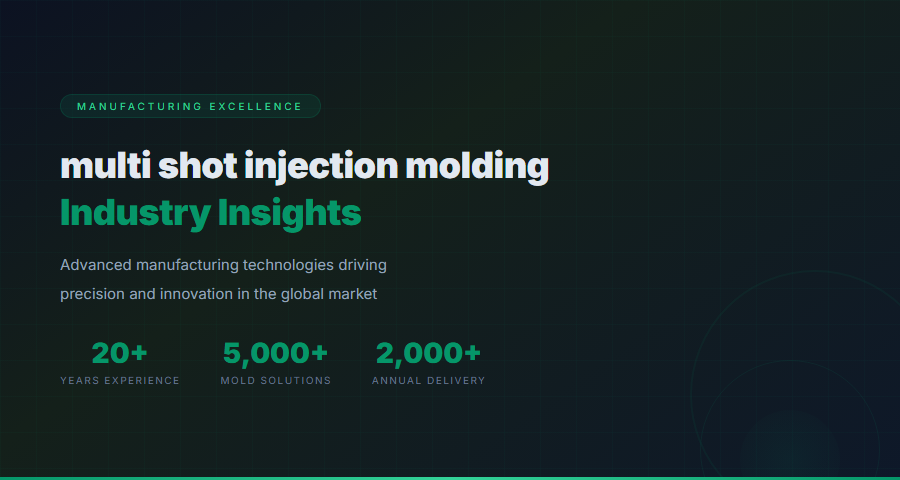
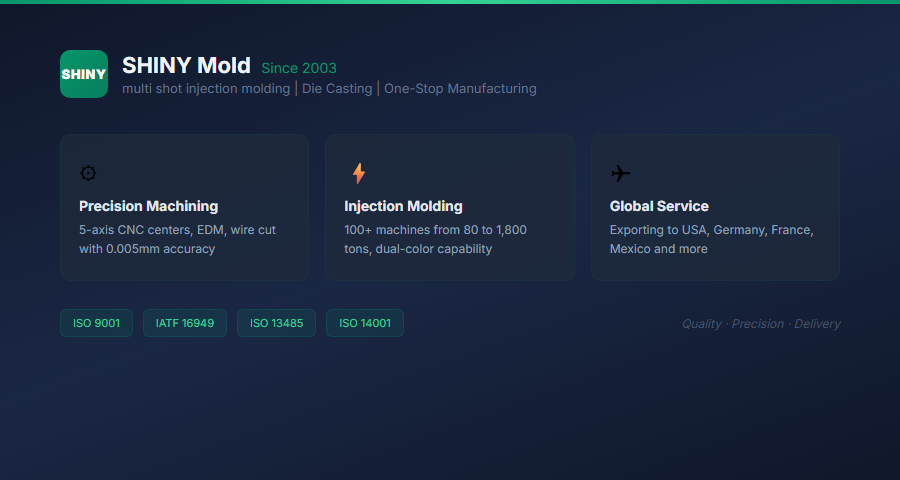
Founded in 2003, SHINY (Dongguan Xinxuan Mold) is headquartered in Chang'an, Dongguan — China's premier mold manufacturing hub. With fixed assets of USD 5 million, a 23,000+ square metre facility, and 400+ skilled employees, SHINY specializes in high-precision plastic injection molds, aluminum die-casting molds, and magnesium die-casting molds.
Our facility features 100+ injection molding machines ranging from 80 to 1,800 tons, dual-colour injection capability, and dedicated clean room molding areas. With a design library of 5,000+ successful mold designs and annual output of 2,000+ molds, we serve clients across automotive, new energy, medical devices, consumer electronics, home appliances, power tools, and lighting industries.
SHINY is certified under ISO 9001:2015, ISO 14001:2015, ISO 13485:2016, and IATF 16949:2016. Our export markets include the United States, Canada, Mexico, Germany, France, Poland, and throughout Europe.
2. Per-Part Production Cost
Once the mold is ready, each part costs money to produce. Typical per-part pricing:
- Simple small parts (under 10g): $0.05 – $0.30 each
- Medium parts (10g – 100g): $0.30 – $1.50 each
- Large parts (100g – 500g): $1.50 – $5.00 each
- Very large parts (500g+): $5.00 – $15.00+ each
These prices depend on cycle time, material selection, machine tonnage, and annual volume. Higher volumes significantly reduce per-part costs through economies of scale.
Injection Molding Cost Breakdown Table
| Cost Component | Typical Range | Notes |
|---|---|---|
| Mold design & engineering | $500 – $5,000 | DFM analysis, simulation (Moldflow) |
| Mold fabrication (steel + machining) | $3,000 – $80,000 | Steel grade, cavity count, complexity |
| Mold trial (T0/T1) | $300 – $1,000 | Material + machine time + labor |
| Raw material (per kg) | $2 – $20/kg | PP/ABS cheapest, engineering resins more |
| Machine time (per hour) | $30 – $150/hr | Depends on tonnage (80T vs 1800T) |
| Labor & overhead | 15-30% of machine cost | Operator, quality inspection, packaging |
| Quality inspection (CMM) | $100 – $500/lot | FAI & CPK reports, dimensional checks |
| Shipping & logistics | $200 – $2,000 | Depends on weight, destination, mode |
How Part Volume Affects Injection Molding Cost
The volume you order dramatically changes per-part cost. Here is a realistic example for a medium-sized ABS part (50g, simple geometry):
| Annual Volume | Mold Configuration | Mold Cost | Per-Part Cost | Cost Including Mold Amortization |
|---|---|---|---|---|
| 1,000 | Single cavity (aluminum) | $5,000 | $2.50 | $7.50 |
| 10,000 | Single cavity (steel) | $8,000 | $0.80 | $1.60 |
| 50,000 | 2-cavity (steel) | $12,000 | $0.35 | $0.59 |
| 100,000 | 4-cavity (steel) | $18,000 | $0.25 | $0.43 |
| 500,000+ | 8+ cavity (hardened steel) | $35,000 | $0.12 | $0.19 |
Material Cost Comparison
Material choice significantly affects injection molding cost. Here are typical resin prices for common engineering plastics:
- Polypropylene (PP): $1.50 – $2.50/kg — General purpose, low cost
- ABS: $2.50 – $4.00/kg — Good balance of strength and cost
- Nylon/PA6: $3.50 – $6.00/kg — Strong, wear-resistant
- Polycarbonate (PC): $4.00 – $8.00/kg — Impact-resistant, transparent
- PEEK: $60 – $120/kg — High-performance, high-temperature
- Liquid Silicone Rubber (LSR): $15 – $30/kg — Flexible, medical-grade
How to Get Accurate Injection Molding Cost Quotes
To get accurate pricing from molders, prepare the following for your RFQ:
- 3D CAD model (STEP or IGES format preferred)
- 2D drawing with critical dimensions, tolerances, and GD&T
- Material specification — grade, supplier, or required properties
- Annual volume and order quantity — determines cavity count and tool steel
- Surface finish and appearance requirements — SPI/VDI grade
- Target timeline — mold delivery and production start
- Quality requirements — ISO certifications, PPAP level, inspection standards
Ways to Reduce Injection Molding Cost
- Design for manufacturability (DFM): Simplify part geometry, avoid undercuts, maintain uniform wall thickness
- Choose the right mold material: Aluminum molds for low-volume, P20 steel for medium-volume, H13 for high-volume
- Optimize gate location: Proper gate placement reduces cycle time and improves fill
- Increase cavity count: More cavities = lower per-part cost (for sufficient volumes)
- Source internationally: Mold fabrication in China typically saves 40-60% compared to US or European tooling shops
- Consolidate parts: Combine multiple components into one molded part where possible
- Negotiate annual contracts: Guaranteed volume often earns better per-part pricing
Frequently Asked Questions About Injection Molding Cost
How much does an injection mold cost?
A production-grade steel injection mold typically costs between $8,000 and $50,000. Simple prototype molds can cost as little as $3,000, while complex multi-cavity high-production molds can exceed $100,000. The exact price depends on part size, complexity, cavity count, and steel quality.
Why is injection molding so expensive for small runs?
The mold cost is a fixed upfront investment. For small runs (under 1,000 parts), this cost dominates the total. For low-volume projects, consider aluminum prototype molds, 3D-printed mold inserts, or rapid injection molding services.
Does injection molding cost less than 3D printing?
For volumes above 500-1,000 parts, injection molding is significantly cheaper per part. Below that threshold, 3D printing or CNC machining may be more cost-effective. The breakeven point depends on part complexity, material, and quality requirements.
How can I estimate injection molding cost before contacting suppliers?
Many online calculators provide rough estimates based on part volume, material, and estimated cycle time. However, for accurate pricing, submit a detailed RFQ to multiple molders. Most reputable manufacturers including SHINY Mold provide free DFM analysis and competitive quotes.
What is the average injection molding cost per part?
For medium-volume production (10,000 – 100,000 parts), per-part costs typically range from $0.10 to $2.00 depending on size, material, and complexity. The key is amortizing the mold cost over the production volume.
Conclusion
Understanding injection molding cost means looking beyond just the per-part price. Consider the complete picture: mold investment, material selection, volume requirements, quality standards, and supplier capabilities. A slightly higher mold investment from an experienced, ISO-certified manufacturer often delivers better long-term value through longer tool life, stable production, and consistent part quality.
When evaluating injection molding suppliers for cost, request detailed breakdowns, verify quality certifications, and don't hesitate to ask for DFM recommendations — the best suppliers will help you optimize your part design to reduce overall cost.