
 Chinese
Molded Metal: The Complete Guide to Metal Molding Processes & Precision Manufacturing in 2026
When engineers and procurement professionals search for "molded metal" solutions, they're typically looking for a manufacturing process that can produce complex metal parts with precision, repeatability, and cost efficiency. Unlike plastic injection molding, metal molding encompasses several distinct technologies — each suited to different geometries, volumes, material requirements, and budgets.
This guide breaks down the major molded metal processes, compares their capabilities, and helps you select the right approach for your project. We'll also introduce how a world-class manufacturing partner like SHINY Mold delivers precision metal parts to global clients across automotive, medical, consumer electronics, and industrial applications.
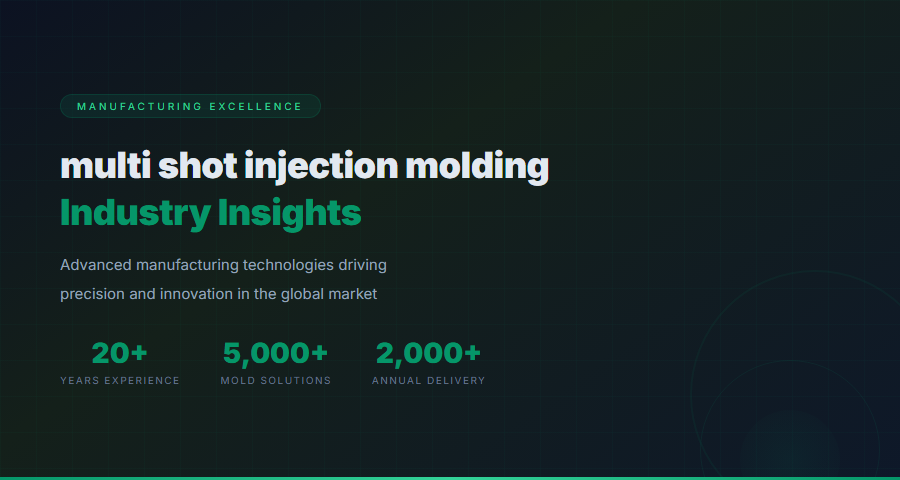
What Is Molded Metal Manufacturing?
Molded metal manufacturing refers to processes where molten or powdered metal is shaped into a desired geometry using a mold or die. The term covers several key technologies:
- Metal Injection Molding (MIM) — Fine metal powder mixed with binder, injected into a mold, then sintered to full density
- Die Casting — Molten metal forced into a steel die under high pressure
- Powder Metallurgy (PM) — Metal powder compacted in a die and sintered without melting
- Investment Casting — Wax pattern coated with ceramic, melted out, and filled with molten metal
- Sand Casting — Molten metal poured into a sand mold (typically for larger, lower-volume parts)
Each process has unique strengths in terms of part complexity, dimensional accuracy, material options, production volume, and cost per part. Choosing the right one depends on your specific requirements.
Metal Injection Molding (MIM): The Preferred Molded Metal Process for Complex Parts
Metal Injection Molding (MIM) is the fastest-growing segment in the molded metal industry. It bridges the gap between the design freedom of plastic injection molding and the mechanical properties of wrought metal.
How MIM Works
- Feedstock preparation — Fine metal powders (typically < 20 microns) are mixed with a thermoplastic binder system
- Injection molding — The feedstock is injected into a multi-cavity mold, creating a "green part" that is roughly 20% oversized to account for shrinkage
- Debinding — The binder is removed through solvent and thermal processes, leaving a porous "brown part"
- Sintering — The brown part is fired in a controlled atmosphere furnace at temperatures near the melting point, causing the metal particles to fuse to 96-99% density
- Secondary operations — Optional coining, heat treatment, surface finishing, or machining to meet final specifications
Materials Available for MIM
| Material Type | Common Grades | Typical Applications |
|---|---|---|
| Stainless Steels | 316L, 17-4PH, 304L, 420 | Medical devices, surgical instruments, firearms |
| Low-Alloy Steels | 4140, 4340, 8620 | Automotive components, lock parts, gears |
| Tool Steels | M2, D2, H13 | Cutting tools, wear-resistant parts |
| Titanium | Ti-6Al-4V, CP-Ti | Medical implants, aerospace, luxury goods |
| Copper Alloys | Copper, Brass, Bronze | Electrical connectors, heat sinks, decorative parts |
When to Choose MIM for Molded Metal Parts
- Complex 3D geometries that cannot be machined cost-effectively
- Annual volumes between 10,000 and 2,000,000 parts
- Part weights under 100 grams (typical sweet spot: 0.1 - 50 grams)
- Tight tolerances (typically ±0.3% to ±0.5%)
- Need for near-100% density and mechanical properties comparable to wrought metal
Die Casting: The High-Volume Molded Metal Solution
For larger metal parts produced in high volumes, die casting is often the most economical molded metal process. Molten metal (typically aluminum, zinc, or magnesium alloys) is injected into a steel die under high pressure, producing parts faster than any other metal forming process.
Powder Metallurgy: Cost-Effective Route
For simpler shapes, conventional powder metallurgy (PM) offers the lowest-cost route to medium-volume molded metal parts. Metal powder is compacted in a rigid die at room temperature, then sintered to bond the particles. Key advantages include lowest tooling cost, near 100% material utilization, and production rates up to 1,000+ parts per hour.
Common Applications of Molded Metal Parts
Automotive — Engine components, transmission parts, sensor housings, fuel system components. Medical devices — Surgical instruments, orthodontic brackets, biopsy tools, implantable devices. Consumer electronics — Smartphone hinges, camera modules, connector housings, SIM card trays. Industrial — Hydraulic fittings, valve components, pump parts, cutting tools. Firearms & defense — Trigger components, firing pins, safety levers, sight systems. Aerospace — Brackets, latches, fasteners, interior fittings.
About SHINY Mold — Precision Molded Metal Manufacturing Partner
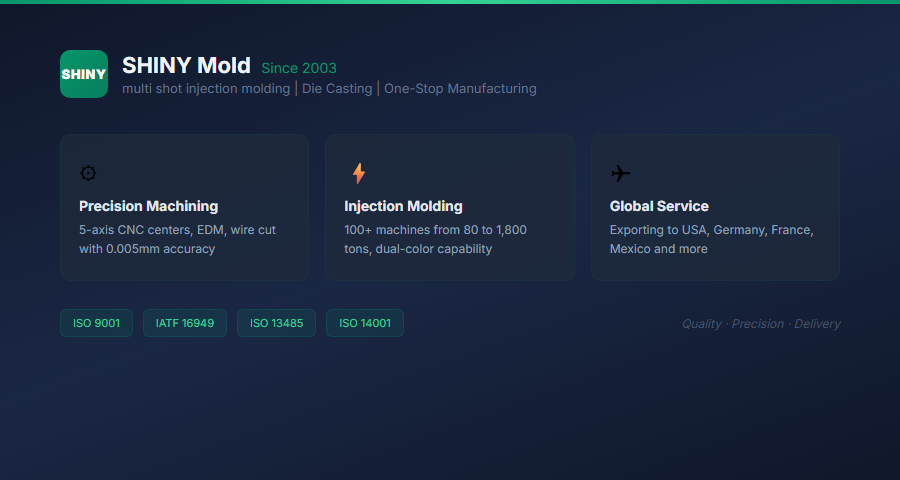
Founded in 2003, SHINY (Dongguan Xinxuan Mold) is headquartered in Chang'an, Dongguan — China's premier mold manufacturing hub. With fixed assets of USD 5 million, a 23,000+ square metre facility, and 400+ skilled employees, SHINY specializes in high-precision plastic injection molds, aluminum die-casting molds, and magnesium die-casting molds — delivering comprehensive molded metal solutions to clients worldwide.
Our facility features 100+ injection molding machines ranging from 80 to 1,800 tons, dual-colour injection capability, and dedicated clean room areas. With a design library of 5,000+ successful mold designs and annual output of 2,000+ molds, we serve clients across automotive, new energy, medical devices, consumer electronics, home appliances, power tools, and lighting industries.
SHINY is certified under ISO 9001:2015, ISO 14001:2015, ISO 13485:2016, and IATF 16949:2016. Our export markets include the United States, Canada, Mexico, Germany, France, Poland, and throughout Europe. We combine Chinese manufacturing efficiency with international quality standards — delivering precision, reliability, and value to clients worldwide.
How to Choose the Right Molded Metal Process
- Define your material requirements — Mechanical properties, corrosion resistance, magnetic properties needed?
- Determine part geometry — Does the part have undercuts, threads, or thin walls?
- Establish volume requirements — Annual quantities drive tooling investment decisions
- Set tolerance expectations — MIM offers tightest tolerances (±0.3-0.5%), die casting (±0.5-1.0%), conventional PM (±1.0-2.0%)
- Consider secondary operations — Plating, heat treatment, machining, or assembly?
- Evaluate cost targets — Balance tooling NRE with per-part cost over projected production run
Quality Certifications for Molded Metal Parts
When sourcing molded metal components, verify your supplier holds relevant certifications: ISO 9001:2015 (general quality management), IATF 16949:2016 (automotive, PPAP, CPK), ISO 13485:2016 (medical, material traceability), AS9100D (aerospace), and ISO 14001:2015 (environmental management).
2026 Trends in Molded Metal Manufacturing
Hybrid MIM + Machining — Combining MIM's near-net-shape capability with precision CNC for features requiring tighter tolerances. Sustainable Production — Recycled metal powders, energy-efficient sintering, closed-loop cooling. Digital Twin Simulation — AI-powered software predicting shrinkage, warpage, and density gradients. Multi-Material Parts — Two-shot MIM combining different metals in a single component.
Frequently Asked Questions
What is the most cost-effective molded metal process for small complex parts?
Metal Injection Molding (MIM) offers the best cost-value balance for complex parts under 100 grams in volumes of 10,000+ per year.
How does cost compare to CNC machining?
For simple geometries under 500 parts, CNC is cheaper. As volumes increase and parts become more complex, molded metal processes become more economical. The crossover for MIM vs. machining is typically 5,000-10,000 parts.
What metals can be molded?
Stainless steels, low-alloy steels, tool steels, titanium alloys, cobalt-chrome, copper alloys, and refractory metals via MIM. Die casting covers aluminum, zinc, magnesium, and copper alloys.
Are molded metal parts as strong as machined ones?
High-quality MIM parts achieve 96-99% density with properties comparable to wrought metal. Die-cast parts are near 100% dense. Properly manufactured molded metal parts meet or exceed requirements for most structural applications.
Conclusion
The term "molded metal" encompasses a family of precision manufacturing processes — MIM, die casting, powder metallurgy, and more — each with distinct strengths for different part geometries, volumes, and material requirements. Making the right choice requires a clear understanding of your project's technical requirements and production goals.
Whether you need high-volume die-cast housings, complex MIM components, or precision magnesium parts for lightweight applications, partnering with an experienced manufacturer like SHINY Mold ensures access to world-class capabilities, certified quality systems, and proven expertise across multiple molded metal technologies. Contact SHINY Mold today to discuss your molded metal project and receive a professional DFM analysis and competitive quotation.