
 Chinese
Custom Plastic Injection Moulding: Complete Guide to Precision UK-Style Manufacturing
Custom plastic injection moulding is one of the most versatile manufacturing processes for producing high-quality plastic parts at scale. Whether you need a few hundred prototypes or millions of production components, finding the right custom moulding partner is critical to your product's success.
This guide covers everything you need to know about custom plastic injection moulding — from material selection and design considerations to cost factors and how to evaluate potential manufacturing partners.
What Is Custom Plastic Injection Moulding?
Custom plastic injection moulding is a manufacturing process where molten plastic is injected into a custom-designed mould cavity under high pressure. The plastic cools and solidifies into the desired shape, producing parts with excellent dimensional accuracy and surface finish. Unlike off-the-shelf components, custom moulding creates parts designed specifically for your application — unique geometries, specific material properties, and tight tolerances.
Key Benefits
- Design flexibility — Virtually any shape or complexity can be moulded
- High precision — Tolerances as tight as ±0.05mm
- Excellent repeatability — Consistent quality across millions of parts
- Wide material selection — Hundreds of plastic grades available
- Low per-part cost — Economical at high volumes
- Minimal post-processing — Parts ready for use directly from the mould
Materials for Custom Injection Moulding
Commodity Plastics
- Polypropylene (PP) — Excellent chemical resistance, living hinge capability
- Polyethylene (PE) — Good impact resistance, food-safe grades
- ABS — Tough, impact-resistant, excellent surface finish
Engineering Plastics
- Nylon (PA6, PA66) — High strength, wear resistance
- Polycarbonate (PC) — Exceptional impact strength, optical clarity
- POM (Acetal) — Low friction, excellent dimensional stability
- PBT — Good electrical properties, chemical resistance
The Custom Moulding Process
- Part Design — CAD design with draft angles and wall thickness
- Mould Design — Engineering cooling channels, ejection, and gating
- Mould Fabrication — CNC, EDM, wire cutting, precision grinding
- Mould Trial (T1) — First samples inspected dimensionally
- Sample Approval — Customer approves with dimensional reports
- Production — Full run with process monitoring
- Secondary Ops — Assembly, printing, packaging
Cost Breakdown
| Component | Range | Key Factors |
|---|---|---|
| Mould (Tooling) | $2,000 - $100,000+ | Complexity, cavity count, steel grade, surface finish |
| Material | $1 - $50/kg | Resin type, fillers, additives, colour |
| Per-Part Cost | $0.05 - $5.00 | Cycle time, material cost, part weight, volume |
About SHINY Mold
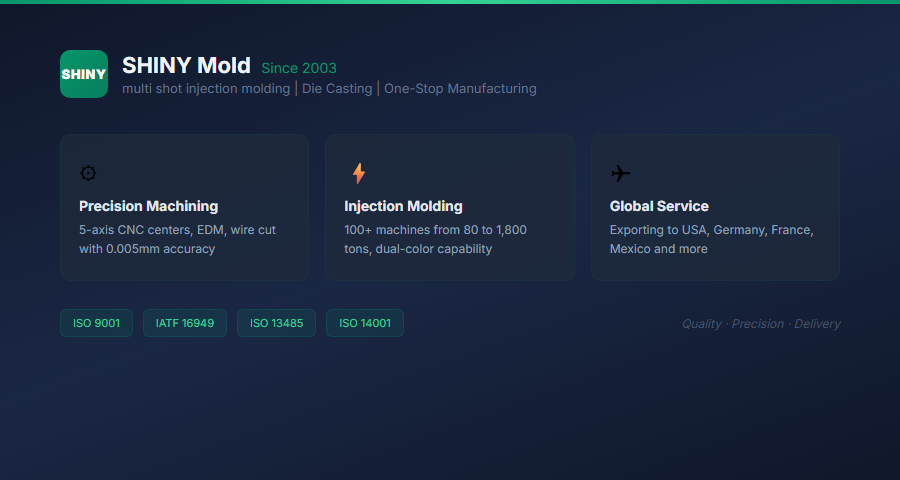
Founded in 2003, SHINY (Dongguan Xinxuan Mold) is headquartered in Chang'an, Dongguan — China's premier mould manufacturing hub. With fixed assets of USD 5 million, a 23,000+ square metre facility, and 400+ skilled employees, SHINY specialises in custom plastic injection moulding for clients worldwide.
Our facility features 100+ injection moulding machines from 80 to 1,800 tons, dual-colour injection capability, and clean room moulding areas. With 5,000+ successful mould designs and annual output of 2,000+ moulds, we serve clients across automotive, new energy, medical, consumer electronics, home appliances, power tools, and lighting industries.
SHINY is certified under ISO 9001:2015, ISO 14001:2015, ISO 13485:2016, and IATF 16949:2016. Our export markets include the United Kingdom, United States, Canada, Germany, France, Poland, and throughout Europe — delivering precision, reliability, and value to clients worldwide.
How to Choose a Moulding Partner
Evaluate potential partners on: in-house mould design and fabrication capability, machine range (80-1,800+ tons), quality certifications (ISO 9001, IATF 16949, ISO 13485), industry experience in your sector, and communication responsiveness — especially for international partnerships.
Frequently Asked Questions
What is the typical lead time for custom plastic injection moulding?
Mould fabrication: 6-10 weeks. Sampling and approval: 2-4 weeks. Production depends on volume.
What is the minimum order quantity?
Varies by moulder. Low-volume runs can be 500-5,000 parts; high-volume production starts at 10,000+.
What file formats do moulders need?
3D CAD files (STEP, IGES) and 2D engineering drawings with tolerances, material specifications, and annual volume projections.
Conclusion
Custom plastic injection moulding is a proven, cost-effective manufacturing process for producing high-quality plastic parts at any scale. The right moulding partner brings technical expertise, quality assurance, and a commitment to your project's success. For your next project, SHINY Mold offers the experience, equipment, and certifications to deliver precision results from initial design through full-scale production.