
 Chinese
Manufacturing Process Steps For Injection Molded Parts: The Complete Guide for 2026
manufacturing process steps for injection molded parts is a critical manufacturing process in the plastic and metal fabrication industry, enabling the mass production of high-precision parts across automotive, medical, electronics, and consumer goods sectors. As we move through 2026, advancements in materials, automation, and quality control are making manufacturing process steps for injection molded parts more capable and cost-effective than ever before.
This comprehensive guide covers everything you need to know: the technology, materials, quality systems, cost drivers, and proven strategies for selecting the ideal manufacturing partner.
What Is Manufacturing Process Steps For Injection Molded Parts?
manufacturing process steps for injection molded parts refers to the specialised manufacturing process and related services that enable the production of precision parts through injection moulding technology. This includes mould design and fabrication, material selection, precision moulding, quality inspection, and value-added services such as assembly and packaging.
A professional manufacturing process steps for injection molded parts provider offers end-to-end solutions:
- Design for Manufacturability (DFM) — Engineering optimisation for mouldability and cost reduction
- Mould Design & Fabrication — In-house tool room with advanced CNC and EDM capabilities
- Rapid Prototyping — 3D printing, CNC machining, and soft tooling for design validation
- Production Moulding — High-volume precision injection moulding on modern equipment
- Quality Control — CMM inspection, functional testing, SPC, and full traceability
- Secondary Operations — Printing, coating, ultrasonic welding, and assembly
The Manufacturing Process Steps For Injection Molded Parts Process: Step by Step
- Clamping — The mould closes and clamping force is applied to prevent flash during injection
- Injection — Molten material is injected into the mould cavity at controlled pressure and speed
- Dwelling — Holding pressure compensates for material shrinkage during cooling
- Cooling — The part solidifies; cooling time typically represents 50-80% of total cycle time
- Mould Opening — The moving platen separates from the fixed platen
- Ejection — Ejector pins push the finished part out of the mould
Modern all-electric injection moulding machines deliver exceptional repeatability, energy efficiency, and cleanroom compatibility — essential for medical and electronics applications.
Materials Used in Manufacturing Process Steps For Injection Molded Parts
Material selection is fundamental to part performance, cost, and manufacturability. Here are the most commonly used materials:
| Material | Key Properties | Typical Applications |
|---|---|---|
| ABS | Impact resistance, excellent surface finish | Electronics housings, automotive interior |
| PP | Chemical resistance, living hinge capability | Food containers, caps, battery cases |
| PC | High impact strength, optical clarity | Automotive lenses, safety equipment |
| PA (Nylon) | High strength, wear resistance, heat resistance | Gears, bearings, under-hood automotive |
| POM (Delrin) | Dimensional stability, low friction | Precision gears, fuel system components |
| PEEK | High temperature resistance, chemical inertness | Aerospace, medical implants, oil & gas |
Quality Standards & Certifications
Reputable manufacturing process steps for injection molded parts providers maintain internationally recognised certifications:
- ISO 9001:2015 — Quality management systems (foundational standard)
- IATF 16949:2016 — Automotive quality management (mandatory for automotive suppliers)
- ISO 13485:2016 — Medical device quality management (required for medical moulding)
- ISO 14001:2015 — Environmental management systems
About SHINY Mold
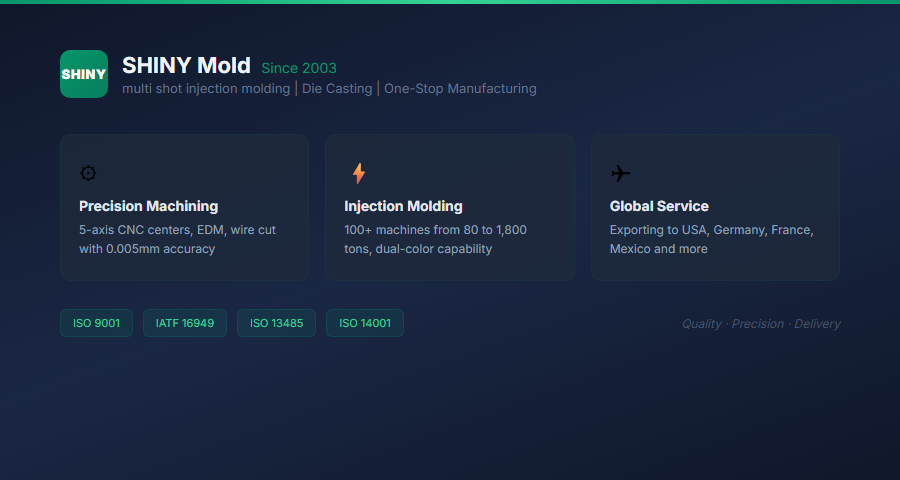
Founded in 2003, SHINY (Dongguan Xinxuan Mold) is headquartered in China's mould manufacturing hub — Chang'an, Dongguan. With fixed assets of USD 5 million, a facility spanning over 23,000 square metres, and a workforce of 400+ employees, SHINY specialises in high-precision plastic injection moulds, aluminium die-casting moulds, and magnesium die-casting moulds.
Backed by a comprehensive library of 5,000+ mould designs, SHINY delivers over 2,000 moulds annually. Our products serve industries including automotive, new energy, medical devices, consumer electronics, home appliances, power tools, and lighting. With 100+ injection moulding machines (80–1,800 tons), dual-colour injection capability, and dedicated assembly lines, SHINY provides end-to-end manufacturing from product design and prototyping to mould development, injection moulding, and finished product assembly.
SHINY is certified under ISO 9001, ISO 14001, ISO 13485, and IATF 16949 quality management systems. Our clients span the United States, Canada, Mexico, Germany, France, Poland, and other European and American markets.
Cost Factors in Manufacturing Process Steps For Injection Molded Parts
Understanding cost drivers helps optimise your project budget:
Mould Cost (One-Off / NRE)
- Mould complexity — Undercuts, sliders, and multi-cavity designs increase cost
- Mould material — P20 (standard), H13 (high-volume), S136 (mirror finish)
- Cavity count — Single-cavity vs. multi-cavity (2, 4, 8, 16+)
- Surface finish — Standard polish vs. high-gloss / VDI 3400 texture
- Lead time — Standard (6-10 weeks) vs. expedited (3-5 weeks, +30-50% cost)
Piece Price (Per-Part Cost)
- Material cost — Commodity resins (PP, PE) vs. engineering resins (PC, PEEK)
- Part size & weight — Larger parts require larger machines and more material
- Cycle time — Optimised cooling and process control reduce cycle time
- Production volume — Higher volumes justify multi-cavity moulds and automation
- Tolerance requirements — Tight tolerances increase scrap rate and inspection cost
How to Choose the Right Manufacturing Process Steps For Injection Molded Parts Partner
- Evaluate Technical Capability
- Do they have in-house tool room with 5-axis CNC, EDM, and CMM?
- Do they use CAE simulation (Moldflow, Moldex3D) for mould design?
- What is their machine tonnage range and moulding capacity?
- Verify Quality Certifications
- ISO 9001 (minimum), IATF 16949 (automotive), ISO 13485 (medical)
- Do they provide PPAP, FAIR, SPC, and material certifications?
- Review Industry Experience
- Do they have proven experience in your industry?
- Can they provide customer references and case studies?
- Assess Communication & Project Management
- Do they provide DFM feedback and design optimisation?
- Is project status transparent with regular updates?
2026 Trends in Manufacturing Process Steps For Injection Molded Parts
Industry 4.0 & Smart Moulding
Leading manufacturing process steps for injection molded parts providers are adopting IoT sensors, real-time process monitoring, AI-driven optimisation, and digital twin simulation to reduce setup times and minimise defects.
Sustainable Moulding Practices
Bio-based polymers, recycled-content resins, energy-efficient all-electric machines, and closed-loop recycling systems are becoming standard among environmentally responsible moulders.
Multi-Material & Overmoulding
Two-shot moulding, overmoulding, and insert moulding enable complex multi-material parts in a single cycle, increasingly in demand for soft-touch grips and sealed assemblies.
Frequently Asked Questions
What is the typical lead time for injection moulding?
Prototype tooling: 2-4 weeks. Production mould (standard complexity): 6-10 weeks. Complex or multi-cavity moulds: 10-16 weeks.
What is the minimum order quantity (MOQ)?
Most providers prefer runs of 1,000+ pieces. Some offer low-volume production (100-1,000 pieces) using aluminium tooling. For prototypes, 50-100 pieces may be feasible.
How do I ensure consistent quality in production?
Work with a moulder who follows Scientific Moulding principles, Design of Experiments (DOE), Statistical Process Control (SPC), and first-article inspection (FAI). Request CPK data for critical dimensions.
What files do I need to provide for a quotation?
3D model (STEP, IGES), 2D drawing with critical dimensions and tolerances, material specification, estimated annual volume, and any special requirements (food-grade, flame-retardant, etc.).
Conclusion
Selecting the right manufacturing process steps for injection molded parts partner is a strategic decision that impacts every stage of your product lifecycle. By understanding the technology, evaluating quality systems, and choosing a partner with proven technical capability and industry experience, you can ensure your parts are manufactured to the highest standards of quality, consistency, and cost-effectiveness.
In 2026 and beyond, the most successful manufacturing partnerships will be built on transparency, technical collaboration, and a shared commitment to quality and sustainability. Choose wisely — your product's success depends on it.