
 Chinese
Injection Molding Services: Complete Guide to Precision Manufacturing in 2026
Finding the right injection molding services provider can make or break your product development timeline. Whether you are launching a new consumer product, scaling automotive production, or prototyping a medical device, the quality and reliability of your molding partner directly impacts part consistency, cost efficiency, and time to market.
This guide covers everything you need to know about injection molding services in 2026 — from the fundamentals of the process to material selection, quality standards, cost optimization, and how to evaluate and select the best manufacturing partner for your project.

What Are Injection Molding Services?
Injection molding services encompass the full spectrum of manufacturing support provided by professional moulders: from initial part design review and mould fabrication through production moulding, quality inspection, and secondary operations such as assembly, decorating, and packaging.
A comprehensive injection molding service provider typically delivers:
- Design for Manufacturability (DFM) — Expert engineering feedback to optimize part geometry for mouldability, reduce cycle time, and minimize defects
- Mould Design and Fabrication — In-house tooling with CNC machining, EDM, wire cutting, and mould flow analysis
- Rapid Prototyping — Quick-turn prototypes via 3D printing, CNC machining, or soft tooling before committing to production moulds
- Production Moulding — High-volume, precision injection moulding on machines ranging from 50 to 2,000+ tons
- Quality Assurance — CMM inspection, SPC monitoring, first-article inspection (FAI), and full material traceability
- Value-Added Services — Printing, coating, ultrasonic welding, assembly, and custom packaging
How the Injection Molding Process Works
Understanding the injection molding process helps you communicate effectively with your service provider and make informed decisions about design, materials, and production planning.
- Material Preparation — Raw plastic resin (typically in pellet form) is dried to remove moisture and loaded into the hopper of the injection moulding machine
- Melting and Injection — The material is heated to its melting temperature inside the barrel, then injected under high pressure (up to 30,000 PSI) into the mould cavity through the runner and gate system
- Packing and Holding — After the cavity is filled, additional pressure is maintained to compensate for material shrinkage as the part cools — this stage is critical for dimensional accuracy
- Cooling — The moulded part solidifies inside the closed mould, with cooling channels in the mould plates circulating water or oil to control the cooling rate
- Mould Opening and Ejection — The mould opens and ejector pins push the solidified part out; cycle times range from seconds for small parts to several minutes for large components
- Post-Moulding Operations — Parts may require degating, trimming, inspection, printing, coating, or assembly before shipping
Common Materials Used in Injection Molding Services
Material selection is one of the most important decisions in any injection molding project. The right resin balances performance requirements, cost, mouldability, and regulatory compliance.
| Material | Key Properties | Common Applications |
|---|---|---|
| ABS | Impact resistance, toughness, good surface finish, easy to paint and glue | Consumer electronics housings, automotive interior trim, keyboard keys |
| PP (Polypropylene) | Chemical resistance, fatigue resistance, living hinge capability, low density | Food containers, automotive battery cases, caps and closures, living hinges |
| PC (Polycarbonate) | High impact strength, optical clarity, heat resistance, dimensional stability | Automotive headlamp lenses, safety goggles, medical devices, electronic housings |
| PA (Nylon) | High tensile strength, wear resistance, self-lubricating, chemical resistance | Gears, bearings, automotive under-hood components, electrical connectors |
| POM (Acetal/Delrin) | Excellent dimensional stability, low friction, high stiffness, creep resistance | Precision gears, fasteners, fuel system components, conveyor parts |
| PBT | Good electrical insulation, chemical resistance, flame retardant grades available | Connectors, sensor housings, LED frames, automotive electrical parts |
| PEEK | Exceptional temperature resistance, chemical inertness, biocompatibility | Aerospace components, medical implants, semiconductor, oil and gas |
| PMMA (Acrylic) | Optical clarity, UV resistance, weatherability, scratch resistance | Lighting diffusers, display screens, automotive light covers, optical lenses |
Quality Standards in Injection Molding Services
Professional injection molding service providers invest heavily in quality management systems and certifications to ensure consistent, reliable production output.
- ISO 9001:2015 — The foundational quality management standard, ensuring systematic process control and continuous improvement
- IATF 16949:2016 — The global automotive quality standard, mandatory for suppliers to OEMs and Tier 1 automotive manufacturers
- ISO 13485:2016 — Medical device quality management, required for moulders producing medical-grade components
- ISO 14001:2015 — Environmental management, demonstrating commitment to sustainable manufacturing practices
- UL Recognition — Underwriters Laboratories certification for flame-retardant plastics used in electrical applications
Top-tier moulders also employ advanced quality tools including Moldflow/Moldex3D simulation, Design of Experiments (DOE), Statistical Process Control (SPC), and PPAP (Production Part Approval Process) for automotive applications.
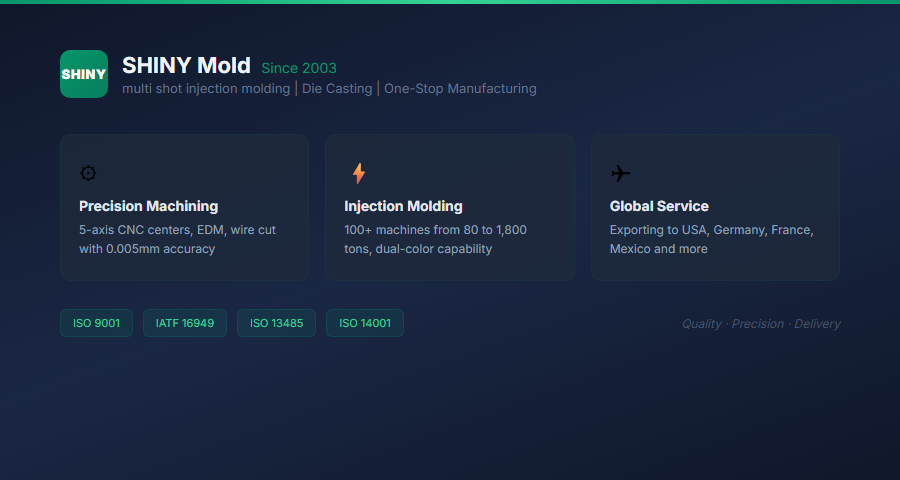
About SHINY Mold — Your Trusted Injection Molding Services Partner
Founded in 2003, SHINY (Dongguan Xinxuan Mold) is headquartered in Chang'an, Dongguan — China's premier mould manufacturing hub. With fixed assets of USD 5 million, a modern facility spanning over 23,000 square metres, and a dedicated workforce of 400+ professionals, SHINY has established itself as a leading provider of precision injection molding services.
Our capabilities include high-precision plastic injection moulds, aluminium die-casting moulds, and magnesium die-casting moulds, backed by a comprehensive library of 5,000+ mould designs. SHINY delivers over 2,000 moulds annually, serving industries from automotive and new energy to medical devices, consumer electronics, home appliances, power tools, and lighting.
Equipped with 100+ injection moulding machines (80–1,800 tons), dual-colour injection capability, and dedicated assembly lines, SHINY provides true end-to-end manufacturing — from product design, prototyping, and mould development through injection moulding production to finished product assembly. We are certified under ISO 9001, ISO 14001, ISO 13485, and IATF 16949, serving clients across the United States, Canada, Mexico, Germany, France, Poland, and beyond.
Key Factors Affecting Injection Molding Service Costs
Understanding the cost structure of injection molding services helps you optimize your project budget and make smarter sourcing decisions.
Mould (Tool) Investment — One-Time Cost
- Mould Size and Complexity — Larger parts, undercuts, sliding cores, and multi-cavity layouts significantly increase tooling cost
- Mould Material — P20 steel for standard volumes, H13 tool steel for high-volume production, S136 stainless for optical finishes, or aluminium for rapid prototyping
- Number of Cavities — Multi-cavity moulds (2, 4, 8, 16+) reduce per-part cost but increase upfront tooling investment proportionally
- Surface Finish Requirements — SPI/SPE finish grades from textured (VDI) to high-gloss mirror polish (A-1) affect cost and lead time
- Lead Time — Standard production moulds: 6–10 weeks. Expedited: 3–5 weeks at a premium of 30–50%
Per-Part Production Cost
- Material Selection — Commodity resins (PP, PE, PS) cost $1–3/kg; engineering resins (PC, PA, POM) cost $4–12/kg; high-performance resins (PEEK, PEI) cost $50–150+/kg
- Part Size and Weight — Larger parts require bigger machines (higher hourly rates) and more material per shot
- Cycle Time — Optimised cooling channels, conformal cooling, and Scientific Moulding practices reduce cycle time and per-part cost
- Production Volume — Higher volumes unlock multi-cavity moulds, automation, and better material pricing
- Secondary Operations — Printing, coating, assembly, and packaging add incremental cost per part
How to Choose the Right Injection Molding Services Provider
- Assess Technical Capability
- Does the provider have an in-house tool room with CNC, EDM, wire cutting, and CMM inspection?
- Do they use mould flow simulation (Moldflow, Moldex3D) for design validation?
- What is their machine tonnage range and production capacity?
- Verify Quality Certifications
- ISO 9001 as a minimum baseline; IATF 16949 for automotive; ISO 13485 for medical
- Do they provide PPAP, FAIR, SPC data, and material certifications?
- Evaluate Industry Experience
- Proven track record in your specific industry (automotive, medical, electronics, consumer goods)
- Client references, case studies, and facility audit readiness
- Check Communication and Project Management
- Responsive DFM feedback and proactive design optimisation suggestions
- Transparent project status updates with clear milestones
- Dedicated project manager or engineer as your single point of contact
- Consider Total Cost of Ownership
- Look beyond piece price — factor in mould quality, scrap rates, lead times, and long-term support
- A low-cost mould that requires frequent repairs or produces high scrap is far more expensive over time
2026 Trends Shaping Injection Molding Services
Industry 4.0 and Smart Manufacturing
Leading injection molding service providers are deploying IoT sensors on moulding machines, real-time process monitoring dashboards, AI-driven parameter optimisation, and digital twin technology. These advancements reduce setup times by 20–40%, minimise defect rates, and boost Overall Equipment Effectiveness (OEE) above 85%.
Sustainable and Green Moulding
Environmental responsibility is driving transformation across the industry. Bio-based polymers, post-consumer recycled (PCR) resins, energy-efficient all-electric injection machines, and closed-loop water recycling systems are becoming standard offerings among forward-thinking moulders.
Multi-Material and Overmoulding Capabilities
Two-shot (dual-shot) moulding, overmoulding, and insert moulding enable complex multi-material assemblies in a single cycle. These capabilities are increasingly demanded for soft-touch grips, hermetic seals, aesthetic contrast parts, and sealed electronic assemblies.
Rapid Tooling for Faster Time to Market
Aluminium moulds, 3D-printed conformal cooling inserts, and CNC-machined prototype tools reduce lead times to 2–4 weeks for design validation and low-volume bridge production, accelerating the path from concept to market.
Frequently Asked Questions
What is the typical lead time for injection molding services?
Prototype tooling: 2–4 weeks. Production moulds (standard complexity): 6–10 weeks. Complex multi-cavity moulds: 10–16 weeks. Many providers offer expedited options at premium pricing.
What is the minimum order quantity (MOQ) for injection molding?
Most production moulders prefer minimum runs of 1,000–5,000 pieces. However, many providers now offer low-volume production (100–1,000 pieces) using aluminium tooling or shared-cavity arrangements. Prototype quantities as low as 50 pieces may be feasible.
How do I request a quote for injection molding services?
Prepare: a 3D CAD model (STEP or IGES format), a 2D drawing with critical dimensions and tolerances, material specification, estimated annual volume, and any special requirements (food-grade, flame-retardant, medical-grade, etc.). Most providers return quotations within 2–5 business days.
Can injection molding services handle complex geometries?
Yes. Modern mould design techniques — including side actions, lifters, collapsible cores, and unscrewing mechanisms — enable production of parts with complex undercuts, threads, thin walls, and multi-material features that would be impossible with other processes.
What quality assurance should I expect from an injection molding service provider?
Look for: FAI/PPAP documentation, SPC capability studies (CPK > 1.33 for critical dimensions), CMM inspection reports, material certifications, incoming quality inspection, in-process monitoring, and outgoing final inspection with statistical sampling.
Conclusion
Choosing the right injection molding services provider is a strategic decision that directly influences product quality, production cost, and time to market. By understanding the technology, evaluating quality systems and technical capabilities, and selecting a partner with proven industry experience, you position your product for success from prototype through high-volume production.
In 2026, the best injection molding partnerships are built on transparency, technical collaboration, and a shared commitment to quality, sustainability, and continuous improvement. Invest the time to evaluate your options carefully — the right partner will deliver consistent quality, competitive pricing, and reliable delivery for years to come.