
 Chinese
Injection Molding Processing: Complete Guide to the Plastic Manufacturing Workflow in 2026
Injection molding processing is the backbone of modern plastic manufacturing — transforming raw polymer materials into precision-engineered components used across industries from automotive and medical devices to consumer electronics and home appliances. Understanding the complete processing workflow is essential for engineers, procurement professionals, and manufacturing managers looking to optimize quality, reduce costs, and accelerate time-to-market.
This comprehensive guide walks through every stage of the injection molding processing workflow in 2026, from material preparation and machine setup to mold design, production cycle optimization, and post-processing quality control.

What Is Injection Molding Processing?
Injection molding processing is the manufacturing method by which molten plastic is injected into a precisely machined metal mold cavity under high pressure, cooled until solid, and ejected as a finished part. The process is known for its ability to produce complex geometries with tight tolerances at high production volumes and low per-unit costs.
Key Advantages of Injection Molding Processing
- High precision & repeatability — Tolerances as tight as ±0.05 mm for critical dimensions
- Complex geometries — Incorporates features like threads, undercuts, living hinges, and snap fits in a single part
- Material versatility — Compatible with 20,000+ engineering-grade materials including ABS, nylon, polycarbonate, PEEK, and liquid silicone rubber
- High throughput — Cycle times as short as 5–30 seconds for small parts
- Excellent surface finish — SPI A1 mirror polish to VDI 3400 textured finishes directly from the mold
- Low waste — Runners and sprues are regrindable, achieving near 100% material utilization
The Complete Injection Molding Processing Workflow
A successful injection molding processing workflow involves eight interconnected stages. Let's examine each one in detail.
Stage 1: Part Design & DFM Analysis
Before any metal is cut, the part design undergoes a thorough Design for Manufacturability (DFM) review. This critical step identifies potential issues before they become expensive problems:
- Wall thickness optimization — Uniform walls (typically 1.0–4.0 mm) prevent sink marks and warpage
- Draft angle verification — 1–3 degrees per side ensures clean ejection
- Gate placement analysis — Moldflow simulation determines optimal gate location, size, and type
- Undercut assessment — Identify features requiring sliders, lifters, or unscrewing mechanisms
- Corner radius and fillet design — Reduces stress concentration and improves material flow
About SHINY Mold — Your Injection Molding Processing Partner
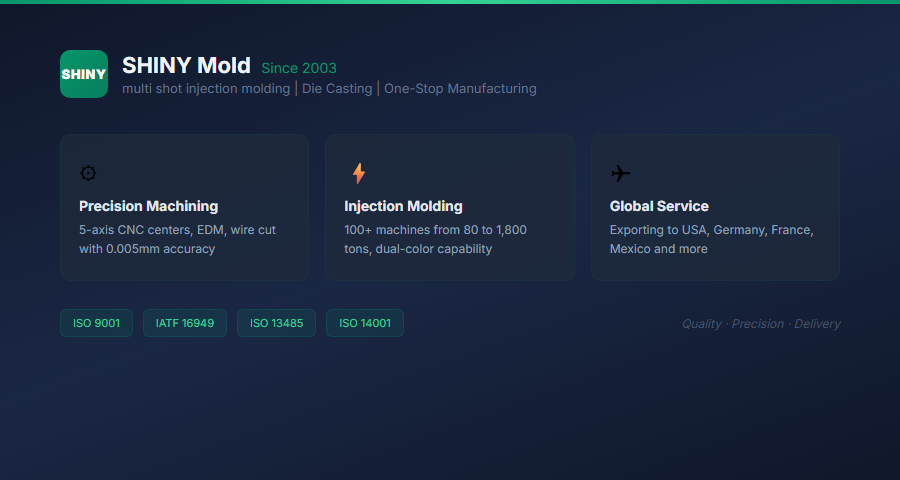
Founded in 2003, SHINY (Dongguan Xinxuan Mold) is headquartered in Chang'an, Dongguan — China's premier mold manufacturing hub. With fixed assets of USD 5 million, a 23,000+ square metre facility, and 400+ skilled employees, SHINY specializes in high-precision plastic injection molds, aluminium die-casting molds, and magnesium die-casting molds. Our DFM engineers have completed over 5,000 successful mold designs and conduct comprehensive Moldflow analysis on every project to optimize gate placement, cooling efficiency, and warpage control before cutting a single piece of steel.
Our facility features 100+ injection molding machines from 80 to 1,800 tons, dual-colour injection capability, and dedicated clean room molding areas. We serve clients across automotive, new energy, medical devices, consumer electronics, home appliances, power tools, and lighting — with certifications including ISO 9001:2015, ISO 14001:2015, ISO 13485:2016, and IATF 16949:2016.
Stage 2: Material Selection & Drying
Material selection directly impacts part performance, cycle time, and cost. The injection molding processing engineer must consider:
- Mechanical properties — Tensile strength, impact resistance, flexural modulus
- Thermal properties — Melt temperature, glass transition temperature, HDT (heat deflection temperature)
- Flow characteristics — Melt flow index (MFI) determines how easily the material fills the cavity
- Chemical resistance — Compatibility with the end-use environment
- Regulatory compliance — FDA, UL, RoHS, REACH, NSF certifications as required
Many engineering plastics are hydroscopic (they absorb moisture from the air) and must be dried before processing. Nylon (PA), polycarbonate (PC), and PET require drying to moisture levels below 0.02% to prevent hydrolysis, surface defects, and mechanical property degradation. Typical drying conditions range from 80–120°C for 2–6 hours depending on the material.
Stage 3: Mold Design & Fabrication
The injection mold is the heart of the injection molding processing system. A typical production mold consists of:
| Mold Component | Function | Typical Material |
|---|---|---|
| Cavity & Core | Forms the part geometry | P20, H13, S136, NAK80 |
| Runner System | Delivers molten plastic to cavities | Same as cavity material |
| Gate | Controls flow into cavity | Tool steel (wear-resistant insert) |
| Cooling System | Regulates temperature, controls cycle time | Drilled channels in plates |
| Ejector System | Pushes finished part out of mold | Ejector pins (H13 or SKD61) |
| Hot Runner System | Maintains plastic in molten state in runner | Heater bands + manifolds |
Stage 4: Machine Setup & Parameter Optimization
Once the mold is fabricated, it's mounted on the injection molding machine. The processing engineer sets the following critical parameters:
- Melt Temperature — Typically 180–320°C depending on material (e.g., ABS ~220°C, PC ~300°C, PEEK ~380°C)
- Mold Temperature — Controlled by the cooling system, typically 40–120°C (higher for semi-crystalline materials)
- Injection Speed & Pressure — Multi-stage injection profiles prevent flow marks and jetting
- Packing Pressure — 50–80% of injection pressure, held for 1–5 seconds to compensate for shrinkage
- Back Pressure — Applied during screw retraction to ensure uniform melt, typically 5–20 MPa
- Cooling Time — Typically 50–70% of total cycle time; optimized via conformal cooling channel design
- Screw Rotation Speed — Controls plasticizing rate without degrading the material
Modern injection molding machines feature process monitoring systems that record every cycle parameter for traceability and quality assurance. Parameters are logged against each production batch and can be recalled for repeat orders.
Stage 5: Production & Process Monitoring
During production, the injection molding processing system continuously monitors key quality indicators:
- Cavity pressure curves — Real-time pressure monitoring detects short shots, flash, or viscosity shifts
- Melt temperature consistency — ±2°C stability ensures consistent part quality
- Part weight monitoring — Statistical weight checks correlated with dimensional stability
- Visual inspection — Automated camera systems detect surface defects, burns, and contamination
- SPC data collection — CpK and PpK values calculated from critical dimensions measured at defined intervals
Stage 6: Post-Processing & Secondary Operations
Many injection molded parts require secondary operations before shipment:
- Gate trimming — Manual or automated removal of gate vestiges
- Degating & deflashing — Removal of flash (excess material) at the parting line
- Ultrasonic welding — Joining two plastic parts using high-frequency vibration
- Printing & labeling — Pad printing, screen printing, or laser marking
- Coating & plating — Painting, EMI shielding, vacuum metallization
- Assembly — Multi-component assembly, packaging, and labeling
Stage 7: Quality Control & Inspection
Quality control in injection molding processing encompasses multiple inspection stages:
- First Article Inspection (FAI) — Complete dimensional verification of T1 samples against the 2D drawing
- In-process inspection — Dimensional and visual checks at defined intervals during production
- Material testing — MFI, density, tensile strength, and impact testing per ASTM/ISO standards
- CMM measurement — Coordinate Measuring Machine for 3D dimensional verification
- Functional testing — Fit, form, and function tests on assembled products
- Packaging inspection — Final check before shipment to ensure parts meet packaging specifications
Stage 8: Delivery & Ongoing Support
A complete injection molding processing service doesn't end at shipment. Leading molders provide:
- Mold maintenance documentation — Including recommended spare parts and service intervals
- Storage options — Secure mold storage for repeat production runs
- Engineering change support — Mold modifications for design revisions or improvements
- Remote troubleshooting — Video-based support for production line issues
Common Injection Molding Processing Defects & Solutions
| Defect | Cause | Solution |
|---|---|---|
| Short Shot | Insufficient material injection | Increase shot size, injection pressure, or melt temperature |
| Flash | Excess material escaping mold | Reduce injection pressure, check clamp force, clean parting line |
| Sink Marks | Localized shrinkage | Increase pack/hold pressure, add cooling time, reduce wall thickness |
| Weld Lines | Material flow fronts meeting | Increase melt temperature, optimize gate location, add overflow wells |
| Warpage | Uneven cooling | Balance mold temperature, optimize cooling channel design |
| Jetting | High-speed injection through small gate | Reduce injection speed, enlarge gate, use fan gate |
2026 Trends in Injection Molding Processing
Smart Manufacturing & Industry 4.0
Injection molding processing in 2026 is increasingly data-driven. IoT sensors on injection molding machines provide real-time data on temperature, pressure, and cycle times — enabling predictive maintenance and reducing unplanned downtime by up to 30%.
Conformal Cooling Technology
3D-printed conformal cooling channels follow the contour of the mold cavity, reducing cooling time by 30–50% compared to conventional straight-drilled channels. This directly reduces cycle time and improves part quality by ensuring uniform cooling.
Sustainable Processing
Environmental sustainability is reshaping injection molding processing. More clients require post-consumer recycled (PCR) content, bio-based resins, and energy-efficient processing. Some facilities now achieve zero-waste processing by regrinding all runners, sprues, and rejected parts.
Frequently Asked Questions
What is the typical cycle time for injection molding processing?
Cycle times vary widely based on part size, wall thickness, material, and cooling efficiency. Small parts may cycle in 5–15 seconds, medium parts in 20–60 seconds, and large parts with thick walls can require 2–5 minutes or more. Cooling typically accounts for 50–70% of the total cycle time.
How do I choose the right injection molding machine tonnage?
Choose a machine tonnage that provides sufficient clamp force to keep the mold closed during injection. A rough rule of thumb: 3–5 tons per square inch of projected part area. For a part with 50 in² projected area, you'd need a 150–250 ton machine.
What materials are most commonly used in injection molding processing?
The most common materials include ABS (for rigidity and impact strength), polypropylene/PP (for chemical resistance and flexibility), nylon/PA (for strength and wear resistance), polycarbonate/PC (for optical clarity and impact strength), and acrylic/PMMA (for transparency and UV resistance).
How long does it take to manufacture an injection mold?
Typical mold fabrication lead times range from 4–10 weeks for a steel production mold, depending on complexity, cavity count, and mold maker workload. A SHINY Mold project typically delivers T1 samples within 5–8 weeks of design approval.
What is the minimum order quantity for injection molding?
MOQ depends on the mold type. Single-cavity prototype molds can produce as few as 100–500 parts. Production steel molds typically run 5,000–10,000 parts minimum to justify the tooling investment. Many molders offer flexible volume arrangements — discuss your specific needs with your partner.
Conclusion
Injection molding processing is a sophisticated manufacturing technology that has evolved significantly in 2026 to incorporate smart manufacturing, sustainable practices, and advanced simulation capabilities. From part design and DFM through mold fabrication, production, and quality assurance, each stage contributes to the final part's quality, cost, and delivery timeline.
By partnering with an experienced injection molding processing specialist like SHINY Mold, you gain access to comprehensive capabilities — design engineering, Moldflow simulation, precision mold fabrication, high-volume production, and rigorous quality management — all under one roof, backed by 23+ years of industry experience and global certifications.
Contact SHINY Mold today to discuss your injection molding project and discover how our complete processing capabilities can bring your product to life.