
 Chinese
Plastic Injection Molding Companies: How to Evaluate and Choose the Right Manufacturer in 2026
Finding the right partner among thousands of plastic injection molding companies can feel overwhelming — especially when your product quality, production timeline, and bottom line all depend on making the right choice. Whether you're launching a new product, scaling production, or looking for a more cost-effective supplier, this guide will help you evaluate injection molding manufacturers with confidence.
What to Look for in Plastic Injection Molding Companies
Not all plastic injection molding companies are created equal. The right partner for a high-volume automotive component may be completely wrong for a low-volume medical device. Here are the key factors to evaluate:
1. Technical Capabilities & Equipment
A capable injection molding company should have:
- Full in-house mold making — Design, CNC machining, EDM, wire cutting, and CMM inspection under one roof
- Wide clamping force range — From 80 tons for small precision parts to 1,800+ tons for large components
- Multi-material molding — Two-shot (dual-color), overmolding, and insert molding capabilities
- Secondary operations — Assembly, ultrasonic welding, printing, packaging — ideally in-house
- CAE simulation — Moldflow or Moldex3D analysis to optimize gate placement, cooling, and warpage control
2. Quality Certifications & Standards
Reputable plastic injection molding companies hold industry-recognized certifications. These are not just wall decorations — they represent real quality management systems:
- ISO 9001:2015 — Baseline quality management for any serious manufacturer
- IATF 16949:2016 — Essential if you're in the automotive supply chain
- ISO 13485:2016 — Required for medical device component manufacturing
- ISO 14001:2015 — Environmental management system
- PPAP Level 3 — Production Part Approval Process documentation
3. Industry-Specific Experience
The best plastic injection molding companies have deep experience in your industry:
- Automotive — Tight tolerances, high-volume production, IATF 16949
- Medical & Healthcare — Clean room molding, material traceability, ISO 13485
- Consumer Electronics — Cosmetic surfaces, thin-wall molding, precision assembly
- Home Appliances — Large parts, cost optimization, durable tooling
- New Energy / EV — Battery components, connectors, thermal management
- Power Tools — Impact-resistant materials, overmolded grips, high-cycle tooling
- Lighting — Optical-grade materials, transparent parts, heat dissipation
4. Communication & Project Management
Many engineers worry about communication when working with overseas plastic injection molding companies. Here's what separates great partners from average ones:
- DFM (Design for Manufacturing) feedback — Professional analysis of your part design before mold construction
- Dedicated project management — A single point of contact throughout the project lifecycle
- Regular progress updates — Photos, videos, and written reports on mold fabrication milestones
- English-speaking engineers — Technical communication without language barriers
- Clear sample approval process — T1, T2 sampling with dimensional reports and CPK data
Global vs. Local Plastic Injection Molding Companies
When searching for plastic injection molding companies, you'll find options both locally and overseas. Here's a practical comparison:
| Factor | Local Companies | Overseas Companies (e.g. China) |
|---|---|---|
| Mold cost (NRE) | $$$$$ High | $$ 40-60% less |
| Per-part price | $$$ | $ 30-50% less |
| Mold lead time | 8-16 weeks | 6-10 weeks |
| Communication | Easy, same timezone | PM + email, manageable |
| Shipping | Minimal | Sea/air freight required |
| Quality systems | Varies | ISO certified, proven exports |
About SHINY Mold — A Leading Name Among Plastic Injection Molding Companies
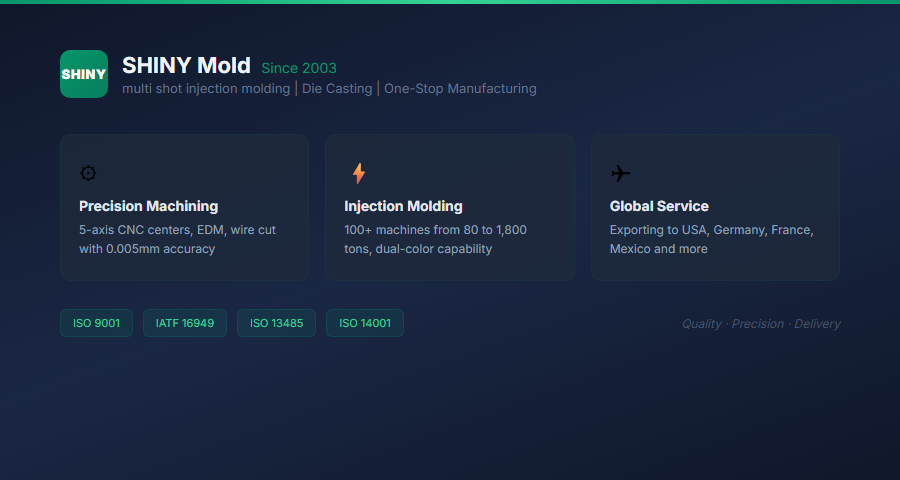
Founded in 2003, SHINY (Dongguan Xinxuan Mold) is headquartered in Chang'an, Dongguan — the heart of China's mold manufacturing industry. With fixed assets of USD 5 million, a 23,000+ square metre facility, and 400+ skilled professionals, SHINY stands out among plastic injection molding companies by offering comprehensive in-house capabilities.
Our facility features 100+ injection molding machines from 80 to 1,800 tons, dual-color injection capability, dedicated clean room areas for medical molding, and full in-house mold making. With over 5,000 successful mold designs and annual output exceeding 2,000 molds, we serve clients across automotive, new energy, medical devices, consumer electronics, home appliances, power tools, and lighting industries.
SHINY is certified under ISO 9001:2015, ISO 14001:2015, ISO 13485:2016, and IATF 16949:2016. Our export markets include the United States, Canada, Mexico, Germany, France, Poland, and throughout Europe — making us a trusted global partner among plastic injection molding companies worldwide.
How to Shortlist Plastic Injection Molding Companies
Follow this step-by-step process to build a shortlist of qualified plastic injection molding companies:
Step 1: Define Your Requirements
Before reaching out to any injection molding company, clearly define:
- Part geometry and complexity
- Material specification (resin type, grade, supplier)
- Annual volume and batch sizes
- Tolerance requirements and critical dimensions
- Surface finish and cosmetic requirements (SPI grades, texture)
- Regulatory requirements (FDA, UL, RoHS, REACH)
- Target budget and timeline
Step 2: Research & Verify
Use these channels to find potential plastic injection molding companies:
- Industry trade shows — NPE, Fakuma, ChinaPlas, K Show
- Online directories — ThomasNet, MFG.com, Global Sources, Made-in-China
- Google search — Search with specific requirements and geographic filters
- Industry referrals — Recommendations from colleagues and industry networks
- Certification databases — Verify ISO and IATF certificates through registrars
Step 3: Request RFQs
Send a detailed RFQ (Request for Quotation) including:
- 3D CAD model (STEP/IGES or native format)
- 2D drawing with GD&T callouts
- Material specification
- Annual volume and batch size
- Cosmetic and quality requirements
- Target timeline
Step 4: Evaluate Responses
Compare quotes based on more than just price:
- DFM quality — Did they identify potential manufacturing issues?
- Mold construction proposal — Cavity count, steel grade, hot runner system, cooling design
- Sampling and approval timeline — Realistic and detailed schedule
- Payment terms — Standard T/T or L/C terms for international projects
- Warranty and after-sales support — Mold warranty period and maintenance support
Key Questions to Ask Plastic Injection Molding Companies
- How long have you been in business? — Look for 10+ years of stable operation
- What industries do you specialize in? — Relevant experience reduces learning curve
- Can you provide customer references? — Ideally in your industry and geographic market
- What is your mold trial and sampling process? — Professional T1-T3 process with documentation
- How do you handle engineering changes? — Clear process for mold modifications and cost transparency
- What is your on-time delivery rate? — Ask for 12-month track record
- Do you offer mold maintenance and repair services? — Long-term support matters
- What are your quality control processes? — IQC, IPQC, OQC protocols
Cost Structure of Plastic Injection Molding Companies
Understanding how plastic injection molding companies structure their pricing helps you compare quotes fairly:
1. Mold Cost (Tooling / NRE)
The mold is typically the largest upfront investment. Factors affecting mold cost include:
- Cavity count (single vs. multi-cavity)
- Part complexity and geometry
- Steel grade (P20, H13, S136, 420SS, etc.)
- Hot runner vs. cold runner system
- Side actions, lifters, and unscrewing mechanisms
- Expected mold lifespan (100k vs 1M+ shots)
2. Per-Part Price
Ongoing production costs depend on:
- Cycle time (determined by part geometry and cooling design)
- Material cost and waste percentage
- Labor and overhead rates
- Secondary operation requirements
- Packaging and logistics
3. Hidden Costs to Watch For
- Mold trial costs — Some companies charge per trial round
- Engineering change fees — Clarify how modifications are billed
- Shipping and customs — DDP (Delivered Duty Paid) terms simplify international shipping
- Mold storage fees — If the mold stays with the manufacturer
2026 Trends in Plastic Injection Molding
Digital Transformation
Leading plastic injection molding companies now offer virtual factory tours, real-time production monitoring dashboards, and cloud-based project portals. This transparency makes working with overseas partners as seamless as working with local ones.
AI-Enhanced Mold Design
AI-powered design optimization tools reduce mold trial iterations by 30-50%. Forward-thinking companies invest in digital twin technology and automated DFM analysis to get parts right the first time.
Sustainability
More brands require their suppliers to offer recycled-content resins, energy-efficient molding processes, and carbon footprint reporting. The best plastic injection molding companies are investing in sustainable manufacturing practices.
Near-Shoring and Supply Chain Resilience
While China remains the dominant source for injection molds and production, many plastic injection molding companies now operate satellite facilities or partner networks to offer regionalized production options.
Frequently Asked Questions
How do I find reliable plastic injection molding companies?
Start by defining your technical requirements, then research companies through trade shows, industry directories, and referrals. Verify certifications, request RFQs from 3-5 companies, and evaluate based on capability, quality systems, and communication — not just price.
How much does injection molding cost?
Mold costs typically range from $2,000 to $100,000+ depending on complexity and cavity count. Per-part costs vary based on material, cycle time, and volume. Request detailed quotes from multiple plastic injection molding companies for accurate pricing.
Should I choose local or overseas injection molding companies?
It depends on your priorities. Local companies offer easier communication and shorter shipping, while overseas companies — particularly in China — offer 40-60% lower mold costs and competitive per-part pricing. Many successful companies use overseas molders with strong communication and quality systems.
What certifications should plastic injection molding companies have?
At minimum, ISO 9001:2015. For automotive parts, IATF 16949:2016. For medical devices, ISO 13485:2016. Environmental certifications like ISO 14001 are a bonus. Always verify current certificates through the issuing body.
How long does it take to get injection molded parts?
Mold fabrication typically takes 6-10 weeks. Sampling (T1-T2) takes 1-2 weeks. Production lead time depends on volume. Total timeline from order to first parts: typically 8-14 weeks for most projects.
Conclusion
Choosing the right partner among plastic injection molding companies is one of the most important decisions in your product development journey. Look beyond price — evaluate technical capability, quality systems, industry experience, and communication. Whether you choose a local molder or an overseas specialist like SHINY Mold, the right partnership will deliver quality parts on time and on budget.
Ready to start your project? Contact shortlisted companies with a detailed RFQ, and let their responses guide your decision. The best plastic injection molding companies will demonstrate expertise, transparency, and a genuine commitment to your project's success.