
 Chinese
Injection Molding Processing: Complete Guide to the Plastic Manufacturing Workflow in 2026
Injection molding processing is the backbone of modern plastic manufacturing — a process that transforms raw thermoplastic or thermosetting polymers into precision-engineered components across virtually every industry. From automotive dashboards and medical device housings to consumer electronics enclosures and power tool bodies, understanding the full injection molding processing workflow is essential for engineers, procurement professionals, and business owners who want to ensure quality, reduce costs, and accelerate time to market.
This comprehensive 2026 guide breaks down every stage of injection molding processing — from material preparation through mold design, machine setup, production, quality inspection, and post-processing — giving you the knowledge you need to make informed decisions about your plastic parts manufacturing.

What Is Injection Molding Processing?
Injection molding processing refers to the complete sequence of operations involved in manufacturing plastic parts using injection molding technology. It encompasses material selection and drying, mold design and fabrication, machine setup and parameter tuning, the actual injection cycle, quality inspection, and secondary finishing operations.
Unlike a single manufacturing step, injection molding processing represents the entire production ecosystem — from the moment raw material enters the facility to the moment finished parts are packaged and shipped. Optimizing this end-to-end workflow is the key to achieving consistent quality, maximizing productivity, and minimizing waste.
The Injection Molding Processing Cycle: Step by Step
1. Material Preparation
Before production begins, raw plastic materials must be properly prepared:
- Resin drying — Many engineering plastics (PA, PC, ABS) are hygroscopic and must be dried to remove moisture that causes surface defects and brittleness
- Material blending — Mixing color masterbatch, additives (UV stabilizers, flame retardants), and regrind material at controlled ratios
- Material handling — Automated feeding systems transport material from dryers to machine hoppers, maintaining consistent material temperature and moisture levels
2. Mold Setup & Preparation
The injection mold — also called the tool — must be properly installed and prepared:
- Mold mounting — Secure the mold to the machine platens and connect cooling lines and ejection systems
- Mold temperature control — Set mold temperature using water or oil thermal controllers to optimize the cooling rate
- Mold venting — Ensure proper air evacuation from cavities to prevent burn marks and short shots
- Mold protection — Install mold protection systems to prevent damage during clamping
3. Machine Setup & Parameter Tuning
Injection molding machines require precise setup for each job:
- Temperature profiling — Set barrel zone temperatures from feed throat to nozzle, typically 30-80°C above material melting point
- Injection speed & pressure — Program multi-stage injection profiles for optimal filling without flow marks or flash
- Holding pressure & time — Control the pack phase to compensate for material shrinkage and prevent sink marks
- Cooling time — Determine the optimal cooling duration (typically 50-80% of total cycle time)
- Back pressure & screw speed — Optimize plastication for consistent melt quality
4. The Injection Cycle (Clamp → Inject → Pack → Cool → Open → Eject)
The actual production cycle follows six sequential steps:
| Step | Duration | Description |
|---|---|---|
| 1. Clamping | 1-5 seconds | Mold closes with sufficient clamp force to resist injection pressure |
| 2. Injection | 0.5-2 seconds | Molten plastic is injected into the cavity under controlled speed and pressure |
| 3. Packing/Holding | 2-10 seconds | Holding pressure maintains material flow during cooling to compensate for shrinkage |
| 4. Cooling | 15-60 seconds | Part solidifies inside the mold; cooling efficiency determines cycle time |
| 5. Mold Opening | 1-3 seconds | Moving platen retracts to separate mold halves |
| 6. Ejection | 1-2 seconds | Ejector pins push the finished part out of the mold cavity |
5. Quality Inspection
Quality control is integrated throughout injection molding processing:
- First Article Inspection (FAI) — Full dimensional and visual check of the first production parts
- In-Process SPC — Statistical process control monitoring of critical dimensions, weight, and process parameters
- Visual inspection — Check for sink marks, flash, weld lines, burn marks, short shots, and surface defects
- CMM measurement — Coordinate measuring machine verification of critical tolerances
- Functional testing — Assembly fit, drop test, leak test, or electrical testing as required
6. Secondary Operations & Finishing
Many injection molded parts require additional processing after molding:
- Deburring & deflashing — Remove excess flash or gate vestige
- Printing & labeling — Pad printing, inkjet, or laser marking for logos and instructions
- Ultrasonic welding — Join two plastic parts using high-frequency vibration
- Surface finishing — Painting, coating, or plating for enhanced appearance or protection
- Assembly — Snap-fit assembly, screw fastening, or adhesive bonding
- Packaging — Individual packing, bulk packaging, or kit assembly per customer specifications
Key Parameters in Injection Molding Processing
Temperature Control
- Barrel temperature — Typically 180-300°C depending on material (ABS: 200-240°C, PP: 180-230°C, PC: 260-310°C)
- Mold temperature — Controlled via water or oil units, typically 40-120°C
- Nozzle temperature — Slightly below barrel to prevent drooling
- Feed throat temperature — Water-cooled to prevent premature melting
Pressure & Speed
- Injection pressure — 800-2,000 bar typical for most applications
- Holding pressure — 50-70% of injection pressure
- Back pressure — 50-200 bar for consistent melt homogenization
- Injection speed — 30-200 mm/s depending on part geometry and material
- Clamp force — Typically 3-5 tons per square inch of projected area
Time Optimization
- Injection time — 0.5-3 seconds (fast-fill vs. controlled-fill strategies)
- Holding time — Determined by gate freeze time, typically 2-10 seconds
- Cooling time — Often the longest phase; optimized by mold cooling design
- Total cycle time — 15-90 seconds depending on part size and wall thickness
Common Injection Molding Processing Defects & Solutions
| Defect | Cause | Solution |
|---|---|---|
| Flash | Excessive injection pressure or worn mold | Reduce injection pressure, increase clamp force, repair mold |
| Sink marks | Insufficient packing or thick wall sections | Increase holding pressure/time, reduce wall thickness |
| Weld lines | Material flow fronts meeting and cooling | Increase melt temperature, increase injection speed, add gas vents |
| Short shots | Insufficient material volume | Increase shot size, raise injection speed, ensure material flow |
| Warpage | Uneven cooling or molecular orientation | Optimize cooling channel design, reduce mold temperature differential |
| Burn marks | Trapped air overheating | Improve venting, reduce injection speed at last stage |
Materials Used in Injection Molding Processing
Material selection is critical to successful injection molding processing. The most commonly used materials include:
- ABS (Acrylonitrile Butadiene Styrene) — Excellent impact resistance, good surface finish. Used in automotive interior, electronics housings, consumer products
- PP (Polypropylene) — Chemical resistance, living hinge capability. Used in containers, caps, automotive battery cases
- PC (Polycarbonate) — High impact strength, optical clarity. Used in safety equipment, automotive lenses, medical devices
- PA66 (Nylon 66) — High strength and wear resistance. Used in gears, bearings, under-hood automotive components
- POM (Acetal / Delrin) — Dimensional stability, low friction. Used in precision gears, pump components, fuel systems
- HDPE/LDPE — Low cost, good chemical resistance. Used in household items, containers, toys
- PMMA (Acrylic) — Optical clarity, UV resistance. Used in lenses, displays, automotive lighting
- TPE/TPU — Elastomeric properties. Used in overmolding, soft-touch grips, seals
- PEEK — High temperature and chemical resistance. Used in aerospace, medical implants, semiconductor industry
Advanced Injection Molding Processing Technologies (2026)
Scientific Molding
Scientific molding applies a data-driven, process-focused approach to injection molding processing. Instead of trial-and-error parameter setting, scientific molding uses systematic DOE (Design of Experiments), rheology curves, and process window validation to establish robust processing conditions. Key elements include cavity pressure monitoring, viscosity curve analysis, and gate freeze studies.
Industry 4.0 & Smart Manufacturing
Modern injection molding processing facilities leverage IoT sensors, real-time process monitoring, and AI-driven optimization. Smart machines automatically adjust parameters based on real-time sensor feedback, reducing scrap rates and improving overall equipment effectiveness (OEE). Digital twins allow virtual mold trials before steel is cut.
Automation & Robotics
Robotic part removal, automated degating, vision inspection systems, and autonomous guided vehicles (AGVs) for material transport are becoming increasingly standard in high-volume injection molding processing environments. This reduces labor costs and improves consistency.
Sustainable Injection Molding Processing
Environmental considerations are reshaping injection molding processing. Key trends include:
- Bio-based polymers — Plant-derived plastics for reduced carbon footprint
- Closed-loop recycling — In-house regrind systems for runner waste and rejected parts
- Energy-efficient machines — All-electric and hybrid servo-driven machines reduce energy consumption by 30-50%
- Lightweight design — Wall-thickness optimization reduces material usage without sacrificing performance
About SHINY Mold — Your Injection Molding Processing Partner
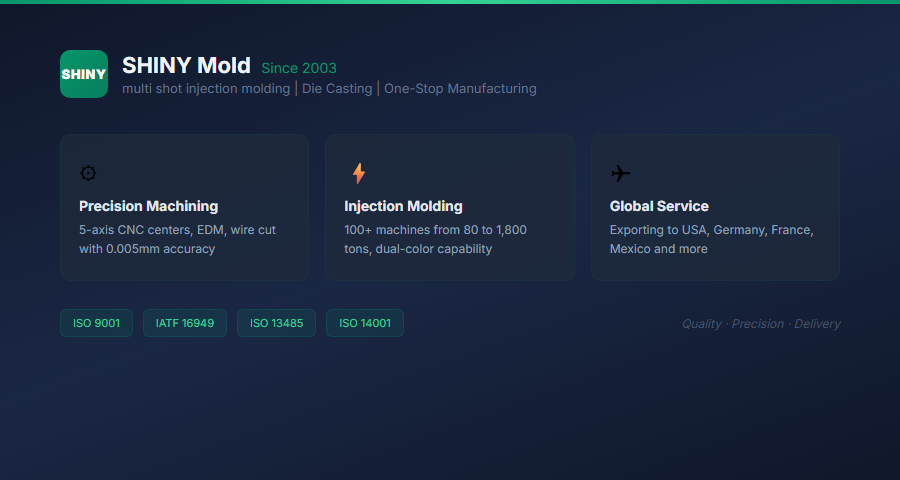
Founded in 2003, SHINY (Dongguan Xinxuan Mold) is headquartered in Chang'an, Dongguan — China's premier mold manufacturing hub. With fixed assets of USD 5 million, a 23,000+ square metre facility, and 400+ skilled employees, SHINY specializes in high-precision plastic injection molds, aluminum die-casting molds, and magnesium die-casting molds. Our annual output exceeds 2,000 molds, and our design library contains 5,000+ successful mold designs.
Our injection molding processing capabilities include 100+ injection molding machines ranging from 80 to 1,800 tons, dual-colour injection molding, and dedicated clean room production areas. SHINY is certified under ISO 9001:2015, ISO 14001:2015, ISO 13485:2016, and IATF 16949:2016. We serve automotive, new energy, medical devices, consumer electronics, home appliances, power tools, and lighting industries — exporting worldwide to North America, South America, and Europe.
Cost Optimization in Injection Molding Processing
Design for Manufacturability (DFM)
DFM is the most impactful cost-reduction lever in injection molding processing. Key DFM principles include:
- Uniform wall thickness (avoid thick-thin transitions)
- Generous draft angles (1-3 degrees minimum)
- Ribbed designs instead of thick sections
- Strategic gate placement for balanced filling
- Standardizing core and cavity inserts for multi-cavity molds
Process Optimization
- Reducing cycle time through optimized cooling design
- Minimizing scrap through scientific molding and SPC
- Using hot runner systems to eliminate runner waste
- Automating part removal and secondary operations
- Selecting the right machine size for each project (avoid oversizing)
Volume Considerations
| Volume Tier | Annual Quantity | Recommended Approach |
|---|---|---|
| Prototype | 10-500 pcs | 3D printing or aluminum tooling |
| Low volume | 1,000-10,000 pcs | Aluminum or soft steel molds, 2 cavities |
| Medium volume | 10,000-100,000 pcs | Hardened steel molds, 4-8 cavities |
| High volume | 100,000-1M+ pcs | Hardened steel molds, 8-32 cavities, hot runner, full automation |
How to Choose an Injection Molding Processing Partner
- Evaluate technical capabilities — Does the partner have in-house mold design, mold fabrication, and injection molding under one roof? Integrated manufacturers reduce lead times and simplify communication.
- Verify quality certifications — ISO 9001 (minimum), IATF 16949 (automotive), ISO 13485 (medical). Request current certificates.
- Assess machine capacity — Does the partner have machines ranging from small (80T) to large (1,800T+)? Machine flexibility matters as projects evolve.
- Review DFM capability — Does the partner provide professional mold flow analysis and design optimization feedback?
- Check industry experience — A partner with experience in your industry understands your specific quality requirements and regulatory landscape.
- Verify communication — For international partners, ensure they have responsive English-speaking project management and engineering teams.
- Ask for references — Speak with existing clients about their experience with quality, delivery, and communication.
Frequently Asked Questions
What is the difference between injection molding and injection molding processing?
Injection molding refers specifically to the machine operation of injecting molten plastic into a mold. Injection molding processing encompasses the entire manufacturing workflow — including material preparation, mold design, machine setup, production, quality control, and secondary operations. Processing is a broader term that covers the complete production system.
What is the typical cycle time for injection molding processing?
Cycle times typically range from 15 to 90 seconds, depending on part size, wall thickness, and material. Small thin-wall parts (e.g., bottle caps) can cycle in 5-10 seconds, while large thick parts (e.g., automotive bumpers) may require 90-120 seconds per cycle. Cooling time is typically the longest phase, accounting for 50-80% of the total cycle.
How can I reduce cycle time in injection molding processing?
Optimize cooling channel design for uniform heat dissipation, use materials with higher thermal conductivity, increase mold temperature for faster crystallization (semi-crystalline materials), optimize gate placement for faster filling, and consider conformal cooling (additive-manufactured cooling channels) for complex geometries.
What tolerances can be achieved in injection molding processing?
Standard injection molding tolerances range from ±0.1mm to ±0.25mm. Precision molding can achieve ±0.05mm for critical dimensions, and high-precision applications can reach ±0.01mm with specialized processes and materials. Tolerance capability depends on material, mold quality, machine precision, and process control.
What is processing in injection molding?
In the injection molding industry, "processing" refers to the complete system of operations that converts raw plastic material into finished parts. This includes material handling, machine parameter optimization (temperature, pressure, speed, time), troubleshooting defects, and maintaining consistent quality throughout production runs.
Conclusion
Injection molding processing is a complex but highly efficient manufacturing discipline that, when properly executed, produces high-quality plastic parts at competitive costs. Understanding the complete processing workflow — from material preparation through mold design, machine setup, production cycle, quality control, and finishing — is essential for anyone involved in plastic part manufacturing.
Whether you are launching a new product, optimizing an existing production line, or searching for a reliable manufacturing partner, choosing a molder with deep processing expertise, modern equipment, and proven quality systems is critical to your success.
In 2026, the most successful injection molding processing operations embrace scientific molding principles, Industry 4.0 technology, sustainable practices, and continuous improvement. The right partner will not just make parts — they will help you optimize your entire manufacturing process for quality, cost, and speed.