
 Chinese
Injection Molding Cost Estimation: Complete Guide to Calculate Your Parts in 2026
Injection molding cost estimation is critical for any product development project. Understanding the cost breakdown helps you make informed decisions about design, materials, and production volume.
This guide provides practical formulas, cost drivers, and tips to accurately estimate your injection molding projects in 2026.
Cost Breakdown: What Makes Up Injection Molding Costs?
Total injection molding costs consist of three main components:
- Tooling Cost - One-time upfront investment
- Material Cost - Recurring per part
- Processing Cost - Machine time, labor, and overhead
1. Tooling Cost
Tooling (mold) cost is the largest upfront expense. It includes:
- Mold base fabrication
- Cavity and core machining
- Cooling system installation
- Ejection system
- Tryout and debugging
Tooling Cost Estimation Formula:
Tooling Cost ≈ ($1,500 - $3,000) × Number of Cavities + Complexity Factor × $500Tooling Cost Factors:
| Factor | Impact |
|---|---|
| Number of cavities | More cavities = higher tool cost, but lower per-part cost |
| Part complexity | Undercuts, threads, complex geometry increase cost |
| Surface finish | Mirror polish, texturing add cost |
| Steel type | P20 (standard) vs H13/S7 (hardened) vs S136 (corrosion-resistant) |
Typical Tooling Cost Ranges (2026):
- Simple single-cavity mold: $1,500 - $5,000
- Medium complexity (2-4 cavities): $5,000 - $15,000
- Complex multi-cavity mold: $15,000 - $50,000+
- High-precision medical/automotive mold: $50,000 - $200,000+
2. Material Cost
Material cost depends on resin type, part weight, and scrap rate.
Material Cost Formula:
Material Cost/Part = (Part Weight in grams × Resin Price/kg) × (1 + Scrap Rate)Common Resin Prices (2026):
| Material | Price Range (per kg) | Applications |
|---|---|---|
| PP (Polypropylene) | $1.00 - $1.50 | Containers, automotive interior |
| ABS | $1.80 - $2.50 | Electronics housings, toys |
| PA6 (Nylon) | $3.00 - $4.50 | Gears, structural parts |
| PC (Polycarbonate) | $3.50 - $5.00 | Optical parts, medical devices |
| PBT | $2.80 - $4.00 | Electrical connectors |
| POM (Delrin) | $2.50 - $3.50 | Precision gears, fasteners |
3. Processing Cost (Machine Time)
Processing cost is based on cycle time and machine hourly rate.
Processing Cost Formula:
Processing Cost/Part = (Cycle Time in seconds / 3600) × Machine Rate ($/hour)Typical Machine Hourly Rates (2026):
| Machine Size (ton) | Hourly Rate Range |
|---|---|
| 50-100 ton | $25 - $40 /hour |
| 100-200 ton | $35 - $55 /hour |
| 200-350 ton | $50 - $75 /hour |
| 350-500 ton | $70 - $100 /hour |
| 500+ ton | $100 - $150 /hour |
About SHINY Mold
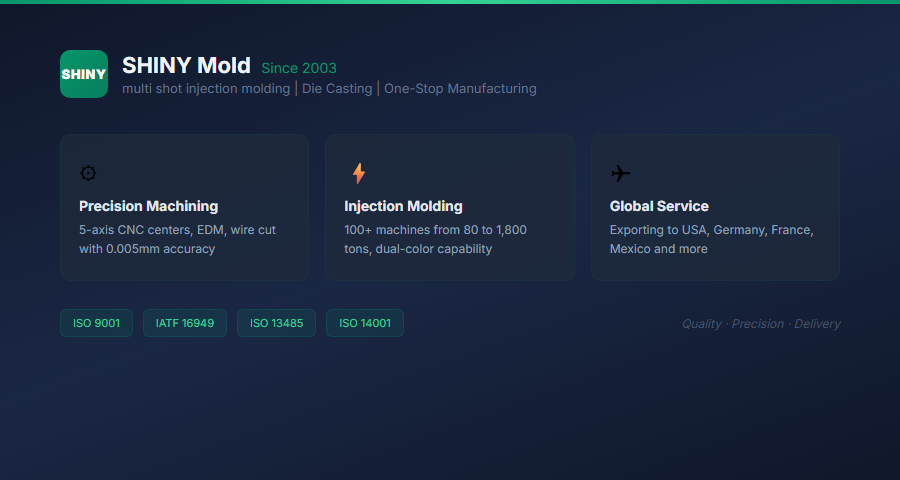
Founded in 2003, SHINY (Dongguan Xinxuan Mold) is headquartered in China's mould manufacturing hub — Chang'an, Dongguan. With fixed assets of USD 5 million, a facility spanning over 23,000 square metres, and a workforce of 400+ employees, SHINY specialises in high-precision plastic injection moulds, aluminium die-casting moulds, and magnesium die-casting moulds.
Backed by a comprehensive library of 5,000+ mould designs, SHINY delivers over 2,000 moulds annually. Our products serve industries including automotive, new energy, medical devices, consumer electronics, home appliances, power tools, and lighting. With 100+ injection moulding machines (80–1,800 tons), dual-colour injection capability, and dedicated assembly lines, SHINY provides end-to-end manufacturing from product design and prototyping to mould development, injection moulding, and finished product assembly.
SHINY is certified under ISO 9001, ISO 14001, ISO 13485, and IATF 16949 quality management systems. Our clients span the United States, Canada, Mexico, Germany, France, Poland, and other European and American markets.
Complete Cost Estimation Example
Let's calculate total cost for a real part:
Part Specifications:
- Part weight: 50 grams
- Material: ABS
- Cycle time: 30 seconds
- Production volume: 10,000 parts
- Machine: 150 ton
- Tooling: 2-cavity mold
Cost Calculation:
Tooling Cost: $8,000 (amortized over 10,000 parts)
Amortized Tooling/Part = $8,000 ÷ 10,000 = $0.80

Material Cost/Part = 0.05 kg × $2.00 × 1.05 = $0.105

Processing Cost/Part = (30 ÷ 3600) × $45 = $0.375

Total Unit Cost = $0.80 + $0.105 + $0.375 = $1.28 per part
Volume Optimization: Break-Even Analysis
| Volume | Tooling Amortization | Est. Total Cost/Part |
|---|---|---|
| 1,000 pcs | $8.00 | $9.28 |
| 5,000 pcs | $1.60 | $2.88 |
| 10,000 pcs | $0.80 | $2.08 |
| 50,000 pcs | $0.16 | $1.44 |
| 100,000 pcs | $0.08 | $1.36 |
Cost Reduction Strategies
- Optimize wall thickness - Reduce material usage and cooling time
- Design for multi-cavity molds - Spread tooling cost over more parts
- Use family mold tooling - Produce multiple similar parts in one mold
- Choose right material - Don't over-specify; PP may work where ABS is specified
- Optimize cycle time - Reduce cooling time through better mold design
- Consider design for manufacturing (DFM) - Simplify geometry to reduce tooling complexity
Quick Cost Estimation Formula
Use this simple formula for quick estimates:
Total Cost/Part ≈ (Tooling ÷ Volume) + (Weight × Material Price × 1.1) + (Cycle Time/3600 × $40)This provides a rough estimate (±20%) for budgeting and design decisions.
Conclusion
Understanding injection molding cost estimation helps you make better decisions about part design, material selection, and production volume. The three main cost drivers—tooling, material, and processing—can be optimized through smart design choices.
For accurate quotes, provide your manufacturer with:
- 3D CAD file or detailed drawing
- Material specification
- Required quantity
- Surface finish requirements
- Tolerances if critical
At SHINY Mold, we provide professional injection molding services with transparent cost breakdowns. Contact us for a detailed quote on your project.