
 Chinese
How to Choose the Right Molding Company for Your Project in 2026
Selecting the right molding company is one of the most consequential decisions in any plastic product development journey. The company you partner with will determine your mould quality, part consistency, production efficiency, and ultimately your product's success in the market.
Whether you need high-volume automotive parts, precision medical components, or low-volume prototype tooling, the wrong moulding partner can cost you months of delays and tens of thousands in rework. This guide walks you through every critical factor to consider when evaluating a molding company in 2026.
What Does a Molding Company Do?
A molding company specialises in transforming raw plastic material into finished parts using the injection moulding process. But modern moulding companies offer far more than just pressing the "start" button on a machine. A full-service provider typically delivers:
- Product Design Review & DFM — Engineering feedback to optimise your part for mouldability, reduce cost, and prevent defects before steel is ever cut
- Mould Design & Fabrication — In-house tool room capabilities including 5-axis CNC, EDM, wire cutting, and polishing
- Prototyping & Validation — 3D printing, CNC machining, and soft tooling for design verification before committing to production moulds
- Production Injection Moulding — From short-run to high-volume production on precision moulding machines
- Secondary Operations — Painting, printing, ultrasonic welding, assembly, and packaging
- Quality Assurance — CMM inspection, first-article inspection, SPC, PPAP, and full material traceability
Choosing a company that offers this full scope of services under one roof eliminates coordination headaches, reduces lead times, and ensures accountability at every stage.
Key Factors to Evaluate a Molding Company
1. Technical Capability & Equipment
The foundation of any good molding company is its technical infrastructure. Key questions to ask:
- What is the machine tonnage range? (A company with 80–1,800 ton machines can handle everything from micro-parts to large structural components)
- Do they have two-shot / multi-material moulding capability?
- Is there an in-house tool room with 5-axis CNC, EDM, and CMM?
- Do they use CAE simulation (Moldflow, Moldex3D) during mould design?
- What is their maximum mould size and weight capacity?
2. Quality Certifications
Certifications are non-negotiable proof that a molding company operates to internationally recognised standards:
| Certification | Scope | When Required |
|---|---|---|
| ISO 9001:2015 | Quality management system | Minimum standard for any moulder |
| IATF 16949:2016 | Automotive quality management | Mandatory for automotive supply chain |
| ISO 13485:2016 | Medical device quality management | Required for medical moulding |
| ISO 14001:2015 | Environmental management | Demonstrates sustainability commitment |
3. Industry Experience & Track Record
Experience in your specific industry matters more than you might think. Automotive parts have different requirements from medical devices, which differ from consumer electronics. A molding company with proven experience in your sector will:
- Understand industry-specific standards and testing requirements
- Anticipate common design pitfalls based on similar projects
- Have established material supply chains for your application
- Provide relevant case studies and customer references
4. Mould Design & Tool Room Capabilities
The mould is the heart of the injection moulding process. A molding company with in-house tool room capabilities offers significant advantages:
- Faster iteration — Mould modifications can be done on-site without shipping tools to a third party
- Better communication — Tool makers and moulding engineers work side by side
- Lower cost — No mark-up from external tool shops
- Quicker maintenance — Scheduled maintenance and emergency repairs happen faster
5. Production Capacity & Scalability
Can the molding company handle your current volume AND grow with you? Consider:
- Number and tonnage range of injection moulding machines
- Available capacity (are their machines running at 90%+ utilisation?)
- Ability to add shifts or machines for volume ramp-up
- Clean room capability if required (medical, food-grade)
6. Lead Time & Responsiveness
In today's fast-moving markets, speed matters. Evaluate:
- Typical mould build lead time (standard: 6-10 weeks, expedited: 3-5 weeks)
- T1 sample delivery timeline
- Response time for RFQs and technical questions
- Project management approach — do they assign dedicated project engineers?
About SHINY Mold
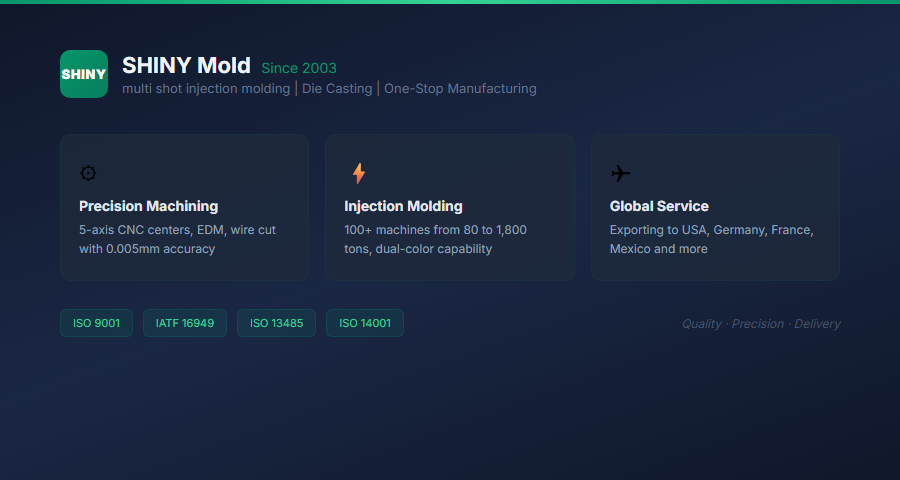
Founded in 2003, SHINY (Dongguan Xinxuan Mold) is headquartered in China's mould manufacturing hub — Chang'an, Dongguan. With fixed assets of USD 5 million, a facility spanning over 23,000 square metres, and a workforce of 400+ employees, SHINY specialises in high-precision plastic injection moulds, aluminium die-casting moulds, and magnesium die-casting moulds.
Backed by a comprehensive library of 5,000+ mould designs, SHINY delivers over 2,000 moulds annually. Our products serve industries including automotive, new energy, medical devices, consumer electronics, home appliances, power tools, and lighting. With 100+ injection moulding machines (80–1,800 tons), dual-colour injection capability, and dedicated assembly lines, SHINY provides end-to-end manufacturing from product design and prototyping to mould development, injection moulding, and finished product assembly.
SHINY is certified under ISO 9001, ISO 14001, ISO 13485, and IATF 16949 quality management systems. Our clients span the United States, Canada, Mexico, Germany, France, Poland, and other European and American markets.
Red Flags: When to Walk Away from a Molding Company
Not every molding company is a good partner. Watch for these warning signs:
- No in-house tool room — They outsource mould fabrication and have limited control over quality and timeline
- Reluctant to provide references — Satisfied customers are the best proof of capability
- Unrealistically low pricing — If the quote seems too good to be true, it probably is. Cheap moulds often mean shortcuts in steel quality, processing, and QC
- No quality certifications — A company without ISO 9001 is not ready for professional production
- Poor communication — Slow responses, vague answers, and missed deadlines during the quoting phase only get worse after you commit
- No DFM feedback — A good moulder will proactively suggest design improvements; a poor one will just build what you give them, defects and all
Cost Considerations: Beyond the Piece Price
When comparing molding company proposals, the lowest piece price does not always mean the lowest total cost. Consider the full picture:
Total Cost of Ownership (TCO)
- Mould quality & longevity — A well-built mould from P20/H13 steel will produce hundreds of thousands more parts than a cheap soft-steel mould
- Scrap rate — A 2% scrap rate difference adds up quickly at high volumes
- Cycle time optimisation — Better mould design and process engineering reduce per-part cost
- Rework and warranty costs — Defective parts that reach your customer cost 10-100x more than catching them at source
- Supply chain reliability — Late deliveries disrupt your production schedule and increase inventory costs
Typical Cost Structure
| Cost Element | Typical Range | Notes |
|---|---|---|
| Production mould (single cavity) | $5,000 – $30,000 | Depends on complexity & steel grade |
| Multi-cavity mould | $15,000 – $100,000+ | 2-64+ cavities, higher steel quality |
| Piece price (commodity resin) | $0.05 – $2.00 | Driven by part size, weight, volume |
| Piece price (engineering resin) | $0.50 – $25.00 | PC, PA, PEEK, PPS, etc. |
| Setup / changeover fee | $200 – $1,000 | Per production run |
2026 Trends Shaping the Molding Company Landscape
Industry 4.0 & Smart Manufacturing
Leading moulding companies are deploying IoT-enabled machines, real-time process monitoring dashboards, AI-driven parameter optimisation, and digital twin technology. These capabilities reduce setup times by 30-50%, minimise defects, and provide full traceability from raw material to shipped part.
Sustainability & Circular Economy
Environmental responsibility is no longer optional. Forward-thinking molding companies are investing in: energy-efficient all-electric machines (50-70% less energy than hydraulic), closed-loop material recycling systems, bio-based and recycled-content resins, and solar-powered facilities.
Nearshoring & Supply Chain Resilience
Post-pandemic supply chain disruptions have accelerated the trend toward nearshoring and dual-sourcing strategies. Many companies now maintain manufacturing partners in both Asia and their domestic market to mitigate risk. A molding company with established export logistics and flexible MOQ policies is better positioned to serve global clients.
Multi-Material & Advanced Moulding
Two-shot moulding, overmoulding, insert moulding, and LSR (liquid silicone rubber) moulding are increasingly in demand. These processes enable complex, multi-material parts that replace assemblies, reduce weight, and improve functionality. Not every molding company has this capability — it requires specialised machines and expertise.
Checklist: Evaluating a Molding Company
Use this checklist when comparing potential molding company partners:
- ✅ In-house tool room with CNC, EDM, and CMM
- ✅ ISO 9001 certification (minimum), IATF 16949 for automotive, ISO 13485 for medical
- ✅ Machine tonnage range suits your part size
- ✅ Proven experience in your industry
- ✅ DFM feedback provided during quoting
- ✅ Transparent pricing with detailed cost breakdown
- ✅ Clear project timeline with milestones
- ✅ Dedicated project engineer assigned
- ✅ Quality system includes FAI, SPC, and PPAP capability
- ✅ Customer references available
- ✅ Responsive communication (same-day email replies)
- ✅ Scalable capacity for volume growth
Frequently Asked Questions
What is the difference between a molding company and a tooling company?
A tooling company focuses on designing and building moulds but may not offer production moulding. A full-service molding company provides end-to-end solutions: mould design, fabrication, production moulding, quality control, and secondary operations. For most projects, a full-service partner is more efficient and cost-effective.
How long does it take for a molding company to build a mould?
Standard lead time is 6-10 weeks for a single-cavity production mould. Complex multi-cavity moulds take 10-16 weeks. Expedited timelines of 3-5 weeks are available at premium cost. Prototype moulds (aluminium) can be ready in 2-4 weeks.
What is the minimum order quantity (MOQ) for production moulding?
Most molding companies prefer production runs of 1,000+ pieces. Some accept low-volume orders of 100-1,000 pieces, especially for validation or bridge production. Mould cost is amortised over the production volume — higher volumes mean lower per-part cost.
Should I choose a local or overseas molding company?
It depends on your priorities. Overseas molding companies (particularly in China) typically offer 30-60% lower mould and piece prices with comparable quality if you choose a certified, experienced provider. Local moulders offer faster communication and shorter shipping times. Many companies use a hybrid approach: overseas for high-volume production, local for prototypes and urgent runs.
What information does a molding company need for a quote?
3D CAD model (STEP or IGES), 2D drawing with critical dimensions and tolerances, material specification, estimated annual volume, surface finish requirements, and any special requirements (food-grade, flame-retardant, UV-resistant, etc.). The more complete your information, the more accurate the quote.
Conclusion
Choosing the right molding company is a strategic decision with long-term implications for your product quality, cost, and time to market. By evaluating candidates systematically — technical capability, quality systems, industry experience, tool room infrastructure, production capacity, and communication — you can identify a partner who will deliver consistent, high-quality results.
In 2026, the best molding companies distinguish themselves through investment in smart manufacturing, sustainability, and end-to-end service capability. Look for a partner who does more than just mould parts — look for one who helps you make better parts, faster, and at a lower total cost of ownership.