
 Chinese
Automotive Injection Molding: Precision Parts for the Mobility Industry
Automotive injection molding is the backbone of modern vehicle manufacturing. From interior trim components to under-hood functional parts and EV battery housings, injection-molded plastic parts deliver the volume, consistency, and cost-efficiency that the automotive industry demands.
With the rapid transition to electric vehicles and smart mobility, automotive injection molding is evolving — adopting new materials, tighter tolerances, and advanced quality management systems to meet the challenges of next-generation transportation.

Applications of Automotive Injection Molding
Interior Components
The vehicle interior is the largest consumer of injection-molded parts:
- Dashoard assemblies — Complex multi-material components
- Door panels and trims — Texture-matched aesthetic parts
- Center consoles — Integrated functional and decorative elements
- Pillar trims (A/B/C pillars) — Safety-critical interior components
- Seat components — Adjusters, covers, structural elements
Exterior Parts
Exterior applications demand weather resistance and structural integrity:
- Bumper fascias — Large, complex geometries with tight tolerances
- Grilles and valances — Aesthetic and functional integration
- Mirror housings — Dimensional stability for optical integration
- Claddings and moldings — Durable exterior trim
- Lighting housings — Optical-grade surfaces for LED systems
Under-the-Hood Components
Engine compartment applications require high-temperature materials:
- Intake manifolds — Complex geometries, weight reduction vs. metal
- Coolant reservoirs — Chemical and temperature resistance
- Engine covers — Heat resistance, noise reduction
- Air ducting systems — Complex routing, aerodynamic optimization
- Sensor housings — Precision mounting and environmental protection
Electrical & Electronics
Modern vehicles contain 50-100+ electronic control units (ECUs):
- Connector housings — Precision mating, vibration resistance
- Fuse boxes and relay holders — Electrical integrity
- Wiring harness connectors — High-density interconnects
- Sensor enclosures — Environmental protection
New Energy Vehicle (NEV) Components
The EV revolution has created new application categories:
- Battery module housings — Fire-resistant, structural components
- BMS (Battery Management System) enclosures — Precision electronics protection
- Charging port assemblies — High-current carrying capacity
- Power electronics housings — Thermal management integration
- Lightweight structural components — Replace metal for weight reduction
Automotive-Grade Materials
| Material | Key Properties | Typical Applications |
|---|---|---|
| PP (Polypropylene) | Chemical resistance, low cost | Bumper fascias, interior trims |
| ABS | Balance of properties, paintability | Interior components, grilles |
| PC/ABS | Heat resistance, impact strength | Instrument panels, console lids |
| PA (Nylon) | High temperature, wear resistance | Intake manifolds, connectors |
| PBT | Electrical properties, hydrolysis resistance | Connectors, sensor housings |
| POM (Delrin) | Dimensional stability, low friction | Gear systems, actuating mechanisms |
Quality Standards in Automotive Injection Molding
IATF 16949:2016
The automotive industry's foundational quality management standard:
- Customer-specific requirements — OEM-specific quality protocols
- Advanced Product Quality Planning (APQP) — Structured new product development process
- Production Part Approval Process (PPAP) — Part approval before production
- Failure Mode and Effects Analysis (FMEA) — Risk assessment methodology
- Statistical Process Control (SPC) — Process monitoring and control
- Measurement Systems Analysis (MSA) — Gage repeatability and reproducibility
ISO 9001:2015
Foundation quality management standard, applicable to all industries including automotive suppliers.
IMDS (International Material Data System)
Automotive material compliance tracking system — all materials must be registered and compliant with REACH, RoHS, and other regulations.
Automotive Injection Molding Process Flow
- Program Launch — APQP phase 1-3, design validation
- Tooling Design & Build — Mold flow analysis, precision machining
- T0-T3 Trials — Progressive mold trials and optimization
- PPAP Submission — Level 1-5 submission based on customer requirements
- Production Part Approval — Customer sign-off for production
- Mass Production — SPC-monitored, Cpk-validated production
- Continuous Improvement — Ongoing process optimization
Key Considerations for Automotive Injection Molding
Dimensional Accuracy
Automotive parts often require tight tolerances (±0.05mm to ±0.15mm). Mold design must account for material shrinkage, thermal expansion, and post-molding warpage.
Surface Quality
Class-A surface requirements for visible parts (interior/exterior) demand exceptional mold surface quality (SPI A-1 to A-3 polish) and controlled processing parameters.
Traceability
Automotive requires full traceability: material lot numbers, production date/time, machine parameters, and quality inspection results must be recorded and retained.
Process Capability
Automotive production requires demonstrated process capability: typically Cpk ≥ 1.33 for critical dimensions, with Cpk ≥ 1.67 preferred for safety-critical characteristics.
About SHINY Mold
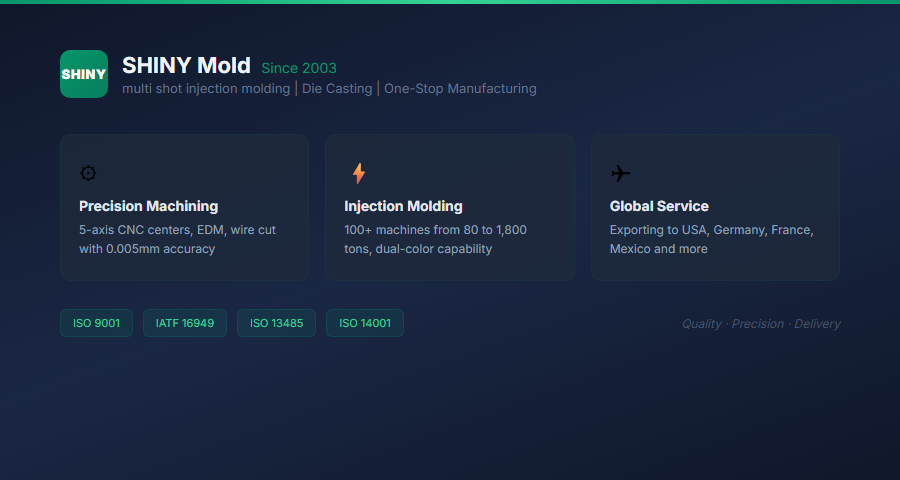
Founded in 2003, SHINY (Dongguan Xinxuan Mold) is headquartered in China's mold manufacturing hub — Chang'an, Dongguan. With fixed assets of USD 5 million, a facility spanning over 23,000 square meters, and a workforce of 400+ employees, SHINY specializes in high-precision plastic injection molds, aluminum die-casting molds, and magnesium die-casting molds.
SHINY serves the automotive industry with IATF 16949-certified manufacturing processes. Our capabilities include automotive interior/exterior components, under-hood parts, and new energy vehicle (NEV) components. With 100+ injection molding machines (80–1,800 tons) and comprehensive CAE analysis, SHINY delivers automotive-grade quality for global OEMs and Tier 1 suppliers.
SHINY is certified under ISO 9001, ISO 14001, ISO 13485, and IATF 16949 quality management systems. Our automotive clients span the United States, Germany, France, and other global markets.
Choosing an Automotive Injection Molding Partner
Certification & Compliance
Non-negotiable requirements:
- IATF 16949:2016 certification — Essential for automotive supply chain
- IMDS registration — Material compliance capability
- Customer-specific certifications — GM, Ford, VW, Toyota, etc.
Technical Capability
- Large-tonnage machines (1,000+ tons for bumper-sized parts)
- Two-shot / multi-material molding for complex assemblies
- In-mold decoration (IMD/IML) for integrated graphics
- Foam molding capability for lightweighting
- Cleanroom options for electronic components
Quality Management
- SPC implementation with real-time monitoring
- Cpk studies and process validation
- Full-dimensional inspection (CMM, vision systems)
- Material certfication and traceability systems
- PPAP documentation and submission capability
Program Management
- APQP-experienced engineering team
- Proficiency with PPAP submission levels 1-5
- English-speaking project management
- Transparent program timing and milestone tracking
Trends in Automotive Injection Molding
Lightweighting
EV range requirements drive weight reduction:
- Replacing metal components with engineered plastics
- Foam molding for density reduction
- Structural composite molding
- Multi-material over-molding for integrated functions
Integration & Modularization
Reducing assembly complexity:
- Multi-functional single components
- Integrated electronic functions in molded parts
- Modular sub-assemblies for simplified vehicle assembly
Sustainable Materials
Environmental initiatives in automotive:
- Recycled content plastics (post-consumer, post-industrial)
- Bio-based polymers (PLA, bio-PE)
- Design for recyclability (material selection, disassembly)
Industry 4.0 & Smart Manufacturing
Digital transformation in automotive manufacturing:
- IoT sensors for real-time process monitoring
- Digital twin technology for process optimization
- AI-driven quality prediction and defect prevention
- Automated inspection and sorting systems
Conclusion
Automotive injection molding stands at the intersection of high-volume manufacturing, precision engineering, and rigorous quality management. As the mobility industry transitions toward electrification, autonomy, and sustainability, injection molding continues to evolve — delivering lighter, stronger, and more integrated components that enable the vehicles of tomorrow.
Success in automotive injection molding requires deep expertise in materials science, process engineering, quality management systems, and program execution. By partnering with certified, experienced manufacturers who understand the unique demands of automotive applications, OEMs and Tier 1 suppliers can achieve their cost, quality, and time-to-market objectives.
FAQ
What is IATF 16949 certification?
IATF 16949:2016 is the globally recognized quality management system standard for the automotive industry. It incorporates ISO 9001:2015 requirements plus automotive-specific requirements for design, development, production, and service parts.
What is PPAP?
The Production Part Approval Process (PPAP) is the standardized process in the automotive industry for approving production parts before mass production. It ensures that the manufacturing process consistently produces parts meeting all engineering design and specification requirements.
What are typical automotive tolerance requirements?
Typical tolerances range from ±0.05mm for precision mating features to ±0.5mm for non-critical aesthetic features. Safety-critical dimensions often require Cpk ≥ 1.67 validation.
How does injection molding support automotive lightweighting?
Plastic components weigh 50-70% less than equivalent metal parts. Foam molding, structural composites, and multi-material over-molding further reduce weight while maintaining structural integrity.
What is the typical lead time for automotive injection molding programs?
Automotive programs typically require 16-24 weeks from program kickoff to PPAP approval. Complex programs with multiple cavities and secondary operations may require 30-40 weeks. Rush programs can be accelerated to 12-16 weeks with appropriate expediting resources.