
 Chinese
Automotive Injection Molding: Precision Parts for the EV & Traditional Automotive Industry 2026
Automotive injection molding is the backbone of modern vehicle manufacturing. From interior trim and dashboard components to under-hood parts and EV battery enclosures, injection-molded plastic parts account for over 50% of the total number of components in a typical vehicle — and that percentage is rising rapidly as automakers pivot to electric vehicles (EVs).
This guide provides a comprehensive overview of automotive injection molding in 2026: the materials, processes, quality standards, and strategic considerations for sourcing high-precision automotive plastic parts.

Why Automotive Injection Molding Matters More Than Ever
The automotive industry is undergoing its most significant transformation since the introduction of the assembly line. Three megatrends are driving unprecedented demand for advanced automotive injection molding:
- Electrification — EVs require large, complex plastic components: battery enclosures, thermal management housings, charging port assemblies, and lightweight interior structures. Injection molding is the only process capable of producing these high-precision, high-volume parts cost-effectively.
- Lightweighting — Every kilogram saved improves fuel efficiency (ICE vehicles) or extends driving range (EVs). High-performance engineering plastics replace metal components in brackets, housings, and structural parts, reducing vehicle weight by 10-30%.
- Autonomous Driving & Connectivity — Sensors, cameras, LiDAR housings, and infotainment system components all rely on precision injection-molded parts with tight tolerances and excellent surface finish.
Common Automotive Injection Molding Applications
| Application Area | Typical Parts | Common Materials |
|---|---|---|
| Interior | Dashboard, door panels, console, pillar trims, seat components | PP, ABS, PC/ABS, TPO |
| Exterior | Bumper fascias, grille, mirror housings, emblems, roof rails | PP, TPO, PC/PBT, ASA |
| Under-Hood | Air intake manifolds, coolant reservoirs, fan shrouds, sensor housings | PA66, PPA, PPS, PEI |
| EV-Specific | Battery enclosures, charging ports, inverter housings, thermal management | PBT, PA66, PPS, LCP, thermally conductive plastics |
| Lighting | Headlamp lenses, taillight housings, LED reflectors, light pipes | PC, PMMA, optical-grade resins |
| Powertrain | Gear shift housings, transmission components, engine covers | PA66+GF, POM, PPS |
Materials for Automotive Injection Molding
Material selection in automotive injection molding is driven by a combination of mechanical performance, thermal resistance, chemical resistance, aesthetics, and cost. Here are the most widely used automotive plastics in 2026:
Commodity Plastics
- Polypropylene (PP) — The workhorse of automotive plastics. Excellent chemical resistance, low density, good fatigue resistance. Used for interior trim, bumper fascias, and battery separator components. Often filled with talc or glass fiber for improved stiffness.
- ABS (Acrylonitrile Butadiene Styrene) — Good impact resistance and excellent surface finish for painting/plating. Used for interior glossy parts, emblems, and decorative trims.
- TPO (Thermoplastic Olefin) — Weatherable, flexible, paintable. The standard material for exterior bumper fascias and interior soft-touch skins.
Engineering Plastics
- Polyamide (PA / Nylon) 6 & 66 — High strength, wear resistance, and heat resistance. PA66+GF (glass fiber reinforced) is standard for under-hood structural parts. PA6 is used for air intake manifolds via lost-core molding.
- Polycarbonate (PC) & PC/ABS — High impact strength and optical clarity (PC); balanced properties (PC/ABS). Used for headlamp lenses, instrument clusters, and electronic housings.
- PBT (Polybutylene Terephthalate) — Good electrical properties, chemical resistance, and dimensional stability. The preferred material for automotive connectors, sensor housings, and EV charging port components.
- POM (Delrin / Acetal) — Excellent dimensional stability, low friction, and creep resistance. Used for precision gears, fuel system components, and seat adjustment mechanisms.
High-Performance Plastics
- PPS (Polyphenylene Sulfide) — Outstanding chemical and thermal resistance (continuous use up to 220°C). Used for throttle bodies, water pump impellers, and EV power electronics housings.
- PEEK (Polyether Ether Ketone) — Extreme temperature resistance, chemical inertness, and mechanical strength. Used for transmission bushings, EV motor components, and high-performance sensor parts.
- LCP (Liquid Crystal Polymer) — Exceptional flowability, dimensional stability, and high-temperature resistance. The material of choice for high-density EV connectors and high-frequency RF antenna components.
SHINY Mold: Your Automotive Injection Molding Partner
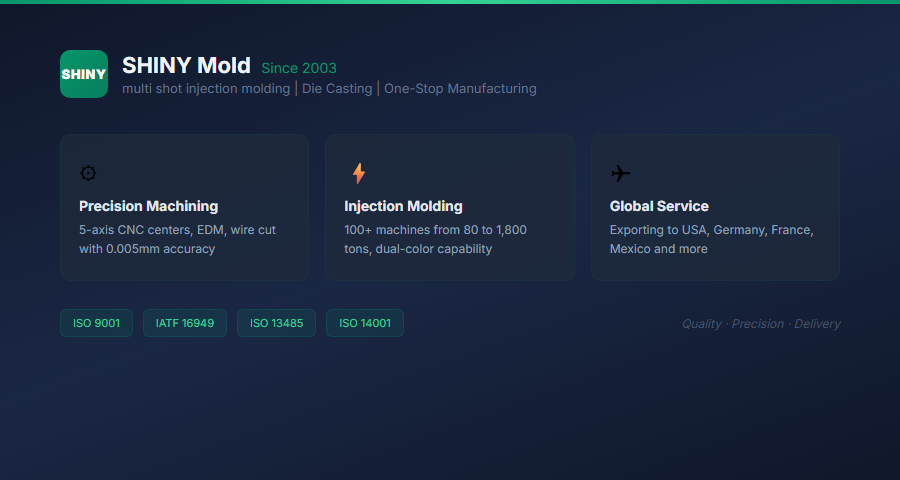
Founded in 2003, SHINY (Dongguan Xinxuan Mold) is headquartered in Chang'an, Dongguan — the heart of China's mould manufacturing industry. With fixed assets of USD 5 million, a 23,000+ m² facility, and 400+ skilled employees, SHINY delivers high-precision automotive injection molding solutions for Tier 1 and Tier 2 automotive suppliers worldwide.
SHINY's automotive capabilities include: 100+ injection molding machines (80–1,800 tons), dual-colour injection, clean room molding (ISO Class 7), and a fully equipped in-house tool room with 5-axis CNC, EDM, and CMM inspection. Our 5,000+ mould design library and 2,000+ moulds manufactured annually ensure fast, reliable tooling for automotive programs.
Certified under IATF 16949:2016, ISO 9001:2015, ISO 13485:2016, and ISO 14001:2015, SHINY provides full PPAP documentation, SPC, and material traceability for every automotive project. Our clients include automotive suppliers in the United States, Germany, France, Poland, and Mexico.
Quality Standards: IATF 16949 & PPAP
Automotive injection molding demands the highest levels of quality control and process consistency. The industry's foundational quality standard is IATF 16949:2016 (replacing ISO/TS 16949), which defines the quality management system requirements for automotive production and relevant service parts organizations.
Key quality deliverables in automotive molding programs include:
- PPAP (Production Part Approval Process) — A standardized process for approving production components and suppliers. PPAP submission levels (1-5) define the documentation package, which typically includes: design records, engineering change documents, DFMEA / PFMEA, process flow diagram, control plan, MSA (Measurement System Analysis), dimensional results, material/performance test results, and the part submission warrant (PSW).
- FAIR (First Article Inspection Report) — Dimensional and functional verification of the first production-representative parts.
- SPC (Statistical Process Control) — Real-time monitoring of critical dimensions using control charts to detect and prevent process drift.
- CPK Monitoring — Process capability indices (CPK ≥ 1.33 for standard characteristics, ≥ 1.67 for critical characteristics) demonstrate that the process is capable of producing parts within specification.
- Material Certifications — Mill test reports (MTRs), RoHS/REACH compliance certificates, and UL recognition (where applicable).
Automotive Injection Molding Process: Key Considerations
Design for Manufacturability (DFM)
Successful automotive injection molding starts with DFM. Automotive parts often have complex geometries, tight tolerances (±0.05mm to ±0.15mm), and demanding aesthetic requirements. DFM analysis identifies potential issues early: undercuts, draft angle insufficiency, wall thickness variations, sink mark risks, and weld line locations. Moldflow simulation (Autodesk Moldflow, Moldex3D) predicts fill patterns, cooling uniformity, and warpage — enabling design optimization before tool fabrication.
Mould Design & Fabrication
Automotive moulds are among the most complex and demanding tools in the industry. Key considerations include:
- Steel selection — H13 (HRC 48-52) for high-volume production; S136 (mirror-polishable) for optical parts; P20 for lower-volume programs.
- Cooling design — Conformal cooling (3D-printed or CNC-machined) reduces cycle time and improves part uniformity in thick-walled automotive parts.
- Hot runners — Eliminate sprue/runner scrap, reduce cycle time, and improve part consistency. Essential for large automotive parts (bumpers, door panels).
- Multi-cavity balance — For multi-cavity moulds, flow balance analysis ensures all cavities fill simultaneously and achieve consistent dimensions.
Scientific Moulding
Scientific Moulding is a systematic approach to process development that decouples the four plastic variables (melt temperature, fill time, pack pressure, and cooling time) and establishes a robust, repeatable process window. In automotive programs, Scientific Moulding reduces setup time, minimizes scrap, and ensures consistent part quality across shifts and machines.
EV-Specific Injection Molding Challenges
Electric vehicles introduce new requirements for automotive injection molding:
Battery Enclosures & Thermal Management
EV battery enclosures are large (often >1m²), thin-walled, and require excellent dimensional stability, flame retardancy (UL 94 V-0), and EMI shielding. Injection-molded plastic enclosures (vs. aluminum) reduce weight by 30-50% and integrate cooling channels and mounting features in a single part. Material choices include PBT+GF, PA66+GF, and thermally conductive PPS compounds.
High-Voltage Connectors & Inverter Housings
High-voltage (400V-800V) EV architectures demand connectors and housings with exceptional tracking resistance (CTI ≥ 600V), high-temperature resistance (150°C+), and dimensional stability. LCP and PBT are the dominant materials. Insert molding (metal terminals overmolded with plastic) ensures hermetic seals and mechanical strength.
Flame Retardancy & Thermal Runaway Protection
EV battery components must meet stringent flame retardancy standards (UL 94 V-0, GB 38031 in China). Halogen-free flame retardant (HFFR) compounds are increasingly preferred for environmental and recycling reasons. Thermal runaway propagation delay (preventing fire spread between cells) is achieved through a combination of material selection, wall thickness design, and thermal barrier integration.
Cost Optimization Strategies
Automotive programs are notoriously cost-sensitive. Experienced automotive injection molding partners help optimize costs without compromising quality:
- Consolidate Parts — Overmolding, insert molding, and multi-shot molding combine multiple parts into a single molded component, eliminating assembly labor and fasteners.
- Optimize Wall Thickness — Uniform, minimized wall thickness reduces material usage and cycle time. Ribs and gussets provide stiffness without excessive thickness.
- Choose the Right Mould Cavitation — Higher cavitation (multi-cavity moulds) reduces piece price for high-volume programs but increases tooling cost. The break-even point typically falls at 50,000-100,000 pieces.
- Standardize Materials — Using the same resin across multiple parts reduces material cost through volume purchasing and simplifies regrind/recycling management.
- Design for Automation — Parts designed for robotic removal, in-mould labeling, and automated inspection reduce labor cost and improve consistency.
2026 Automotive Injection Molding Trends
Sustainable Materials & Circular Economy
Automakers have announced ambitious sustainability targets: 30-50% recycled content by 2030. Recycled PP, ABS, and PA (post-consumer and post-industrial) are entering production programs. Bio-based plastics (bio-PA, bio-ABS) are emerging for non-structural interior parts. Moulders must adapt processing windows and quality control for recycled-content resins, which have wider property variation than virgin material.
Structural Electronics (In-Mould Electronics)
In-mould electronics (IME) integrates printed electronics (touch sensors, heating elements, antennas) directly into injection-molded parts. The process: print conductive traces on a thermoformable substrate, thermoform it, and inject mold plastic over it. IME eliminates separate electronic assembly and enables seamless, lightweight smart surfaces in automotive interiors.
Digital Twin & Industry 4.0
Leading automotive moulders are implementing digital twin technology: real-time sensor data from the injection moulding machine, mould (cavity pressure, temperature), and part (vision inspection) feed into a digital model that predicts quality deviations and optimizes process parameters autonomously. This is particularly valuable for automotive programs with high traceability requirements.
Overmolding Soft-Touch Surfaces
Two-shot (dual-shot) injection molding bonds a soft-touch TPE/TPV skin over a rigid PP/ABS substrate in a single cycle. This eliminates adhesive bonding and provides a premium tactile experience for steering wheels, gear knobs, armrests, and dashboard soft-touch areas. EV interiors, in particular, emphasize soft-touch, seamless surfaces to convey quiet, premium quality.
Frequently Asked Questions
What is the typical lead time for automotive injection molding tools?
Automotive moulds are complex and typically require 10-20 weeks from PO to T1 samples. Simple single-cavity prototypes: 4-6 weeks. High-cavitation, multi-slider production tools: 16-24 weeks. Expedited programs are possible with premium cost (+30-50%).
What is the minimum order quantity (MOQ) for automotive molding?
Automotive programs typically require high volumes: 10,000-100,000+ pieces annually per part. Some moulders offer bridge production (1,000-10,000 pieces) using aluminium tooling for pre-production validation and market testing.
Can I get PPAP documentation for automotive parts?
Yes. Reputable automotive injection molding suppliers provide full PPAP submission packages (Level 1-5, as required). Ensure your supplier is IATF 16949 certified and has experience with automotive PPAP processes.
How do I ensure my parts meet automotive quality standards?
Choose an IATF 16949 certified moulder with proven automotive experience. Require a control plan, PFMEA, and SPC for critical characteristics. Request CPK data for dimensional inspections and material certifications for every batch.
What files are needed for an automotive molding quotation?
3D model (STEP preferred), 2D drawing with GD&T (geometric dimensioning and tolerancing), material specification (resin grade, flame retardancy, color), annual volume, PPAP level requirement, and any special process requirements (clean room, traceability, marking).
Conclusion
Automotive injection molding in 2026 is defined by precision, quality, and adaptability. As vehicles become more electrified, connected, and sustainable, the demands on molded plastic parts continue to rise — and the moulders who master material science, process control, and quality systems will lead the industry.
Whether you are developing traditional automotive components or next-generation EV systems, choosing the right injection molding partner is critical. Look for IATF 16949 certification, proven automotive experience, Scientific Moulding capability, and a collaborative approach to DFM and process optimization.
SHINY Mold combines 20+ years of automotive molding experience, IATF 16949 certification, and state-of-the-art equipment to deliver precision automotive plastic parts for customers worldwide. From prototype to high-volume production, we are your trusted automotive injection molding partner.