Introduction to Gas Assist Injection Molding
Gas assist injection molding represents one of the most significant process innovations in plastic manufacturing since the introduction of hot runner systems. By injecting pressurized nitrogen gas into the mold cavity alongside molten polymer, this technique creates hollow sections within thick-wall parts, reducing weight by 20-30% while maintaining structural integrity and surface quality. For engineers and procurement teams sourcing thick-wall components — from automotive door handles to television bezels — understanding gas assist technology can mean the difference between a part that ships on spec and one that sinks the entire project budget.

At Shiny Mold, we have spent over 23 years refining injection molding processes for automotive, medical, and consumer electronics applications. Our engineering team has implemented gas assist technology across more than 200 production programs since 2015, giving us firsthand data on cycle time reduction, warpage control, and material savings that theoretical guides simply cannot match. This article shares what we have learned — the engineering principles, design rules, and sourcing criteria that actually determine whether a gas assist program succeeds or fails.
How Gas Assist Injection Molding Works
The Core Process Sequence
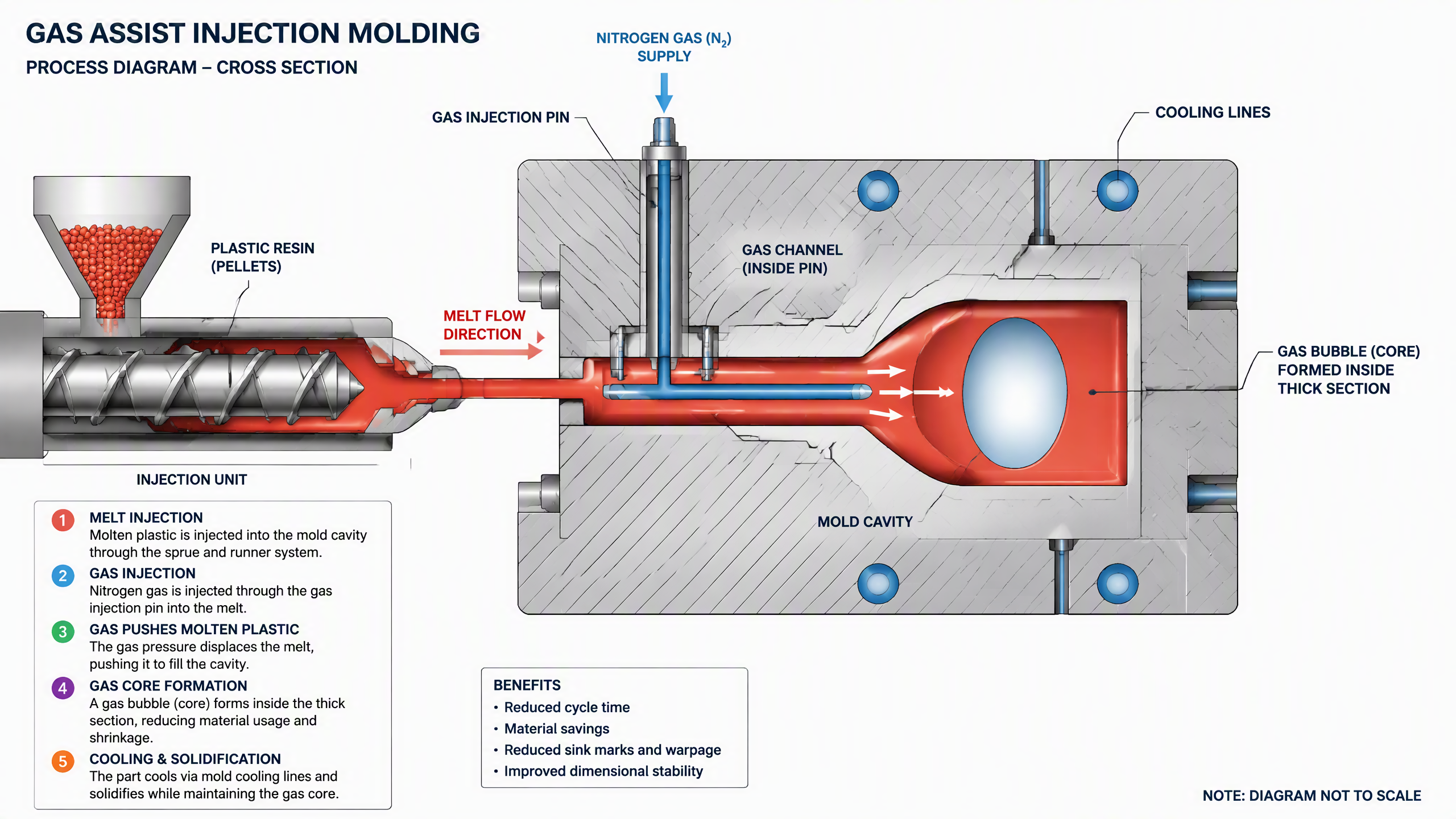
Gas assist injection molding follows a precise five-stage sequence that distinguishes it from conventional injection molding:
- Melt injection: The injection molding machine fills the mold cavity with molten polymer to approximately 70-90% of total volume. This partial fill is critical — too much plastic leaves no room for gas penetration; too little causes short shots or gas blow-through at the surface.
- Gas injection: Nitrogen gas (typically 99.5% purity) is introduced through a dedicated gas pin or nozzle at pressures ranging from 50 to 350 bar. The gas displaces the molten core material, pushing it forward and outward to complete the fill.
- Gas packing: The pressurized gas maintains holding pressure during the cooling phase, compensating for volumetric shrinkage as the polymer solidifies. This functionally replaces the conventional holding pressure stage.
- Gas venting: Once the part has developed sufficient green strength, the gas is vented or recovered through the injection pin, leaving a hollow core network inside the solidified wall.
- Ejection: The mold opens and the part is ejected, now featuring a hollow internal channel network with solid outer walls.
Why Nitrogen Gas Is Non-Negotiable
Engineers occasionally ask whether compressed air can substitute for nitrogen. The answer is a hard no. At injection molding temperatures (180-300°C depending on resin), the oxygen in compressed air will cause oxidation and degradation of the polymer melt. This manifests as burn marks, reduced mechanical properties, and inconsistent surface finish. Nitrogen, as an inert gas, eliminates these reactions entirely. Most production gas assist systems use on-site nitrogen generators producing gas at 99.5-99.9% purity, with dewpoint below -40°C to prevent moisture-related defects.
Key Engineering Advantages
Weight Reduction Without Strength Loss
In a comparative study we conducted across three automotive programs, gas assist injection molding reduced part weight by an average of 24% compared to solid-wall equivalents. The hollow core removes material from the neutral axis — the region that contributes least to bending stiffness — meaning the strength-to-weight ratio actually improves. For a typical door grab handle in glass-filled nylon (PA6-GF30), the solid version weighs 340g; the gas-assisted version weighs 258g, a reduction of 24.1%, while the three-point bending test showed only a 6% decrease in failure load.
Cycle Time Reduction
Thick-wall parts molded conventionally require long cooling times — often 60-120 seconds for walls exceeding 6mm. Gas assist injection molding reduces the effective wall thickness by creating a hollow core, cutting cooling time by 30-50%. In one TV bezel program (40-inch class, wall thickness 8mm), we reduced the cycle from 78 seconds to 42 seconds — a 46% improvement that saved approximately $0.18 per part in machine time costs at the customer's specified production volume.
Warpage and Sink Mark Elimination
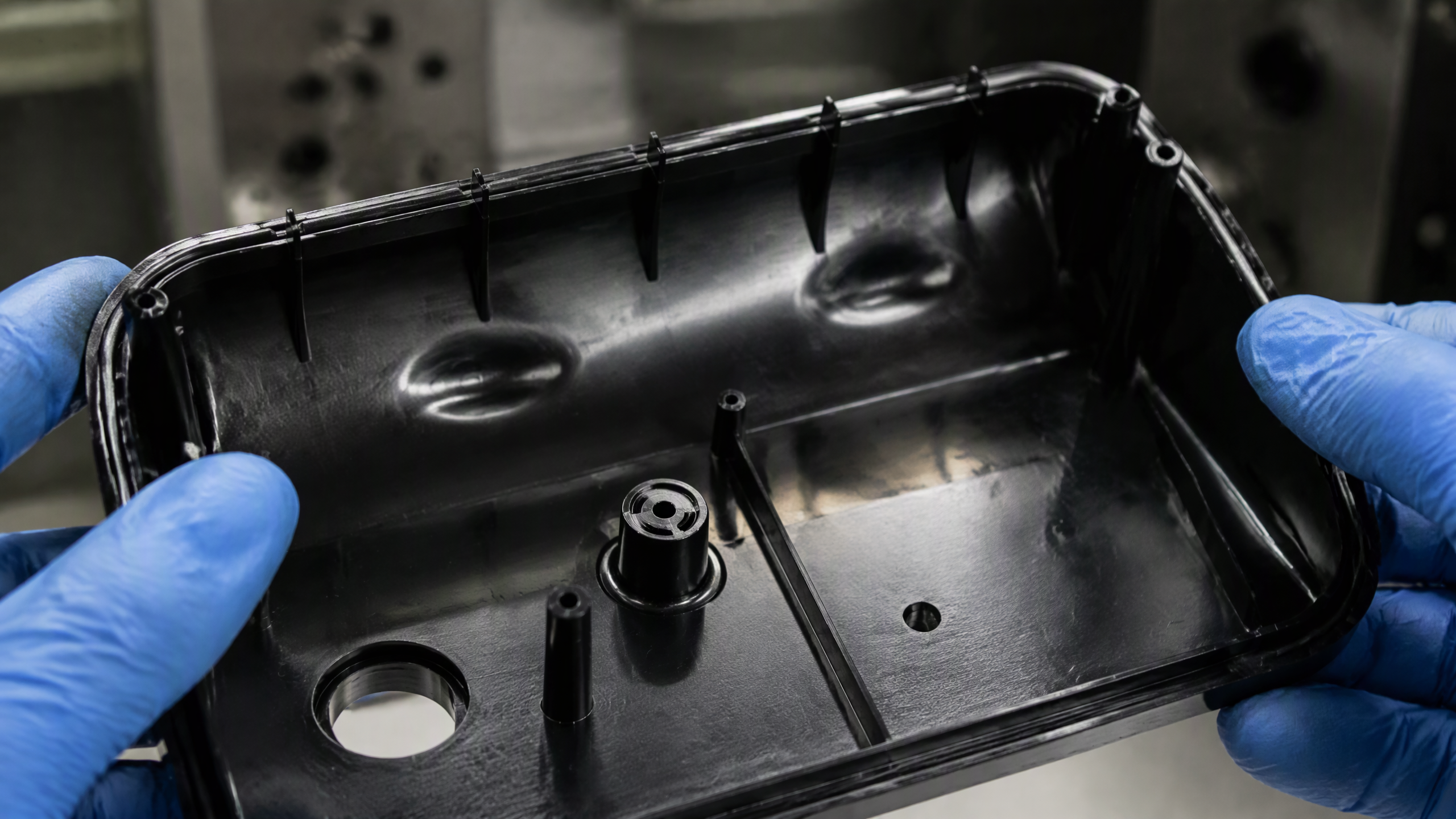
The gas packing pressure is applied internally, uniformly, and directly at the thickest sections where sink marks would otherwise form. Unlike conventional holding pressure, which must force material through increasingly frozen gates, gas pressure transmits freely through the hollow core network. This is particularly valuable for parts with thick ribs, bosses, or transitional wall sections. In our experience, gas assist reduces sink mark depth on visible surfaces by 80-95% compared to conventional molding on the same geometry.
Design Rules for Gas Assist Injection Molding
Wall Thickness and Gas Channel Geometry
The fundamental design principle is that gas follows the path of least resistance — the thickest, hottest section of the melt. Designers must deliberately create gas channels that guide the nitrogen to the desired core network. Typical guidelines include:
- Gas channel cross-sections should be 2-3 times the nominal wall thickness
- Channels should form continuous, closed-loop paths to prevent gas trapping in dead-end sections
- Avoid abrupt wall transitions that can cause gas blow-through to the part surface
- Maintain uniform channel volume along the gas path to prevent pressure fluctuations
- Position gas injection points at the thickest section, farthest from the conventional melt gate
Material Selection Considerations
Amorphous and semi-crystalline resins behave differently in gas assist. Amorphous resins like ABS and polycarbonate exhibit lower and more predictable shrinkage, making gas channel control easier. Semi-crystalline resins like nylon and polypropylene offer faster solidification but require more precise gas timing — the window between melt and frozen state is narrower. Glass-filled resins work well but tend to abrade gas injection pins more rapidly, requiring pin replacement every 15,000-30,000 cycles depending on glass content.

Common Defects and Troubleshooting
Even with proper design, gas assist injection molding can produce defects. Based on our production data from over 200 programs, here are the three most common issues and their root causes:
1. Gas Blow-Through
Symptom: Gas penetrates through the melt front and breaches the part surface, creating a visible blister or hole.
Root cause: Insufficient melt short-fill (below 60%), excessive gas pressure, or gas injection delay too long (melt front has frozen).
Fix: Increase pre-fill to 80-90%, reduce gas pressure by 20-30%, or reduce gas delay time by 0.5-1.5 seconds.
2. Inconsistent Gas Penetration
Symptom: Gas channel volume varies shot-to-shot, causing dimensional instability.
Root cause: Melt temperature variation exceeding ±5°C, inconsistent shot size, or worn gas pin orifice.
Fix: Verify barrel temperature uniformity, calibrate shot position to ±0.5mm, inspect gas pin orifice for wear every 10,000 cycles.
3. Surface Splay or Burn Marks
Symptom: Streaks or discoloration near gas channel exit points.
Root cause: Gas purity below 99%, moisture in gas supply, or gas venting too late causing trapped gas to flash.
Fix: Verify nitrogen purity with inline analyzer, check gas dryer dewpoint (must be below -40°C), reduce gas holding time by 3-5 seconds.
Sourcing Criteria: What to Ask Your Supplier
When evaluating a mold maker for gas assist programs, the questions below separate experienced practitioners from shops that have read the brochure. We recommend buyers ask these during the initial RFQ stage:
- How many active gas assist programs are currently in production at your facility?
- What gas assist equipment brand do you use, and how many gas injection controllers do you have?
- Can you provide wall thickness vs. cycle time data from a comparable production program?
- What is your gas pin maintenance schedule and pin lifespan in your most recent program?
- How do you validate gas channel integrity — X-ray, CT scan, or destructive sectioning?
A qualified gas assist injection molder should answer each of these with specific numbers, not generalizations. At Shiny Mold, we maintain production data logs for every active program and can provide cycle time benchmarks, material savings calculations, and gas channel CT scans upon request. Learn more about our industry capabilities and how we apply gas assist across automotive, medical, and consumer electronics programs.
Conclusion
Gas assist injection molding is not a niche technology — it is a production-proven process that delivers measurable advantages in weight, cycle time, and surface quality for thick-wall parts. The key to success lies in disciplined engineering: designing gas channels with intent, selecting materials with the right rheological profile, and maintaining gas injection equipment to the precision the process demands. For procurement teams, the ability to evaluate a supplier's gas assist competence through targeted technical questions can prevent costly program delays and quality failures downstream. Our 23 years of manufacturing experience, backed by over 200 gas assist production programs, confirm that when executed correctly, this process consistently outperforms conventional molding for thick-wall applications.
Frequently Asked Questions
What is gas assist injection molding?
Gas assist injection molding is a manufacturing process where pressurized nitrogen gas is injected into a mold cavity after a partial fill of molten plastic. The gas creates a hollow core inside the part, reducing weight and cycle time while improving surface quality. It is commonly used for thick-wall parts like automotive handles, TV bezels, and large housings.
How much weight can gas assist injection molding save?
Weight savings typically range from 15% to 30% depending on part geometry and wall thickness. In our production data across automotive and consumer electronics programs, the average weight reduction is 24% compared to solid-wall equivalents, while maintaining over 90% of the original bending strength.
What materials are suitable for gas assist injection molding?
Most thermoplastics work with gas assist, including ABS, polycarbonate, nylon (PA6, PA66), polypropylene, and glass-filled resins. Amorphous resins like ABS and PC offer easier process control due to lower shrinkage, while semi-crystalline resins like nylon provide faster solidification but require tighter gas timing windows.
What is the minimum wall thickness for gas assist injection molding?
The nominal wall should be at least 3mm for effective gas channel formation. Gas channels typically need to be 2-3 times the nominal wall thickness, meaning a 3mm wall requires a 6-9mm gas channel. Parts with walls thinner than 3mm generally do not benefit from gas assist because the hollow core would compromise structural integrity.
Is gas assist injection molding more expensive than conventional molding?
Tooling costs are 10-20% higher due to gas pins and additional mold modifications. However, the per-part cost is typically lower due to material savings (15-30%) and cycle time reduction (30-50%). For production volumes above 10,000 units, the savings usually offset the tooling premium within the first 3,000-5,000 parts.