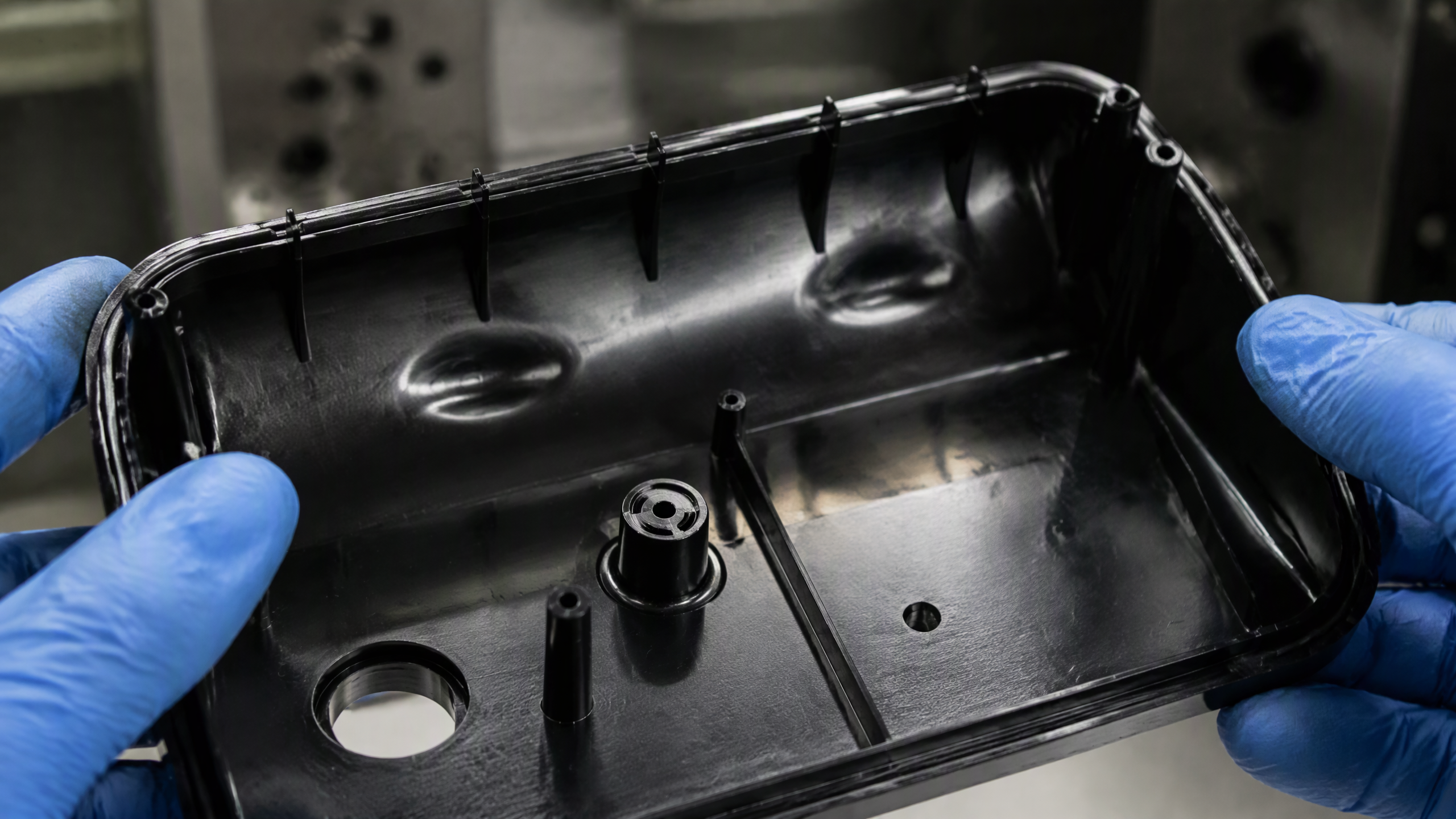
Injection Molded Product
Walk through any workshop or open your kitchen drawer and you'll spot them everywhere — the remote shell in your hand, the clip holding a car panel together, the syringe barrel at the clinic. An injection molding product is just a plastic part shaped by pushing molten resin into a steel cavity, then letting it cool into the final form. It sounds simple. Yet the gap between a part that works on the shelf and one that warps in the box comes down to choices most buyers never see.
We've been cutting molds and running parts out of Dongguan for years, and the questions from procurement stay the same. They want to know if the part holds its shape, what it costs at 50k units, and whether the shop can actually hit the drawing. This piece covers what an injection molded product really involves, the material calls that matter, and the few checks worth doing before you sign.
What Actually Counts as an Injection Molded Product
The short answer is almost any rigid plastic thing made in volume. Plastic Injection Molding covers enclosures for consumer electronics, medical connectors, automotive interior trim, and the humble food container. If it's a repeatable shape in the tens of thousands, molding beats CNC or 3D printing on unit cost every time.

Material is where the real conversation starts. Most parts land on one of five resins, and each carries a trade-off you feel in the field rather than on a datasheet.
| Resin | Typical use | Why buyers pick it | Watch-out |
|---|---|---|---|
| ABS | Enclosures, appliance bodies | Good surface, easy to paint | Brittle in cold |
| PP | Living hinges, caps, bins | Chemically resistant, cheap | Low temp resistance |
| PC | Transparent covers, lenses | High impact, clarity | Needs dry resin |
| PA (nylon) | Gears, clips, brackets | Wear-resistant, strong | Absorbs moisture |
| TPU | Soft grips, seals, gaskets | Flexible, abrasion-proof | Slow cycle time |
On the ground, PP and ABS cover maybe 70% of what walks through our door. Nylon shows up constantly in automotive clips because it survives under-hood heat that ABS would never take — we had a buyer switch a bracket material after a heat-cycle test cooked the original grade.
PC and nylon are hygroscopic. They pull moisture from the air and need a dryer at 80–120°C for a few hours before they hit the hopper. Skip that step and you get splay marks and weak welds that look like a molding defect but are really a housekeeping miss — an easy thing to miss when a new resin lot arrives on a humid afternoon.
Why Injection Molding Wins at Volume
Tooling isn't cheap. A proper production mold runs from about $3,000 for a single-cavity prototype to well past $30,000 for a hardened multi-cavity tool. The payoff is per-part cost: once the steel is cut, each shot is just resin plus machine minutes, and that number drops fast past the first few thousand units.
Repeatability is the quieter advantage. Part two million looks like part one, assuming the press is stable and the resin lot is consistent. That consistency is why medical and auto teams spec molding instead of hand-finished alternatives, even when the up-front number stings. A 30-second cycle on a 16-cavity tool means roughly 1,900 good parts an hour — try hitting that on a mill.
The Part Nobody Warns You About: Designing for the Mold
Here's the trap we see constantly. A buyer sends a CAD file drawn like a machined block — uniform 3 mm walls, sharp internal corners, a gate dropped wherever it looked convenient. Molding hates all three. Thick sections sink. Sharp corners create stress lines. A bad gate leaves a visible weld mark right where the customer's logo sits.
We once had a client whose remote-control housing kept showing flow lines across the face, no matter how many times they re-shot it. The resin was fine. The problem was a gate stuck at the far edge, so the melt had to travel the full width and cool before it met. We moved the gate to the side wall and bumped to a higher-flow ABS grade — the lines vanished, and the cycle dropped by 6 seconds. Six seconds sounds tiny until you multiply it across 200k units a month.
Draft angle is another one people skip. A half-degree of taper on vertical walls is often free insurance against sticking and scuffed surfaces. Most of our Mold Making Services quotes include a DFM pass that flags these issues before steel gets cut — catching it on paper costs nothing, catching it after first trial means a rework.
Gate type is its own quiet decision. An edge gate is cheap and easy to trim but leaves a visible nub. A submarine gate buries the mark on the parting line, and a hot-tip gate feeds straight from the manifold with no runner to scrap. The right call depends on whether the surface needs to stay clean or the cycle needs to stay short.
How Tight Can the Tolerances Get
Sales sheets love to throw around ±0.01 mm. It's real — we hold it on precision inserts cut by mirror EDM and checked on a CMM. But hold that line only where it matters. Tight tolerances everywhere just inflate cost and scrap rate for no gain.
For a typical molded shell, ±0.1 mm on most dimensions is plenty, tightening to ±0.05 mm on a snap-fit or a bearing seat. Resin also shrinks as it cools, anywhere from 0.5% for PS to around 2% for unfilled nylon, so the mold cavity is cut deliberately oversized to land on the drawing. We measure first articles on the CMM so the numbers are traceable, not guessed.

Rapid Tooling vs Production Tooling
If you only need a few hundred parts for a trade show or a design validation, a hardened production mold is overkill. Rapid Tooling uses softer aluminum or pre-hardened steel and gets you parts in one to two weeks instead of six. You trade some cavity life for speed.
| Factor | Rapid tool | Production tool |
|---|---|---|
| Lead time | 1–2 weeks | 5–8 weeks |
| Shot life | Up to ~50k | 500k–1M+ |
| Best for | Prototypes, pilots | Long runs |
A buyer chasing a hard launch date took rapid tooling for a 20k pilot, then cloned the geometry into a hardened steel mold for the real run. Smart move — it de-risked the design before committing to expensive steel, and the pilot paid for itself in early field feedback.
What to Check Before You Send the PO
Before you commit, ask for three things and you'll dodge most disasters. A DFM report, so you know the part is actually moldable. A first-article CMM sheet, so the dimensions are verified not promised. And a clear resin spec with the exact grade, not just "ABS" — there are dozens, and they don't behave the same on the press.
Also pin down the inspection standard. For Automotive Injection Molding Parts the bar is PPAP-level docs; for a toy component an AQL sampling plan is usually enough. Knowing which one applies keeps your supplier honest without drowning them in paperwork.

Three Things to Keep in Your Back Pocket
Pick the resin for the job, not the catalog — PP and ABS cover most cases, nylon earns its place under heat. Get a DFM pass before steel is cut, because rework after first trial is the expensive kind. And match the tool to the volume: rapid for pilots, hardened steel for the long haul.
We're happy to look at a drawing and tell you straight whether it'll mold clean or fight you — that early call saves a purchase order later. If you want to browse molds and parts we run day to day, our team can turn around a DFM review within a couple of days.
About SHINY Mold
SHINY Mold has made precision molds since 2003, from a 22,000 m² plant in Dongguan with 120+ engineers and 100+ injection machines. We're ISO-certified and run DFM through mass production under one roof — electronics, medical, automotive, and home-appliance parts. Local supply chain means fast sampling and traceable CMM inspection on every first article.