
 Chinese
Plastic Molding Services: The Complete Guide to Choosing the Right Manufacturing Partner in 2026
When you need plastic parts manufactured at scale, plastic molding services are the backbone of modern production. From precision medical components to high-volume consumer goods, molded plastic parts are everywhere — and choosing the right molding service provider determines your product's quality, cost, and time-to-market.
This guide covers all major plastic molding processes, how to evaluate service providers, cost structures, and what separates a commodity molder from a world-class manufacturing partner in 2026.

What Are Plastic Molding Services?
Plastic molding services encompass the full range of manufacturing processes that shape plastic materials into finished parts using precision tooling and controlled heat/pressure. A comprehensive service provider offers:
- Process consultation & DFM — Helping you select the right molding process for your part geometry, volume, and material
- Mold design and fabrication — Custom tooling built to your specifications
- Material selection — Guidance on resin choices for performance, cost, and regulatory compliance
- Production molding — High-volume manufacturing with consistent quality
- Secondary operations — Assembly, welding, printing, coating, packaging
- Quality assurance — Dimensional inspection, material testing, and certification documentation
Types of Plastic Molding Services
1. Injection Molding Services
Injection molding is the most widely used plastic molding process. Molten plastic is injected into a precision mold cavity at high pressure, cooled, and ejected. Ideal for high-volume production of complex, dimensionally precise parts.
Best for: Complex geometries, tight tolerances, high-volume production (1,000+ parts), consumer goods, automotive components, medical devices.
2. Blow Molding Services
Blow molding creates hollow plastic parts by inflating a heated plastic tube (parison) inside a mold cavity. Used primarily for bottles, containers, and hollow industrial parts.
Best for: Hollow parts, bottles, tanks, containers, automotive ducting.
3. Rotational Molding (Rotomolding) Services
Powdered plastic is placed in a mold that's heated and rotated on two axes, producing seamless hollow parts with uniform wall thickness. Lower tooling cost than injection molding but longer cycle times.
Best for: Large hollow parts, low-to-medium volumes, tanks, playground equipment, kayaks.
4. Compression Molding Services
Pre-heated plastic material is placed in an open mold cavity, then the mold closes and pressure is applied. Commonly used for thermoset materials and rubber parts.
Best for: Thermoset parts, rubber components, electrical insulators, large flat parts.
5. Thermoforming Services
A plastic sheet is heated until pliable, then formed over a mold using vacuum or pressure. Lower tooling cost, suitable for large parts with relatively simple geometries.
Best for: Packaging trays, vehicle interior panels, appliance housings, signage.
6. Overmolding & Insert Molding Services
Overmolding molds one material over a previously molded part (e.g., TPE grip over a plastic handle). Insert molding places a metal or plastic insert into the mold before injection. Both create multi-material assemblies in a single process.
Best for: Ergonomic grips, sealed electrical connectors, multi-material assemblies.
| Process | Tooling Cost | Cycle Time | Best Volume | Typical Applications |
|---|---|---|---|---|
| Injection Molding | $$$ – $$$$ | Fast (10–120s) | 1,000 – 1M+ | Precision parts, high volume |
| Blow Molding | $$ – $$$ | Fast (20–60s) | 5,000 – 1M+ | Bottles, containers |
| Rotational Molding | $ – $$ | Slow (10–30 min) | 50 – 5,000 | Large hollow parts |
| Compression Molding | $$ – $$$ | Moderate (1–5 min) | 500 – 50,000 | Thermosets, rubber |
| Thermoforming | $ – $$ | Moderate (30–90s) | 500 – 50,000 | Trays, panels, housings |
How to Evaluate Plastic Molding Services Providers
1. Technical Capabilities & Equipment
The right provider should have in-house capabilities that match your project requirements:
- In-house tool room — CNC machining, EDM, wire cutting, CMM inspection (faster iterations, better quality control)
- Machine tonnage range — From small precision machines (50–100 tons) to large structural molding (1,000–1,800+ tons)
- CAE simulation — Moldflow or Moldex3D analysis to predict and prevent molding defects before cutting steel
- Multi-material capabilities — Two-shot, overmolding, insert molding for complex assemblies
- Clean room molding — ISO Class 7 or better for medical and food-contact applications
2. Quality Certifications
Don't just ask — verify current certificates:
- ISO 9001:2015 — Baseline quality management (expect this from every serious provider)
- IATF 16949:2016 — Required for automotive supply chain
- ISO 13485:2016 — Required for medical device manufacturing
- ISO 14001:2015 — Environmental management
- PPAP / FAIR — Production Part Approval Process and First Article Inspection reports
3. Industry Experience
A molding provider with relevant industry experience understands your specific requirements, regulations, and quality expectations:
- Automotive — High-volume, tight tolerances, full PPAP documentation, IATF 16949
- Medical devices — Clean room molding, material traceability, ISO 13485, FDA-compliant processes
- Consumer electronics — Cosmetic surface finishes, thin-wall molding, precision assembly
- Home appliances — Large parts, cost optimization, durable tooling
- New energy / EV — Battery components, flame-retardant materials, thermal management parts
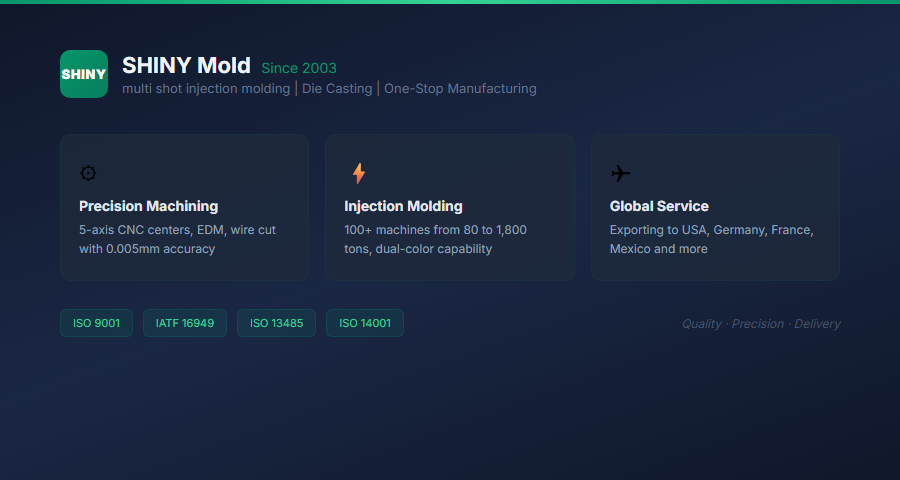
About SHINY Mold — Comprehensive Plastic Molding Services Since 2003
Founded in 2003, SHINY (Dongguan Xinxuan Mold) is headquartered in Chang'an, Dongguan — China's premier mold manufacturing hub. With fixed assets of USD 5 million, a 23,000+ square metre facility, and 400+ skilled employees, SHINY provides comprehensive plastic molding services including high-precision injection molds, die-casting molds, and full production molding.
Our facility features 100+ injection molding machines ranging from 80 to 1,800 tons, dual-colour injection capability, overmolding/insert molding, and dedicated clean room molding areas. With a design library of 5,000+ successful mold designs and annual output of 2,000+ molds, we serve clients across automotive, new energy, medical devices, consumer electronics, home appliances, power tools, and lighting industries.
SHINY is certified under ISO 9001:2015, ISO 14001:2015, ISO 13485:2016, and IATF 16949:2016. Our export markets include the United States, Canada, Mexico, Germany, France, Poland, and throughout Europe. We combine Chinese manufacturing efficiency with international quality standards — delivering precision, reliability, and value to clients worldwide.
Cost Structure of Plastic Molding Services
Understanding cost drivers helps you evaluate quotes and optimize your design:
Tooling Cost (NRE — Non-Recurring Engineering)
The largest upfront investment. Amortized over production volume.
| Mold Type | Typical Cost Range (USD) |
|---|---|
| Prototype aluminum mold (1 cavity) | $1,500 – $5,000 |
| Production mold, simple (1–2 cavities) | $5,000 – $15,000 |
| Production mold, complex (multi-cavity, hot runner) | $15,000 – $80,000 |
| High-precision automotive/medical mold | $50,000 – $200,000+ |
Per-Part Cost
Recurring cost for each molded part:
Per-Part Cost = Material Cost + Processing Cost + Overhead/Profit

Material Cost = (Part Weight × Material Price/kg) × (1 + Scrap Rate)
Processing Cost = (Cycle Time / 3600) × Machine Hourly Rate
Typical Machine Hourly Rates (2026)
| Machine Size | Hourly Rate (USD) |
|---|---|
| 50–100 ton | $25 – $40 |
| 100–200 ton | $35 – $55 |
| 200–350 ton | $50 – $75 |
| 350–500 ton | $70 – $100 |
| 500+ ton | $100 – $150 |
Questions to Ask Before Choosing Plastic Molding Services
- Can you show me case studies in my industry? — Relevant experience matters more than general capability.
- What is your typical on-time delivery rate? — Ask for the past 12 months' track record.
- Do you provide DFM (Design for Manufacturability) feedback? — Early design optimization saves money and prevents defects.
- How do you handle mold maintenance? — Preventive maintenance schedules, spare parts provision, and repair response time.
- What quality documentation do you provide? — PPAP, FAIR, CPK data, material certifications.
- Can I visit the facility or take a virtual tour? — Transparency about equipment and processes is a good sign.
- What is your policy on mold ownership? — You should own your mold and have the right to move it to another molder.
- How do you handle engineering changes? — Mold revisions should be quoted clearly with cost and timeline.
Local vs. Overseas Plastic Molding Services
One of the biggest decisions in sourcing: local vs. international providers.
| Factor | Local Provider | Overseas (e.g. China) |
|---|---|---|
| Tooling cost | Higher ($$$$) | 40–60% less ($$) |
| Per-part cost | Higher ($$$) | 30–50% less ($) |
| Lead time (tooling) | 8–16 weeks | 6–10 weeks |
| Communication | Easy (same timezone) | Good (dedicated PM + email) |
| Quality systems | Varies | ISO certified (top tier) |
| On-site visits | Easy | Travel or virtual tour |
The bottom line: a qualified overseas molding partner with ISO certifications, export experience, and transparent communication often delivers better value than a local provider with limited capabilities. The "right" choice depends on your priorities — speed, cost, control, or a balance of all three.
2026 Trends in Plastic Molding Services
AI-Optimized Mold Design
AI-powered design tools now optimize gate placement, cooling channel layout, and cycle time — reducing mold trial iterations by 30–50%. Ask potential partners if they use AI-assisted design tools.
Sustainable Materials & Processes
More OEMs require molded parts with recycled content, bio-based resins, and carbon footprint reporting. Leading molding services providers now offer material alternatives with lower environmental impact and full traceability.
Digital Manufacturing & Real-Time Monitoring
Cloud-based production dashboards let you monitor your parts' production status, quality metrics, and delivery timeline in real time — making global collaboration seamless.
Multi-Process Integration
The best plastic molding services providers now offer integrated solutions: mold design + molding + secondary operations + assembly + packaging — reducing your vendor management overhead and ensuring consistent quality across the entire process.
Frequently Asked Questions
What's the difference between plastic molding services and injection molding services?
"Plastic molding services" is the broader category covering all molding processes (injection, blow, rotational, compression, thermoforming). "Injection molding services" specifically refers to the injection molding process, which is the most common type of plastic molding for precision parts.
How do I choose between a local and overseas molding provider?
Consider: (1) Total cost including shipping, (2) Required volume and lead time, (3) Importance of in-person communication, (4) Quality certification requirements, (5) IP protection needs. Many companies use overseas partners for tooling and high-volume production, and local providers for low-volume or prototype work.
What should I include in my RFQ for plastic molding services?
3D CAD model (STEP/IGES), 2D engineering drawing with tolerances, material specification, annual volume and batch sizes, surface finish requirements, any special certifications needed (FDA, UL, ROHS, REACH), and target timeline.
How long does plastic molding take from design to production?
Typical timeline: DFM feedback (3–5 days), mold design approval (1–2 weeks), mold fabrication (4–10 weeks), T1 sampling (1 week), revisions if needed (1–3 weeks), production (2–6 weeks depending on volume). Total: 8–20 weeks.
Can plastic molding services handle food-grade or medical-grade requirements?
Yes — provided the provider has the right certifications (ISO 13485 for medical, relevant food-contact material certifications). Clean room molding capability is essential for many medical and food applications. Always verify certifications and ask for references in your specific industry.
What is mold ownership and why does it matter?
Mold ownership means the mold belongs to you, not the molder. You should always retain ownership of your mold. This gives you the freedom to move production to another provider if needed, and ensures you can access your mold if the relationship ends. Reputable molding services providers always acknowledge customer mold ownership in writing.
Conclusion
Choosing the right plastic molding services provider is a critical decision that affects your product quality, cost structure, and market success. The ideal partner combines technical depth, proven quality systems, industry-specific experience, and transparent communication — regardless of geography.
In 2026, the plastic molding industry offers more choices and higher capabilities than ever. Whether you need precision injection molded components, blow-molded containers, or rotomolded large parts, there's a service provider that matches your requirements and budget.
At SHINY Mold, we've been delivering precision plastic molding services to global clients since 2003. With 100+ injection molding machines, full in-house tool room capabilities, and certifications including ISO 9001, IATF 16949, and ISO 13485, we provide the quality, reliability, and value your project deserves.
Contact SHINY Mold today for a free DFM analysis and competitive quote — and discover why leading companies across automotive, medical, electronics, and consumer goods industries trust us with their most demanding plastic molding projects.