
 Chinese
Moulding Maker: How to Choose the Right Injection Moulding Supplier in 2026
In the global manufacturing landscape, finding a trustworthy moulding maker can make or break your product launch. Whether you're sourcing injection moulds for automotive components, consumer electronics, medical devices, or industrial equipment, the quality, lead time, and technical capability of your moulding maker directly determines your production success.
This guide walks you through how to evaluate a moulding maker — from technical capability and quality systems to communication, pricing transparency, and long-term partnership potential.
What Does a Moulding Maker Actually Do?
A moulding maker (or moulding manufacturer) is a factory or workshop that designs, engineers, and produces injection moulds and/or finished plastic parts via injection moulding. The scope of a moulding maker can vary significantly:
- Mould Fabrication Only — Some moulding makers focus exclusively on designing and building moulds for their customers' use
- Moulding Production Only — Others run customer-provided moulds and produce finished parts
- Turnkey Moulding Maker — The most valuable partners handle everything from DFM analysis and mould design to mould manufacturing, injection moulding, and post-production assembly
For most product teams, a turnkey moulding maker offers the best value: one point of contact, integrated quality control, and accountability throughout the entire process.
Key Criteria for Evaluating a Moulding Maker
1. Technical Capability & Equipment
A capable moulding maker should demonstrate mastery across the full manufacturing chain. Key indicators:
- In-house tool room — CNC machining centres, EDM wire cutting, precision grinding, and CMM inspection equipment
- Mouldflow / CAE simulation — Computer-aided engineering to optimise gating, cooling, and warpage before cutting steel
- Machine park — Adequate tonnage range (80–1,800+ tons) for your part size requirements
- Secondary capabilities — Two-shot moulding, overmoulding, insert moulding, ultrasonic welding, painting, printing, and assembly
2. Quality Certifications
Verify that your moulding maker holds the relevant quality certifications for your industry:
- ISO 9001:2015 — The baseline quality management standard; non-negotiable for serious manufacturers
- IATF 16949:2016 — Required for automotive supply chain participation
- ISO 13485:2016 — Mandatory for medical device manufacturing
- ISO 14001:2015 — Environmental management (increasingly required by European and American buyers)
3. Track Record & Industry Experience
Ask your moulding maker about:
- Years in business and total moulds delivered
- Industries served (automotive, medical, electronics, appliances, etc.)
- Case studies or reference projects similar to yours
- Customer retention rate and repeat order percentage
4. Communication & Project Management
Strong communication separates good moulding makers from great ones. Evaluate:
- Responsiveness to RFQ and technical enquiries
- Clarity and completeness of quotations (itemised mould cost, piece price, lead time)
- Proactive DFM feedback and design optimisation suggestions
- Transparency in sharing progress updates, photos, and inspection reports
- English communication proficiency for international collaboration
About SHINY Mold — Your Turnkey Moulding Maker
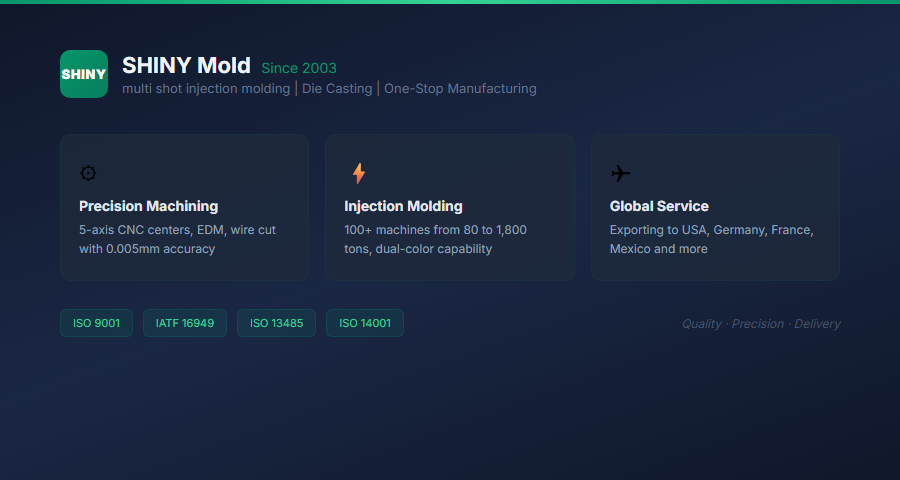
SHINY (Dongguan Xinxuan Mold Co., Ltd.), established in 2003 and headquartered in Chang'an, Dongguan — China's premier mould manufacturing hub — has served as a trusted moulding maker for global customers for over two decades.
With fixed assets of USD 5 million, 23,000+ square metres of production space, and 400+ skilled employees, SHINY delivers 2,000+ moulds and handles large-scale injection moulding production annually. Our machine park includes 100+ injection moulding machines (80–1,800 tons), dual-colour injection capability, and integrated assembly lines — enabling true turnkey manufacturing from prototype to finished product.
SHINY is certified to ISO 9001, ISO 14001, ISO 13485, and IATF 16949 quality management systems, serving customers in the United States, Canada, Mexico, Germany, France, Poland, and other markets worldwide.
The Moulding Maker Selection Checklist
| Evaluation Area | What to Check | Pass? |
|---|---|---|
| In-house tool room | CNC, EDM, CMM available on-site | ☐ Yes ☐ No |
| CAE / Moldflow | Simulation performed before mould fabrication | ☐ Yes ☐ No |
| Quality certifications | ISO 9001 required; IATF/ISO 13485 for specific industries | ☐ Yes ☐ No |
| Industry experience | Proven track record in your target industry | ☐ Yes ☐ No |
| Sample quality | Request T1 samples and dimensional report | ☐ Yes ☐ No |
| Communication | English-speaking account manager, prompt replies | ☐ Yes ☐ No |
| Transparency | Detailed quotation with mould cost breakdown | ☐ Yes ☐ No |
| IP protection | NDA offered, secure data handling, no copying | ☐ Yes ☐ No |
| Lead time | Standard lead time within acceptable range | ☐ Yes ☐ No |
| Payment terms | Secure payment method (TT, L/C, Escrow) | ☐ Yes ☐ No |
Red Flags: How to Spot a Bad Moulding Maker
- No on-site tool room — They outsource mould fabrication; you lose control over quality and lead time
- Vague quotations — A lump-sum price without breakdown is a warning sign; hidden costs often emerge later
- No sample provision — Reluctance to provide T1 samples or third-party inspection reports
- No quality certifications — Operating without ISO 9001 or industry-specific certifications
- Poor communication — Slow responses, language barriers, or evasive answers to technical questions
- Below-market pricing — Unreasonably low quotes often signal compromised steel quality or shortcuts in heat treatment
- No factory audit — They refuse or avoid video calls and factory tours
How to Initiate a Project with Your Moulding Maker
- Submit RFQ — Provide 3D model (STEP/IGES), 2D drawing, material spec, annual volume, and target price
- Receive Quotation — Expect itemised breakdown: mould cost (NRE), piece price, tooling lead time, production lead time
- DFM Review — Your moulding maker should provide Design for Manufacturability feedback before proceeding
- Sign Agreement — NDA, quality agreement, and purchase order with clear terms
- Mould Fabrication — Regular updates with photos; request video call at key milestones
- T1 Sampling — First trial shots with dimensional report; iterate until approved
- Production Release — Mass production begins after T1 approval and pilot run confirmation
Cost Structure: What a Moulding Maker Charges
Mould Cost (Non-Recurring Engineering / NRE)
- Single-cavity mould: USD 3,000–15,000 (standard complexity)
- Multi-cavity mould: USD 15,000–80,000+
- Aluminium prototype mould: USD 500–5,000 (fast turnaround, low volume)
- Expedited tooling: +30–50% premium
Piece Price (Per-Part Cost)
- Commodity plastics (PP, PE, ABS): USD 0.05–0.50 per piece (depends on size and volume)
- Engineering plastics (PC, PA, POM): USD 0.20–2.00 per piece
- High-performance plastics (PEEK, LCP): USD 1.00–10.00+ per piece
Volume is the primary driver of piece price — a moulding maker's ability to justify multi-cavity tooling depends on your committed annual volume.
Why Global Brands Choose SHINY as Their Moulding Maker
- 20+ years of injection mould experience — Over 5,000 mould designs in library; 2,000+ moulds delivered annually
- Full in-house capability — No outsourcing; one factory handles DFM, mould manufacturing, injection moulding, and assembly
- Industry certifications — ISO 9001, ISO 14001, ISO 13485, IATF 16949
- Global client base — Trusted by customers in the US, Canada, Germany, France, Poland, Mexico, and beyond
- IP protection commitment — Strict NDA protocols, secure data handling, zero-tolerance on IP misuse
- Competitive pricing with quality assurance — China's manufacturing efficiency without compromising quality standards
Frequently Asked Questions
What is the typical lead time from a moulding maker?
Prototype moulds: 2–4 weeks. Production moulds (single-cavity): 6–10 weeks. Multi-cavity or complex moulds: 10–16 weeks. Expedited options available at a premium.
Can a moulding maker handle both mould fabrication and production?
Yes — a turnkey moulding maker like SHINY handles the full spectrum: DFM analysis, mould design, mould fabrication, injection moulding, and post-production services such as painting, printing, and assembly.
What information should I provide to a moulding maker for a quotation?
Provide: 3D CAD model (STEP, IGES, or native format), 2D drawing with critical tolerances, material specification, estimated annual volume, target piece price, and any industry-specific requirements.
How do I protect my intellectual property when working with a moulding maker?
Sign a mutual NDA before sharing files. Choose a moulding maker with a documented IP protection policy. Reputable manufacturers like SHINY treat IP protection as a non-negotiable commitment.
What is the minimum order quantity from a moulding maker?
Most moulding makers prefer 1,000+ pieces per order. For lower volumes (100–1,000), aluminium tooling or shared cavity arrangements can reduce unit cost. Prototype runs of 50–200 pieces are typically feasible using rapid tooling.
Does SHINY offer design for manufacturing (DFM) analysis?
Yes. SHINY provides complimentary DFM analysis for all new projects, offering design optimisation recommendations to improve mouldability, reduce costs, and enhance part quality before mould fabrication begins.
Conclusion
Choosing the right moulding maker is one of the most consequential decisions in your product development journey. A great moulding maker doesn't just produce parts — they become a strategic partner, offering engineering expertise, quality assurance, and supply chain reliability that compound in value over time.
Use the checklist and evaluation criteria in this guide to shortlist candidates, request samples, and make an informed decision. And if you're looking for a turnkey moulding maker with 20+ years of experience, international certifications, and a proven track record with global customers — SHINY Mold is ready to be your manufacturing partner.