
 Chinese
Molding Over Molding: The Complete Guide to Overmolding & Multi-Material Injection Molding in 2026
"Molding over molding" — also known as overmolding, two-shot injection molding, or multi-material molding — is one of the most versatile and valuable manufacturing processes in modern plastics engineering. It allows you to combine two or more materials into a single, integrated part, eliminating secondary assembly operations while improving product performance, ergonomics, and aesthetics.
Whether you're designing a power tool with a soft-grip handle, a medical device with a tactile surface, or a consumer electronic with a sealed, water-resistant housing, understanding overmolding can reduce costs, improve quality, and accelerate your time to market.
In this complete 2026 guide, we'll cover everything you need to know about molding over molding: the different process types, material compatibility, design rules, cost considerations, and how to select a manufacturing partner.

What Is Molding Over Molding (Overmolding)?
Molding over molding is an injection molding process where one material is molded onto, over, or around a pre-existing substrate (the "first shot") to create a multi-material part. The substrate can be a previously molded plastic part, a metal insert, or another component.
The result is a single, integrated part with multiple material properties — for example, a rigid plastic core with a soft-touch elastomeric outer layer, or a metal insert encapsulated in engineering plastic for structural reinforcement.
Why Use Molding Over Molding?
- Eliminate assembly operations — No gluing, snapping, or fastening separate components together
- Improved ergonomics — Soft-touch surfaces, non-slip grips, comfortable contact points
- Enhanced aesthetics — Two-colour, two-texture parts without painting or secondary finishing
- Better sealing — Overmolded gaskets and seals for waterproof and dustproof enclosures
- Vibration dampening — Soft overmold layers absorb impact and reduce vibration in power tools and automotive applications
- Reduced part count — Consolidate multiple components into one molded assembly
- Material optimization — Use expensive engineering plastics only where needed, with lower-cost material for the rest
The Three Main Overmolding Processes
1. Two-Shot (2K) Injection Molding
Also called dual-shot or multi-shot molding, this process uses a specialized injection molding machine with two or more barrels and a rotating mold. The first material is injected into the mold cavity. The mold rotates on a rotary table or core-back mechanism, and the second material is injected over the first shot — all within the same molding cycle.
Best for: High-volume production, parts requiring precise material-to-material bonding, and applications where cycle time is critical.
Advantages: Faster cycle times, excellent bond strength (chemical or mechanical), fully automated process, consistent quality.
Limitations: Higher mold cost (complex rotary or sliding mechanisms), requires specialized two-shot injection molding machines.
2. Insert Overmolding
In this process, a pre-formed substrate (plastic part, metal stamping, threaded insert, PCB, etc.) is placed into the mold cavity — either manually by an operator or automatically by a robot — and the second material is injected over and around it.
Best for: Metal-to-plastic assemblies, threaded inserts, encapsulated electronics, and lower to medium volumes where the flexibility of interchangeable inserts is valuable.
Advantages: Lower mold cost than two-shot, works with any substrate material (metal, ceramic, existing plastic parts), compatible with standard injection molding machines.
Limitations: Slower cycle time (insert loading), potential for misalignment or insert movement during injection, requires proper pre-treatment for bond strength.
3. Core-Back Overmolding
A variant of two-shot molding where the mold has a sliding core that retracts after the first shot to create space for the second material. The mold doesn't rotate — the core simply moves back to open a new cavity volume around the first-shot part.
Best for: Parts with simple overmold geometries, where a rotating mold is not justified.
Advantages: Simpler mold construction than rotary two-shot, good for medium volumes.
Limitations: Limited geometric complexity, more design constraints than rotary two-shot.
Material Selection for Overmolding
Material compatibility is the most critical factor in successful overmolding. The two materials must bond effectively — either chemically (similar polymer families) or mechanically (interlocking features).
Common Overmolding Material Combinations
| Substrate (First Shot) | Overmold (Second Shot) | Typical Applications |
|---|---|---|
| ABS | TPU, TPE, PC/ABS | Power tool handles, consumer electronics grips |
| PC (Polycarbonate) | TPE, Silicone (LSR) | Medical devices, phone cases, transparent enclosures |
| Nylon (PA66, PA6) | TPE, TPU | Automotive interior handles, under-hood components |
| PP (Polypropylene) | TPV, TPE | Automotive interior trim, household appliance grips |
| PA66+GF (Glass-filled Nylon) | TPU | Power tool structural housings with soft grip |
| Metal (Aluminum, Steel, Brass) | PC, ABS, Nylon, POM | Threaded inserts, encapsulated connectors, mechanical joints |
Chemical vs. Mechanical Bonding
Chemical bonding occurs when the overmold material is chemically compatible with the substrate — the two materials fuse at the molecular level during injection. This requires careful material selection and typically results in the strongest bond. Examples: ABS/TPU, PC/TPE.
Mechanical bonding relies on physical interlocking features — undercuts, holes, ribs, or textured surfaces on the substrate that the overmold material flows into and around. This is used when the two materials are not chemically compatible, or when additional bond strength is required.
Design Guidelines for Molding Over Molding
Minimum Wall Thickness
- Substrate: 1.5mm - 3.0mm minimum (depends on material and geometry)
- Overmold layer: 1.0mm - 4.0mm (thinner layers may not fill completely; thicker layers add weight and cost)
- Rule of thumb: Keep overmold thickness between 1.5mm and 3.0mm for optimal flow and cooling
Rib and Undercut Design for Mechanical Bonding
- Include through-holes in the substrate for the overmold material to flow through — creating "rivets" that lock the two materials together
- Design undercuts, grooves, or recessed areas on the substrate surface
- Avoid sharp internal corners — use generous fillets (R ≥ 0.5mm) to reduce stress concentration
- Consider diamond-knurling or texturing on metal inserts for maximum pull-out resistance
Gate Placement
- Position gates on the overmold layer to fill from thick to thin sections
- Avoid injecting the overmold material directly against thin wall sections of the substrate — this can cause deflection or collapse
- Use mould flow simulation (Moldflow, Moldex3D) to optimize gate location and predict bond-line formation
Shrinkage Compatibility
- Substrate and overmold materials should have similar shrinkage rates
- If shrinkage rates differ significantly, the part may warp or delaminate after cooling
- Semi-crystalline materials (Nylon, PP) shrink more than amorphous materials (ABS, PC) — account for this in mold design
Draft Angles
- Standard draft: 1°-3° per side
- Deeper textures or matte finishes require additional draft (3°-5°)
- Overmold surfaces with low draft angles may stick in the cavity or show drag marks
Overmolding Process Considerations
Surface Preparation
For insert overmolding, the substrate surface may need preparation to achieve proper bond strength:
- Plasma treatment — Activates low-surface-energy plastics (PP, PE, POM) for improved adhesion
- Flame treatment — Oxidizes the substrate surface for better chemical bonding
- Mechanical abrasion — Sanding or bead blasting to create a textured bonding surface
- Primer or adhesion promoter — Chemical coating applied to the substrate before overmolding
Mold Temperature Control
Proper mold temperature is critical for overmolding. The mold must maintain different temperatures for the first and second shots. In two-shot molding, the mold rotates with the first-shot part still in the cavity — the temperature must be carefully managed to prevent the first shot from cooling too much (reducing bond strength) or overheating (causing distortion).
Injection Pressure and Speed
The overmold material must be injected at a pressure and speed that fills the cavity completely without displacing or deforming the substrate. Low-pressure, slower fill rates are often preferred for overmolding to minimize stress on the first-shot part.
Cost Analysis: Molding Over Molding vs. Traditional Assembly
| Cost Factor | Overmolding | Traditional Assembly |
|---|---|---|
| Tooling investment | $$$ (more complex mold) | $$ (separate molds + assembly fixtures) |
| Per-part cost | $ (low, high-volume) | $$-$$$ (material + labour + overhead) |
| Assembly labour | $0 (none — integrated process) | $$ (manual or automated assembly) |
| Quality & yield | High (automated, repeatable) | Variable (assembly errors, misalignment) |
| Secondary finishing | $0 (integrated colour/texture) | $$ (painting, printing, coating) |
| Part reliability | Excellent (no joints to fail) | Good (depends on assembly quality) |
Breakeven analysis: For volumes above 10,000-20,000 parts per year, overmolding typically becomes more cost-effective than separate parts + assembly, despite the higher initial tooling investment.
About SHINY Mold — Your Multi-Material Molding Partner
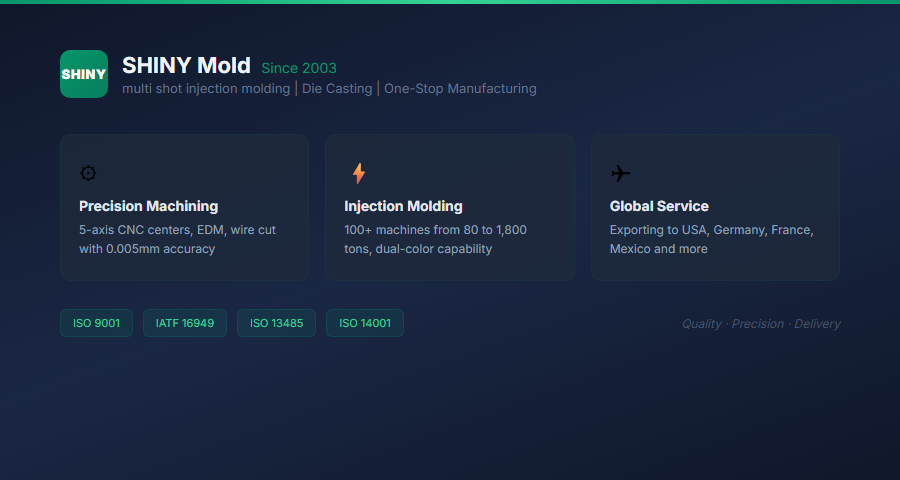
Founded in 2003, SHINY (Dongguan Xinxuan Mold) is headquartered in Chang'an, Dongguan — China's premier mold manufacturing hub. With USD 5 million in fixed assets, a 23,000+ square metre facility, and over 400 skilled employees, SHINY specializes in high-precision injection molds, including advanced multi-material and overmolding solutions.
Our facility is equipped with 100+ injection molding machines ranging from 80 to 1,800 tons, including dedicated dual-colour (two-shot) injection molding machines for overmolding production. We offer complete in-house capabilities: mold design with Moldflow simulation, precision mold fabrication (CNC, EDM, wire cutting, CMM), multi-material injection molding, and secondary operations including ultrasonic welding, printing, and assembly.
With a design library of 5,000+ successful mold designs and an annual output of 2,000+ molds, SHINY serves clients across automotive, new energy vehicles, medical devices, consumer electronics, home appliances, and power tools. We are certified under ISO 9001:2015, ISO 14001:2015, ISO 13485:2016, and IATF 16949:2016, ensuring every overmolded part meets international quality standards. Our export markets span the United States, Canada, Mexico, Germany, France, Poland, and throughout Europe.
Industries That Benefit from Molding Over Molding
Automotive & EV
Two-shot overmolding is extensively used in automotive interiors for soft-touch surfaces, dual-durometer seals, and colour-keyed components. In electric vehicles, overmolding encapsulates high-voltage connectors and battery management system components for insulation and sealing.
Power Tools
Overmolded soft-grip handles are a hallmark of professional power tools. The rigid core (typically glass-filled nylon or PC/ABS) provides structural strength, while the TPE/TPU overmold layer provides comfort, grip, and vibration dampening — all in a single, integrated part.
Medical Devices
Medical overmolding combines rigid plastics (PC, ABS, PP) with soft, biocompatible materials (LSR, medical-grade TPE) for syringe grips, diagnostic device housings, surgical instrument handles, and drug delivery components. Clean room molding (ISO 13485, Class 100K/ISO 7) is often required.
Consumer Electronics
Phone cases, wearable devices, remote controls, and gaming controllers commonly use overmolding for soft-touch surfaces, sealing gaskets, and two-colour cosmetic effects. Thin-wall overmolding (1.0-1.5mm) challenges both mold design and process control.
Home Appliances
Kitchen appliance handles, vacuum cleaner bumpers, and washing machine control panels benefit from overmolding for ergonomic grip, impact protection, and aesthetic differentiation.
Common Overmolding Defects and How to Prevent Them
Delamination (Poor Bond Strength)
Cause: Incompatible material pairing, insufficient melt temperature, contaminated substrate surface, or inadequate packing pressure.
Solution: Select chemically compatible materials, pre-dry materials properly, increase melt temperature, and ensure substrate surface is clean and activated.
Flash on Overmold Layer
Cause: Excessive injection pressure, poor mold fit, or overpacking of the second shot.
Solution: Reduce injection speed and hold pressure, improve mold shut-off surfaces, and optimize gate location.
Sink Marks / Warpage
Cause: Differential shrinkage between substrate and overmold materials, uneven cooling, or insufficient packing.
Solution: Balance wall thicknesses, optimize cooling channel design, and adjust packing pressure and time.
Short Shot (Incomplete Fill)
Cause: Insufficient injection volume, narrow flow channels, or premature freezing of the overmold material.
Solution: Increase shot size, raise mold temperature, and ensure gate and runner dimensions are adequate for the material's flow characteristics.
How to Choose an Overmolding Partner
When evaluating partners for your "molding over molding" project, look for:
- Dual-colour/Two-shot machine capability — Verify they have actual production experience with multi-shot molding, not just the equipment
- Mold flow simulation expertise — Overmolding requires careful simulation of the second material flow over the first-shot geometry
- Material compatibility knowledge — Your partner should guide you on material pairing and bond strength optimization
- Automated insert loading — For insert overmolding, robotic placement ensures consistency and cycle time efficiency
- Quality certifications — ISO 9001 minimum; ISO 13485 for medical; IATF 16949 for automotive
- DFM feedback — They should provide detailed design-for-manufacturability analysis for your overmolded part
- Reference projects — Ask for case studies of similar multi-material parts they've produced
Frequently Asked Questions
What's the difference between overmolding and two-shot molding?
They're related but distinct. Overmolding is the general process of molding one material over another. Two-shot (2K) molding is a specific, highly automated method that performs both shots in one molding cycle using a specialized machine with two barrels and a rotating mold. Two-shot molding is generally faster and more consistent, but requires higher mold investment.
Can overmolding be done on a standard injection molding machine?
Yes — insert overmolding can be performed on a standard injection molding machine by manually or robotically placing the substrate in the mold. No special machine is required. However, two-shot molding requires a dedicated dual-barrel machine and a rotary mold.
How strong is the bond between overmold and substrate?
With chemically compatible materials, the bond can be as strong as the substrate material itself — peel strength exceeding 10-20 N/mm is achievable. For mechanical bonding, pull-out forces depend on the interlocking geometry but can exceed 200N for well-designed mechanical interlocks.
What materials cannot be overmolded?
Low-surface-energy materials like PTFE (Teflon), UHMWPE, and POM (acetal) are difficult to overmold without surface treatment. Some combinations (e.g., silicone on polypropylene without plasma treatment) will not bond chemically and require mechanical interlocking.
Can you overmold over an existing manufactured part?
Yes — this is insert overmolding. Pre-existing parts (plastic, metal, ceramic, even glass) can be placed into the mold and overmolded. The key considerations are the melting temperature of the overmold material (it must not melt or deform the substrate), and the surface preparation for bonding.
How does overmolding affect part cost?
Overmolding typically increases mold cost by 30-100% compared to a single-shot mold (due to complexity). However, per-part cost decreases because assembly operations are eliminated. Total cost savings of 15-40% per part are common for volumes above 20,000 units/year.
Conclusion
Molding over molding — whether through two-shot injection molding, insert overmolding, or core-back techniques — represents a powerful capability for modern product design. By combining multiple materials in a single, integrated process, manufacturers can create products that are more durable, more ergonomic, more aesthetically pleasing, and more cost-effective than traditional assembly methods.
The key to success lies in:
- Proper material selection — Chemical compatibility or well-designed mechanical interlocks
- Thoughtful part design — Wall thickness, gate placement, draft angles, and shrinkage compensation
- Experienced manufacturing partner — One with the equipment, expertise, and quality systems to deliver consistent results
In 2026, the demand for multi-material molded parts continues to grow across every industry — from automotive and medical to consumer electronics and power tools. If you're considering overmolding for your next project, work with a partner who understands both the science and the art of molding over molding.
Ready to explore overmolding for your product? Contact SHINY Mold for a comprehensive DFM analysis and competitive quote. With 23+ years of experience, dual-colour injection molding capabilities, and 5,000+ successful mold designs, we're equipped to handle your most demanding multi-material projects.